
Bill Hanna and Joseph Barbera would openly acknowledge, in the development of their various series and projects for television, looking to all variety of current trends and successes in popular program production, including a heavy attention to live-action shows, for inspiration. Thus, the acknowledged similarities of the Flintstones to the Honeymooners, the Jetsons to Blondie, Top Cat to the Phil Silvers Show, and Scooby Doo to Dobie Gillis, among others. Whole genres of film would result in such topical themes as Secret Squirrel and Hong Kong Phooey. It is thus no surprise that even isolated episodes of established series would take radical shifts in plotline just to incorporate some theme which had resulted in a major success elsewhere (such as the Flintstones’ inclusion of the Gruesomes to capitalize upon the Addams Family and The Munsters, or The Great Gazoo to follow in the space dust of My Favorite Martian).

Thus, Bill and Joe would also be no strangers to building plots around the changing tastes and trends of American pop culture. Whatever was current could be fair game, and, with the studio’s massive production schedule, was often necessary to look to, not merely to keep characters “relevant”, but more to simply give them something interesting to do for the requisite number of contractual episodes. Never mind that the time eras of some series would not naturally lend themselves to some current interests. The King commanding the medieval Goofy Guards could desire to become a superhero, and the Flintstones could take an interest in the aerial exploits of ersatz WWI pilots when Snoopy took a similar interest in fighting the Red Baron, in “The Story of Rocky’s Raiders”. We’ll thus see a wide variety of plots requiring principal characters to adapt to current-time changes in some of the episodes discussed below, sometimes with in-jokes to real life points and persons of reference included, just for fun or so the source of the references would not be overlooked by the viewer. We’ll address a cross-section of miscellaneous series first, then begin coverage of episodes of the Flintstones, a series in which Fred seemed to face the most adaptational dilemmas of any H-B character, resulting in more storylines than can be addressed in a single article.
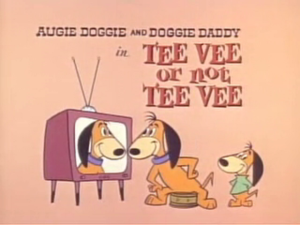 Tee Vee Or Not Tee Vee (Augie Doggie and Doggie Daddy, 11/7/59) – Doggie Daddy finds himself in the middle of an argument he is not even a party to. A new neighbor and son have just moved in, and the new pup on the block is making claims that his dad is better than Augie’s. The newcomer’s father is Rattle Tin Can, the great TV star. (A neat promotional in-joke to tie-in a current popular franchise also handled by Screen Gems distribution – the television revival of Rin Tin Tin.) The newcomer is sure that Augie’s dad isn’t even on TV, and Augie is temporarily caught tongue-tied, but musters up the courage to deny this as a falsehood, boasting that his own Daddy will be on TV tonight at 7:00. The new pup says he’ll be there to see, and Augie retorts as the pup leaves, “Bring your own popcorn”. Daddy has overheard the whole thing from a window, and is shocked that Augie would tell such a fib. He orders Augie to wash out his mouth with soap. But Augie insists it is no fib, and tells Daddy that all he needs to do is let Augie film him with a home movie camera, and take the film to the TV studio. “And that’s how easy it is?” inquires doubting Dad. “You could be the idol of millions”, responds Augie. Dad’s ego is aroused, and he remarks that maybe Augie’s got something there.
Acting as director (complete with beret), Augie runs Dad through various plot scenarios of a variety of popular TV genres. First, a Western. With a rented Shetland pony, Daddy charges a standing dummy, dressed as a bad guy, to jump him. While Augie’s budget includes the horse, a Stetson for Dad, and a prop revolver, he is for some reason short on funds for a soft dummy, and Daddy clangs headfirst into the base of his fictitious opponent – consisting of a covered fire hydrant. Next, a jungle epic a la Tarzan. All Daddy has to do is swing on a vine into an open zoo cage – with a lion in it. However, the lion’s jaws hold no teeth, building Daddy’s confidence. Daddy swings – unknowing that the lion is busy inserting a full set of jagged dentures. Daddy barely escapes unscathed, remaking “It’s amazing what they’re doing with dentistry these days.”
 Next, a private eye show. Trench-coated Daddy is to break down a door to gain entry. To ensure there is no problem for his not-so-strong Pop, Augie has secretly removed the door’s hinges. Daddy charges, but can’t even feel that he has already broken through with the door not fastened in, so keeps right on running – through the front door of their house, and out the back door, picking up every door in-between for a pile-up in the back yard. Finally, Daddy plays a military war hero, assigned to wipe out the enemy by throwing a hand grenade from a foxhole. Memorizing his instructions in reverse, Daddy clutches the grenade between his teeth, pulls out the pin, and throws the pin away. BOOM!
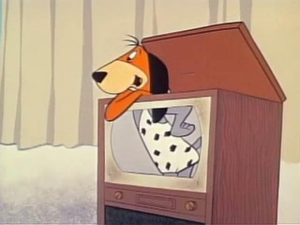
Augie finally concedes that some kids have TV stars for fathers, and others “ain’t”, counting himself as one of the “ain’t” kids. But Daddy promises that Augie will not lose face, and that he will indeed appear for Augie’s friend on TV tonight at 7:00. That night, the neighbor kid watches Daddy repeat several of his roles on the screen of the family TV set. Daddy is not just on TV, but in TV, as he has been presenting his performance live from inside the hollowed-out TV set – so he is even able to rise out of the set to provide the neighbor kid with a personal autograph.
• “Tee Vee or Not Tee Vee” is on ok.ru
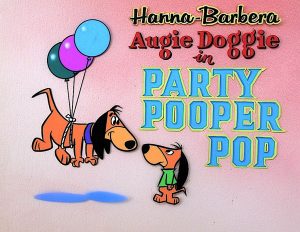 Party Pooper Pop (Augie Doggie and Doggie Daddy, 10/6/61) presents a classic case of Augie not fitting in, and Daddy not being much help in the matter. Yet, their situations are somewhat reversed from one another, as Daddy is woefully behind the times, yet Augie’s problem roots from being too ahead of his times. Augie is by nature just not the partying type. He’s thinks kids’ parties are – well – for kids, and too juvenile an activity for someone of his own high I.Q. Doggie Daddy, on the other hand, sees this development as the budding of a social wallflower, and won’t harbor the thought of Augie turning down a party invitation in favor of engaging in his own science project (rechecking Einstein’s theory, and believing he’s caught “old Albert” in a slight error). Daddy tries to pass on to Augie what he believes to be his legacy, of how to win friends and influence people in a party setting. However, it becomes painfully apparent that Daddy’s methods are drastically out-of-date. He instructs Augie to repeat one of his funniest jokes – “What has four eyes but cannot see? Mississippi!” Augie doesn’t react a jot to the “humor”, referring to it as based upon a play on words, making it a childish pun. Nevertheless, Augie is given his marching orders to repeat the joke for the crowd. A few moments later, he returns, tail drooping, informing his “dad of vaudeville days” that his rib-tickler laid a great big egg. “Maybe it was over their pointy little heads”, ponders Daddy. Augie tells him that wasn’t the problem. “The new generation of pointy little heads also have very sharp brains.”
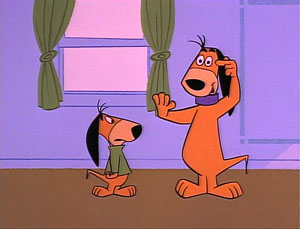 Daddy decides to pull out the stops, instructing Augie in his “old routine”. With straw hat and a cane, Daddy tells an ancient joke about a man who hadn’t had a bite in three days – “So, I bit him”, and breaks into a soft-shoe dance, complete with “rickety-tiks” to give the act class. Placing the hat and cane on Augie, he orders his son to perform it just the way he showed him at the party. “Why fight it”, moans the hopeless pup. As expected, Augie again returns, the straw hat now smashed over his brow, and announces that the routine “laid an egg again – rickety tiks and all”. Finally realizing that audiences have grown tougher these days, Daddy is at a loss what to suggest. Augie is thankful the subject is closed, and he can resume his studies of time and space. “If I let him quit now, he’ll grow up to be a hermit”, says Daddy to the audience. He begs Augie to give it one more try, finally arriving at the realization that perhaps the best advice he can give is for Augie to always be himself. Augie brightens slightly, and heads out for one more gallant try. After an extended time without Augie’s return, Daddy becomes curious at what can possibly have happened. He crosses to the house where the party is taking place, noting things seem unusually quiet for a party atmosphere. To his surprise, he finds Augie being “himself”, and the party guests engrossed by his efforts, as Augie presents to them a scientific lecture upon the mechanics of thrust in a rocket engine. “That’s my boy of tomorrow, who said that today”, beams a proud Daddy to the audience for the fade out.
• “Party Pooper Pop” is on ok.ru
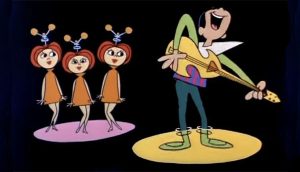 A Date With Jet Screamer (The Jetsons, 9/30/62) – This memorable episode, the second in the series, combines the new phenomena of the rock and roll star with a classic tale of the generation gap, and George’s need to adapt his viewpoint of the new sound to understand the motivations and impulses of his daughter. After a brutal day in space traffic, George returns home, to a mood-improving machine that settles him back in a relaxing chair with a smoke and a dry martini. However, his brief moment of peace and quiet doesn’t last, as a trumpet blare from the next room sends him leaping out of his seat and into Jane’s arms. “What is it? Chinese New Year?” No, a meeting of the Jet Screamer fan club, with Judy presiding over same in their theater-sized TV room. Screamer, Judy’s latest heart-throb and the current rage of the teen set, appears in life-sized form on the screen to beat out “The Solar Swivel”, a new dance that requires an anti-gravity floor to allow the dancers to float and even dance upside down. George calls their gyrations “wearing their clothes out from the inside”. But Jane notes that when George plays his drum set in another room of the apartment, Judy doesn’t call that music – “so you’re even”. George still makes an exit for the duration of the broadcast, to the corner store to get some bananas – not to eat them, but to stuff them in his ears.
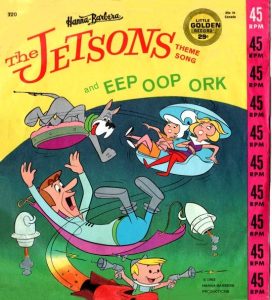 When George returns home, he thinks Judy is busy doing her homework. Instead, she is writing a lyric for a songwriting contest sponsored by the Jet Screamer Show. The winner gets to go out with Jet on a real date. George declares that until Judy gets back to doing homework, no more Jet Screamer anything – and attempts to confiscate several autographed pictures of the rocker. As the door closes behind him, Judy reveals to the camera that she has secret stashes of more pictures hidden in the panels of the walls. George turns his attentions to his other offspring Elroy, summoning him by remote TV hookup from a local playground. As Elroy pops up in the apartment from a vacuum tube, he describes a game he was playing with a friend of writing messages in secret code. George looks over the code Elroy carries, and reads entries like “‘Eep opp ork’ means ‘Meet me tonight’”. After dinner, George is surprised to learn that Judy finished her song entry anyway, and has asked Jane to mail it for her in the morning. George takes the envelope (no, the H-B boys hadn’t yet predicted e-mail or the fax machine), and sabotages Judy’s chances of winning, by replacing her lyric with Elroy’s secret code. But the tables become turned on George, when the night of announcing the contest winner arrives. The judges and Jet actually liked the code as a far-out lyric! Judy is ecstatic at the thought of her upcoming date with Jet, and declares, “I think I’m gonna faint.” “Move over. Make room for me”, moans a collapsing George, fainting for his own personal reasons.
The big night arrives, as does Jet, complete with TV camera crew and a mob of press reporters wanting pictures of everyone. George gets camera fright, and freezes up in his speech so badly, he can’t even voice a protest. Jet and Judy enter his personal space car, and the camera crew and reporters finally let them fly off alone for a pleasant date. But they won’t be alone for long – George insisting that Judy will have a chaperone whether she likes it or not. A pursuit ensues, with George eavesdropping and peeping in on the two daters at every opportunity, including at the Spaceburger car hop and the Fun Pad amusement park. Finally, the daters arrive at the night club where Jet does his swivel show. The club has a policy of “teenagers only”, denying George entrance at the front door. But they’re not as particular at the Band Entrance in the rear, and George slips in with the performers by merely getting in line and snapping his fingers in time to their beat. The drummer is just setting up, and George slips him a $10-spot to “take the night off”. “Hey, for ten bucks, I’ll take the week off, man!”, declares the happy drummer, exiting right on cue.
Jet introduces Judy to his back-up group, but is as surprised as Judy to find George sitting in for Boom Boom Basil. The explanation, to Jet’s mind, is obvious – “He’s a fan.” Receiving a begrudging admission from Judy that George can play the drums – a little – Jet lets George stay, to “keep it in the family”, and when the curtains rise, announces the performance will kick off with a drum solo. George appears nervous, but Jet, calling him “Space-Dust Daddy”, encourages him to “zoom”. George launches into a solo on a 360-degree circular drum set, and finds himself getting into the groove. The solo leads into the winning song “Eep Opp Ork” (which, without explanation, has changed meaning from the code message of “Meet me tonight” to “I love you.”) The number is the highlight of the program, and certainly composer Hoyt Curtin’s best effort to replicate a rock beat with a memorable melody, topping any other rock-themed number to appear in H-B cartoons (with the possible runner up of “The Twitch” discussed below). The evening’s performance sends the audience into “orbit”, and everything is fine by the time Judy gets home to Mom. She’s had a great evening – “but not as good as Dad.” George appears at the door, spiraling in in a flamboyant replication of Jet Screamer’s fancy stage entrance, and wearing a badge of honor on his chest – he has been promoted to the post of new President of the Jet Screamer Fan Club! He and Judy close the show with a reprise chorus of “Eep Opp Ork” in duet.
(James Parten, author of the Needle Drop Notes columns on this website, has often wondered why this series never included another rocker by the name of Roy Orbitson.)
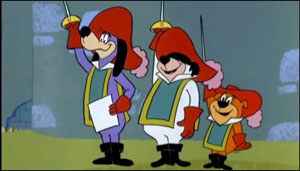 A brief mention should be made of a couple of H-B episodes in which the most unlikely of characters awkwardly attempt to jump into the role of superheroes, capitalizing on the then-current superhero fads of the 1960’s. Hero Sandwiched (Yippee, Yappee, and Yahooey, 10/23/65) finds the King attempting by means of wizard Merlin’s magic to transform into “Super Sovereign”, to eliminate his need for reliance upon the services of the Goofy Guards. Forgetting the unpronounceable magic words that provide his super strength doesn’t help things any. “Super Blooper Heroes” (Magilla Gorilla, 12/25/65) exposes the secret night activities of Magilla and Peebles, donning super suits to masquerade as Super Simian and Super Shrimp to fight crime, but finding no crime to fight. Both episodes have previously appeared in the past Animation Trail, “Reign of the Supertoons (Part 4)”, which can be found on this website.
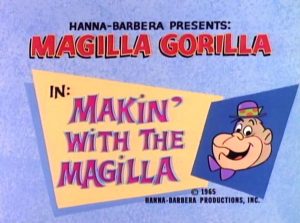 Also from Magilla comes Makin’ With the Magilla (10/23/65), an attempt to capitalize on the trending popularity of surfing as a sport, and upon the pop craze of surfer tunes in the music industry. This cartoon starts out well enough, but disintegrates in the last one-third when the title song is reached. Magilla watches one of his favorite TV shows in the pet shop window – “Surfer Safari” – and tries to imitate the moves by balancing on his toes atop his rocking chair. He topples onto Mr. Peebles, spilling his owners’ supply of pet food. Peebles ties Magilla into his chair, telling him that the only “shooting the tube” he wants around here is for Magilla to stay glued to watching the TV tube. But outside, a hot rod and a classic “Woody” station wagon pass, loaded with teenagers and surfboards. Merely expanding his chest to free himself of the ropes, Magilla runs outside for a better look. As the vehicles pass, a surfboard drops out of the station wagon, and bounces into Magilla’s hands. “Hey, you dropped your board”, shouts Magilla, and takes off in pursuit of the teenagers. In the process, he trods over the top of a man in a convertible driving the other way, who comments, “When the surf’s up, these guys really go ape.”
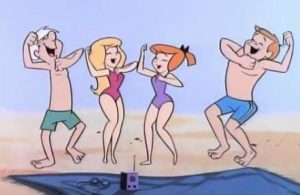 At “Gremmie Gulch” (“Gremmie” being surfer slang for a young and inexperienced surfer), Magilla catches up to the surfers, but slides right by them down a slope, and into the water. Struck in the face by a first wave, Magilla comments, “Someone left the water running.” As teens on the shore look on, a second wave approaches. “The dam musta broke”, Magilla shouts. Finding himself riding atop the wave’s crest, Magilla hopes it’s only soft water. The wave is so tall, it launches Magilla toward the pier at a height above its floorboards, where Magilla sends a trio of fishermen diving into the bay, then makes a u-turn by hooking onto a post to head back in the opposite direction. The teens remark it’s the first time they ever saw anyone shoot the top of the pier. Magilla continues to fly through the air at high altitude, puncturing the sail of a passing sailboat. “I’m getting bored with this board”, thinks Magilla. Ahead looms another tall wave, which flips Magilla for another u-turn in its curl, leaving him surfing upside down. “Gorilla overboard – I mean, Gorilla under-board!”, Magilla wails. He climbs back atop his board (a continuity error shows the keel panel still on top in one shot, then gone in the next scene as if the board turned over under its own power). “Wouldn’t take much of this to make a land-lubber out of a guy”, Magilla again observes. Hitting the water, he leaps over the hull of a rowboat directly in his path, while the board goes right through it, torpedoing the small craft to sink into the deep. Magilla next faces the pier pilings. “Yeoww! An obstacle course!” Magilla shoots the pier in what has to be a current for the record books – backwards and forwards between lines of pilings in reversing directions. Next, he comes up on top of a whale, who propels him into the air with a spout from its blowhole.
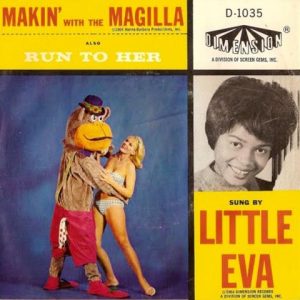 Magilla lands atop the crest of another incoming wave, and is abruptly left aground atop the pinnacle of a high reef. “Looks like low tide”, comments the ape, who wonders why a wave is never around when you need one. In answer, an even taller wave approaches. But instead of floating Magilla off the reef, the force of the blow pulls the entire reef right out from under Magilla. The board falls first, then Magilla, right through it. “Trouble with this board is it’s too tight around the waist”, Magilla says from within the hole, his lower half submerged in water. As one last wave approaches, Magilla decides to head where “the terra is more firma”, and outraces the wave in paddling to shore. “Hail the new king”, shouts one of the teenagers, and they take up Magilla’s board upon their shoulders, with Magilla still waist-deep in it, then release him to sit upon a throne constructed of three crossed surfboards, while the teens dance in his honor. A good cartoon while it lasted, which should have ended there, but now comes the sales pitch, as the last two and one-half minutes of the film present Dimension records’ (a division of Columbia) Little Eva performing the entirely unmemorable number “Makin’ With the Magilla”, concurrently released on a picture-sleeve 45. The singer is not caricatured in the film to raise the performance to a cameo, and Magilla only performs a scant few moves of his own, in no manner resembling the illustrations or instructions on the record’s picture sleeve. It appears unlikely the artists were even provided with the Fred Astaire Dance Studio instructions appearing on the record jacket as to how to dance the step, as the animated movements are just simple and tedious repeating cycles. The number plays like a mere filler of allotted time, with no ending-gag payoff, Magilla merely observing “That’s me” for the fade out. What a letdown.
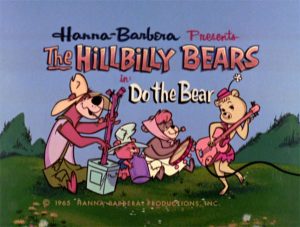 Do the Bear (Hillbilly Bears (From “The Atom Ant-Secret Squirrel Show”) – 10/15/66). The final episode in the series begins with a typical day for the Rugg family. Nothing will wake Paw out of his hammock snooze, except a fake early call by Maw to come to dinner. Paw receives the sad news at the table that there will be no dinner until he goes to the general store for supplies. Grumbling in his usual mumbles about the “sneaky woman tricks”, Paw trudges off to the store. Also arriving in town are two talent scouts, looking throughout the hills for a “new sound” to take back to the city for a recording contract and fame and fortune. They decide to wait at the general store and keep their ears open, until the sound comes to them. Paw enters, and his unintelligible mumbles get the two scouts curious. Paw eyes a guitar on a wall display, and pulls it down to twang out a few notes while he continues mumbling. That’s all the scouts need to hear. They run to Paw with an iron-clad contract, ready to pay him up to five dollars if necessary.
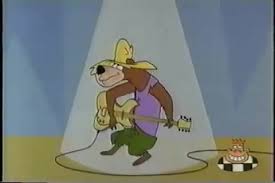 Before he knows it, Paw is whisked away to the city, equipped by the scouts with an electric guitar and a trio of shapely female back-up singers, and booked into the “Big Rockin’ Show” as “The New Sound”. (Watch for a shield logo above the theater stage reading “HBR” – a shameless plug for newly-formed Hanna-Barbera Records, on which an expanded version of the plot and the title song would ultimately appear on the album, “Hillbilly Shindig”.) A performance of the new number “Do the Bear” is presented on stage, with the vocal trio providing most of the lyric, but punctuated every few lines by Paw letting out with a loud guitar twang, and mumbling “Do the Bear”.) He wows the all-female packed house of rabid fans, and at the conclusion of the number, Paw reacts in shock at a stampede of the weaker sex, approximating those we saw each week in “The Beatles” – only these girls want Paw’s autograph instead of hugs and kisses. Paw leads the girls on a merry chase, though Paw is not at all merry about it himself, and just wants to sneak out. The girls are behind every door and around every corner, and Paw tries to thin out the tide behind him, reaching out with a pen to write “X”s in the autograph books of those within reach while still running. Cornered by a mob of the girls outside the theater, Paw fights back in the only way he knows how. Darting back inside, he returns on the street with his electric guitar, and repeats another guitar twang and the mumble “Do the Bear”. The girls all collapse backward in a straight-line column resembling the Rockettes famous mass-collapse of the toy soldiers in their annual Christmas pageant, fainting dead away. Paw sees his chance, and uses the opportunity to drop his guitar and race home.
Paw having been absent a week, Maw wants an explanation when Paw returns. Paw can only utter between mumbles, “You’d never believe it.” A knock at the door brings a visit from Floral’s boyfriend, Claude Hopper, who appears on the porch carrying a guitar, and announcing his intention to serenade Floral. He claims to have learned a new song on the radio, and lets out with one loud twang, and an exact vocal duplication of Paw’s mumble “Do the Bear”. “Don’t like that song”, growls Paw, grabbing the guitar, and doing his own impression of Quick Draw McGraw as El Kabong by smacking Claude over the head with his own instrument. Claude retreats over the hills, pursued by Paw and the guitar, as Floral asks what Paw is doing to her boyfriend. “I’m doin’ Clobber the Bear”, says Paw, as the guitar twangs upon Claude’s head again and again, through the fade out.
• “Do the Bear” is angled on Dailymotion
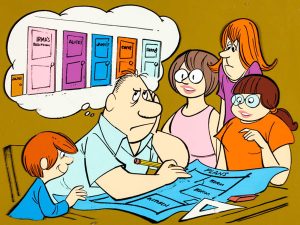 A few words should be said about the prime-time series, Wait Till Your Father Gets Home (1972-74). Maybe the fewer, the better. Here was a series definitely designed to be controversial and to push the envelope in terms of culture shock of a supposed average father (Tom Bosley) attempting to adjust to changes in modern times, modern morals, and troublesome topics. It was allegedly inspired by Normal Lear’s “All In the Family”, and aimed its material at an adult audience – but did so in a way that did not match the spirit or humor levels of Fox’s later “Animation Domination” block by a longshot, and seemed to present characters who existed only to be irritating, lines that would never have generated laughs were it not for the built-in laugh track, and a sense of isolation as Bosley is portrayed as essentially the only “normal” everyman, in a family and societal world gone bonkers. Perhaps its creators felt that everyone would automatically empathize with Bosley this way, never expecting that anyone might exhibit sympathy for the positions of the more radical or wacko characters around him (though I’m sure each such character would represent an entire camp of potential viewers within the real world). But you would think that at least they would offer him the occasional safe-haven of some level of intermittent agreement with his thoughts from his wife and kids (much like Edith Bunker would try to ineffectively console Archie). No way. 99 times out of a hundred, his wife and kids are on the opposing side too – often at the spearhead of it. So the show’s general mood is a total downer, stirring up trouble just for the sake of it, and never leaving one with a sense of final satisfaction or that right has truly triumphed over wrong. The writers may have felt this was the nature of satire, and preferred to leave you to think instead of providing story closure. But such a game just wasn’t the thing then, and probably still is not now, to get viewers to return for viewing week after week.
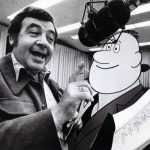
Tom Bosley recording his lines for “Harry”.
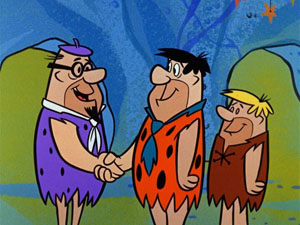 And now, a turn back to the Modern Stone Age, where even thousands of years ago, fads not dissimilar to our own could stir up trouble. Hot Lips Hannigan (The Flintstones, 10/7/60), the second episode aired in the series, opens at a meeting of a fraternal lodge which becomes the predecessor of the better-known Water Buffalo Lodge, run by the Loyal Order of Dinosaurs. (No fuzzy hats – the lodge uniforms look more like Napoleon hats.) An annual benefit show is upcoming, and each member is supposed to do a solo act. Fred traditionally sings, having performed in his youth as a singer with his high school band. Wilma made him quit so he wouldn’t be spending nights out. Plus, his high notes have a tendency to fracture every glass in the house. This, year, Fred wants to do something different. He toys with an idea of Barney’s for a trampoline act, but only succeeds in embarrassing himself by becoming an inadvertent peeping Tom into a dressmaker’s second-story window. So he tries his hand at a magic act. Wilma and Betty go along with the gag of entering Fred’s magical disappearing cabinet, and quickly figure out there is a second door in the cabinet’s rear to make an exit. They hide in the bedroom, fooling Fred into thinking he has really made them disappear when he opens the cabinet’s front door. Now for Fred to bring them back with some magic words, thinks Barney. But Fred sees other possibilities. If the girls can’t come back until he utters the incantation, why rush things? This could mean a free Boys’ Night Out, with the girls none the wiser. And Fred has a destination in mind. The Rockland Dance Hall, where his old high school bandleader, Hot Lips Hannigan, is playing.
Barney tags along to the dance hall with Fred. The girls could have popped out of hiding to stop them, but Betty has a better idea. Dress up in last-year’s masquerade costumes as hip young women, follow the boys, and catch them in the act. At the club, the boys meet Hot Lips. He is dressed up looking for all the world like a beatnik, with glasses, goatee and beret, and utters meaningless growling phrases like “Scootle-de-wow-wow”. His specialty is primordial bebop on a primitive brass instrument, and his orchestra plays in all the discordant chords then associated with the music. But when Hot Lips gets a moment alone with Fred and Barney outside the view of his fans, he speaks in a voice close in style to Ed Wynn, and is strictly a square from wayback, bemoaning the lengths that the music industry will put a musician through just to stay in the business. It is clear that the beatnik guise is just a put-on, and Hot Lips longs for the days when songs had heart, instead of the music of today that doesn’t make sense. An entirely out-of-time-period reference is made by Fred to the 1930’s song, “Annie Doesn’t Live Here Anymore” as an example, almost bringing a reminiscent tear to Hot Lips’ eye. Hot Lips asks Fred to sing a number with the band for old times’ sake. Fred doesn’t think the current kids will get it, but Hot Lips still requests it again – for him. Fred is thus introduced as “The Golden Smog” (a play on popular singer Mel Torme’s nickname, “The Velvet Fog”), and begins to belt out a rocking version of “When the Saints Go Marching In”, while Barney sits in on a drum set, including a turtle shell cymbal with the turtle still inside. Fred’s singing vocal is nowhere close to the tones of Alan Reed, provided by a current night club singer named Duke Mitchell. The girls arrive in costume just as the number begins, and they are shocked to discover that the teenage fans actually dig Fred and Barney’s performance, some of the girls even swooning.
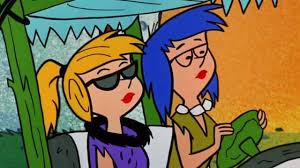
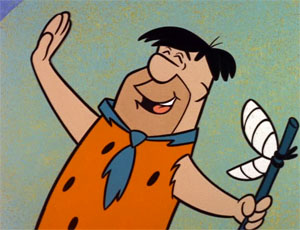 At the conclusion of the piece, Fred and Barney not only receive tumultuous cheers, but the same kind of reception given to Paw Rugg above – a stampede of women in pursuit. These women, however, have romance on their mind rather than mere autographs. Fred and Barney seek any refuge in the backstage wings, and are ushered to a safe dressing room by two young ladies. These ladies, however, are Wilma and Betty, who, without revealing their identities, make their intentions known to have Fred and Barney all to themselves. They even copy the teen beat talk, as Barney protests that he’ll have to talk it over with Betty. “Betty, Betty, she’s out of the scene. She don’t make it”, responds Betty herself. The boys are again forced to beat a hasty retreat, while Hot Lips tries to run interference, holding out his hand in a “give me some skin” manner, and calling for “contact”. He gets it, as Wilma whacks him over the head with her purse, and calls him an old goat.
Fred and Barney escape to the car. Wilma and Betty hurry to their own, and beat the boys back home, in time for the reopening of the disappearing cabinet. But when Fred opens the cabinet door, the girls are still in their teen disguises, and still claim to want to make beautiful music together with the boys. Fred and Barney scream, run, and hide in the closet. They wait until all is quiet in the living room, then slip out of the closet door, Fred blurting out a remark about if the wives had seen them with those… “Ix-nay”, signals Barney, as Wilma and Betty, dressed in their normal attire, are now standing right behind Fred. “Seen you with who?”, Wilma playfully asks. Fred faints dead away. Even hours later, Wilma is still toying with Fred’s mind, breaking into beat talk unexpectedly, leaving Fred not feeling well at all.
 Duke Mitchell would return again for another singing performance of Fred in The Girls’ Night Out (1/6/61), a story line somewhat similar to “Hot Lips Hannigan”, already recycling ideas within the show’s first season. The girls complain that Fred and Barney never take them out – and Fred can’t name in return anyplace he’s taken Wilma since their honeymoon. Seeking anyplace to take them that’s fun, Fred thinks of the Fun House at Joyland Amusement Park. Wilma thinks he’s crazy, but Betty will settle for the amusement park – maybe there are actually people to meet there. The girls live to regret their compromise, bring worn to a frazzle on the parachute ride and roller coaster, and passing on the rocket ride to take five on a bench. Instead of the rocket, Fred and Barney happen upon a coin-operated booth to record a record of your voice, and decide to make a souvenir record so they can always remind the girls that they took them somewhere. Neither knows what to say on the recording, so Fred decides to sing. (A major story continuity error occurs, as Fred’s Bobby Darin-styled vocal of “Listen To the Rockin’ Bird” is mysteriously backed by an unseen band – yet at a later stage of the script, a recording engineer claims to have just dubbed the music behind the vocal. Obviously, they only had one combined vocal and music mix recorded for the session, and didn’t bother to have the singer record the voice track alone all over again.) The girls discover the boys hours later, still playing back the recording, and drag them home, with Fred leaving the record behind on the recording turntable.
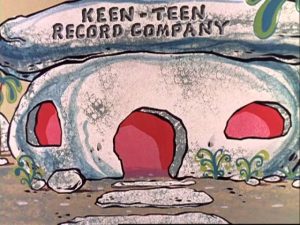 A teenager finds the abandoned record, and for a laugh brings it home to play for his friends. The teens are again sent by Fred’s music, and swear allegiance to the mystery singer as their new pop idol. In a cross-reference to series episode 2 above, one of the teens recalls that they previously swore allegiance to Hot Lips Hannigan, but another of them says that was last week, and Hot Lips is out. The Keen-Teen Record Company allegedly dubs the music behind the record, and plays the piece on the radio, asking anyone to identify the mystery singer. Wilma makes a phone call, but before she can barely speak, her call is traced, and the Colonel behind the record label (a satire on the promoter of Elvis Presley for Sun Records) instantly shows up at the Flintstone doorstep. Fred is decked out with round glasses, hair parted in the middle, and cutaway leotard, plus a guitar, and renamed Hi Fye. A whirlwind cross-country-tour is booked, with transportation in a bumpy old private bus to make all the one-night stands. After four weeks of touring, with no end to Hi Fye’s fame in sight, Wilma and Betty have had it. Their only way out of the endless nightmare is to spread an ugly rumor about Hi Fye to the teens – word from a good source that Hi Fye is really a square. “You mean, four corners?”, says Betty, drawing the geometric shape with her fingers in the air. The word spreads through the crowd like wildfire, and before Fred can finish his song, the performance hall is deserted. Hi Fye is through. Fred and the families return home – but the first night back, it’s the same old thing. Both girls continue to complain that the boys never take them out, and Fred and Barney take their dinners on Fred’s porch stoop. But Barney observes that even the girls’ worst is really not so bad, and Fred agrees, commenting “Bless their little never-take-me-anywhere hearts.”
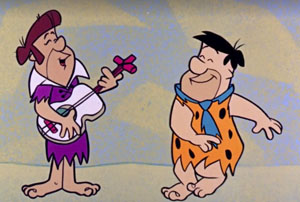 The Twitch (10/12/62) again finds Fred on stage as a rocker – but this time, not by choice. He’s promised Wilma to get a star performer for a benefit of the Lady’s Auxiliary for the paltry sum of $35. He hopes to call in a favor from an old friend who’s become a talent agent, but all he is offered are monkey acts, an acrobatic tumbler (who tosses Fred for a loop), and a young boy who plays a violin while rotating a hula hoop around his waist. Fred is hit with an anticipatory “I told you so” by Wilma when he gets home, and reacts defensively, claiming he got Wilma a big star for nothing. Stalling for time, Fred sits down at the TV without naming the star, and sees a broadcast of rock and roll’s newest sensation, Rock Roll, performing “The Twitch” (a dance named and designed to resemble Chubby Checker’s “The Twist”. Pressed to reveal his star, Fred declares that he got Wilma Rock Roll – then wonders if he should leave town to avoid the repercussions of his lie.
How to get Rock Roll? Kidnap him, thinks Barney. The boys put their heads together, and settle for groveling on their knees and weeping. Rock (who in many ways appears to be a dead ringer for George Jetson) turns out to be a personable country boy, and consents, noting that he understands, having a woman at home who jaws at him all day too. Rock treats the boys to lunch, and recounts the story of his success, when the mistaken delivery to his room of a plate of pickled dodo eggs gets him in a fit of sneezing and scratching. Seems that Rock is highly allergic to the eggs, and was once mistakenly fed one during an early performance. He went into fits of itching and twitching, and it was mistaken as part of his act, resulting in his two million dollar career. But there is an additional side-effect to ingestion of the eggs. Rock will lose his voice completely for days.
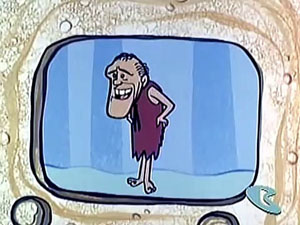 The night of the benefit show, a packed house waits, but Rock is late. Finally, Rock’s limousine pulls up outside. But Rock does not step out of the car. Instead, he acts in pantomime, flapping his arms like wings, and mouthing over and over the syllable “do”. Barney pieces the charade together. An accidental ingestion of another pickled dodo egg sandwich. Rock can’t sing a note. Fred moans in despair, but Rock slaps into his arms a duplicate of his outfit, a guitar, and a copy of his record of “The Twitch”, then places his cocoanut-cut toupee on Fred’s head. Barney again acts as interpreter – Fred must impersonate Rock, and lip-sync to Rock’s record. Fred immediately gets stage fright, but Rock’s limousine drives away, leaving Fred no choice. Barney finally gets him out on stage, by sticking Fred in the rear with a pin. Fred actually does a pretty fair job of imitating Rock’s moves, and fools the audience (despite almost having his cover blown when the record sticks on one line, due to the bird acting as phonograph needle dozing off). Fred overdoes his final spiral spin, and lands on his back with the guitar landing across his face. But the crowd loves it, and no one but Barney and the wives are the wiser. Fred won’t let Wilma leak out how he saved the show the next day, but is found at home unexpectedly, having quit his job for pursuit of a new musical career. In Rock’s toupee, Fred rehearses his own off-key version of The Twitch before a mirror, and Dino tries to avoid the awful wails by putting on a pair of earmuffs. The wives decide to join Dino, extending the reach of the earmuffs so that their own heads are within them, ear-to-ear with Dino’s, as Fred continues to wail away.
NEXT: More Flintstone foibles..