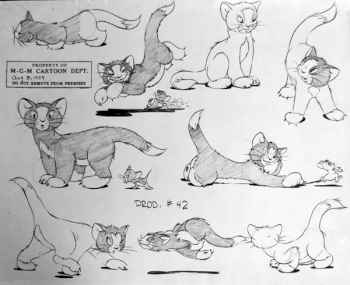

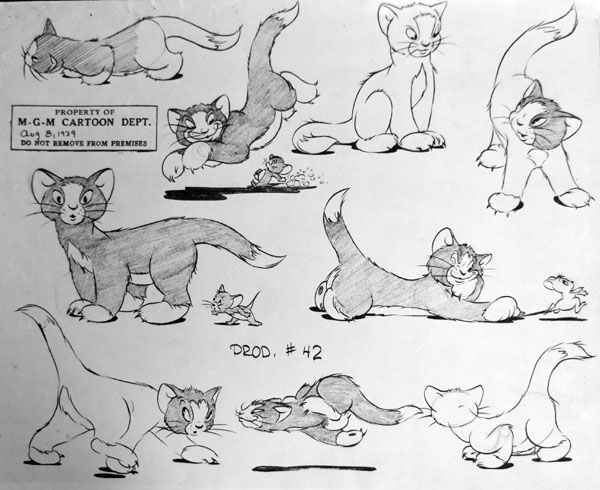
The greatest game of cat and mouse began eighty-six years ago. On February 10th, 1940, MGM debuted the animated short Puss Gets the Boot and, with it, introduced an early, prototypical version of Tom and Jerry.
The short was created and directed by William Hanna and Joseph Barbera, who would go on to helm over 100 shorts featuring Tom and Jerry, during the Studio’s Golden Age of animated cartoons.
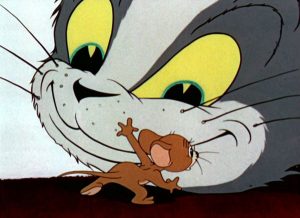 “Bill and Joe were often underestimated,” says Greg Ehrbar, author of Hanna-Barbera: The Recorded History and host of The Funtastic World of Hanna and Barbera Podcast. “When they suggested a cat and mouse series to their colleagues at MGM Animation, they were told it was already overdone. The studio desperately needed a cartoon series with popular lead characters, so Bill and Joe were allowed to pitch their take on the idea.
“They created what is now called an ‘animatic,’ widely used in film and advertising today, basically a filmed storyboard with a few embellishments. This was the perfect way to showcase Barbera’s gags and poses and Hanna’s precise comedy timing. It was something like the ‘Baby Weems’ sequence Walt Disney did a few months later in The Reluctant Dragon. It got Bill and Joe the green light from MGM to make the film.”
Puss Gets the Boot opens with a mouse running in place, trying to get away, while a cat holds the mouse’s tail down. The cat then playfully tortures the poor mouse, threatening to put him in its mouth and preventing the mouse from returning to his hole. The cat even paints a fake mousehole on the wall, causing the little mouse to run into the wall over and over.
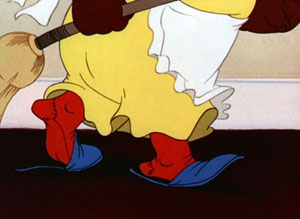 The cat then chases the mouse and knocks over a vase. The Lady of the House (voiced by actress Lillian Randolph) then comes in, yelling at the cat (we learn his name in this short is Jasper, which eventually, of course, will become Tom). She threatens Jasper, informing him that if he breaks one more thing, he will be thrown out of the house.
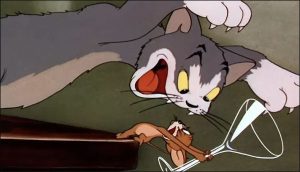
The mouse sees his opportunity and then threatens to break a martini glass to get the cat in trouble, as humble Jasper slinks away. But when the mouse puts the glass down, Jasper tries to attack again, as the mouse picks the glass up, threatening to drop it again.
The mouse then begins dropping all the martini glasses off the table, and Jasper scrambles to catch them all.
Frustrated Jasper then lines the floor with throw pillows, which allows the cat to go back to his old ways, until the mouse begins throwing dishes and Jasper must scramble again to grab them all.
 The exhausted Jasper tries to hold the enormous stack upright, but the mouse throws a plate, causing them to crash to the floor. And, as promised, Jasper is tossed out of the house.
As the short concludes, the mouse walks triumphantly back into his mousehole, placing a “Home Sweet Home Sign” above it.
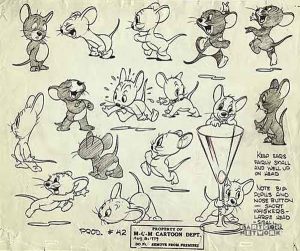
Although an early version of both characters’ designs, the paradigm of their future shorts was squarely in place here, with Jasper/Tom going to desperate lengths to keep himself out of some trouble, while attempting to capture the unnamed mouse/Jerry.
The animation in Puss Gets the Boot is filled with kinetic movements and creative sight gags that became hallmarks of the Tom and Jerry shorts. With masters such as Michael Lah and Pete Burness working on the short, sequences, such as the one where Jasper attempts to balance an ever-teetering stack of dishes, bowls, and cups, are made even funnier thanks to the staggering amount of movement and action.
 The cartoon was part of the eagerly awaited Tom and Jerry: The Golden Era Anthology, 1940-1958 Blu-Ray and DVD (reviewed here on Cartoon Research by Thad Komorowski), which was released in December, and included the duo’s theatrical shorts from this time period, as well as commentaries and documentaries (featuring our own Jerry Beck).
Puss Gets the Boot would go on to garner an Academy Award Nomination. The characters would receive their official names, Tom and Jerry (which came from a studio contest to name them, won by animator John Carr), in their next short, The Midnight Snack (1941).
“Tom and Jerry became the most honored continuous characters in theatrical animation,” Greg adds. “They won seven Oscars, more than any other theatrical short cartoon characters. Because there is little or no dialogue, and their ‘frenemies’ relationship is so relatable, Tom and Jerry cartoons are among the most popular worldwide.”
After their theatrical shorts at MGM, Tom and Jerry would later find fame on TV when their classic cartoons were re-packaged as a series. There were also new animated versions on television in the 1970s (produced, again, by Hanna and Barbera), as well as the 80s and 90s. The pair have appeared in their own full-length feature in 1993, a slew of direct-to-video movies, and a big-budget live-action/animated film in 2021.
But this long-standing game of cat and mouse all started 86 years ago with Puss Gets the Boot.