
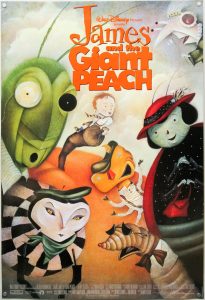
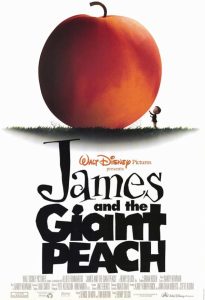
One sheet poster designed by Lane Smith
Selick’s dedication to stop-motion extended well beyond James and the Giant Peach. After the film, he went on to direct the live-action/animated Monkeybone in 2001, the Oscar-nominated Coraline in 2006, and 2022’s Wendell and Wild, continuing his journey in this unique animation style.
“It’s something I grew into. I always enjoyed the stop motion [Ray] Harryhausen films,” said Selick in a 1996 interview, reflecting on his career. “When I was a kid, I saw a lot of European puppet films, cut-out films. When I got into animation, I was going to art school already. So, I was experimenting with cut-out photos, and I even did these sorts of life-size figures that were hinged before I got into animation. I made new ones, animated them, and had them moving and talking. I went from 2D animation into 3D, and it’s sort of hard to go back.”
This dedication is evident in James and the Giant Peach, a film celebrating its 30th anniversary this spring, where Selick’s passion for the arduous and beautiful art of stop-motion truly shines.
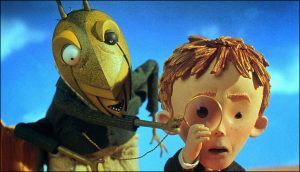 When it was released on April 12, 1996, filmmakers were looking toward the ever-emerging technology of computer-generated imagery—Toy Story had just been released five months earlier. Despite this industry’s focus on computer graphics, Selick remained very comfortable in his stop-motion lane.
“Even in this day of super-impressive computer effects, which are only going to get more impressive over time, stop-motion still has this hold on my imagination,” said Selick in ‘96, adding, “I feel like I’m further and further out on a limb in the land of stop-motion, but the last thing I’m going to do is throw in the towel and try to compete, head-to-head, with everyone else in computers.”
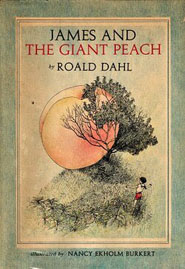 Based on a book by author Roald Dahl, most famous for Charlie and the Chocolate Factory, the tale features the author’s trademark macabre story elements. “I come from this really strong visual background, so I was in love with the visual possibilities,” said Selick in 1996. “I really like the sort of flavor of Roald Dahl‘s books. There’s some pretty twisted, dark things set off against imaginative, heroic children.”
The film James and the Giant Peach opens in live-action, telling the story of young James Henry Trotter (Paul Terry), a lonely orphan living with his wicked aunts, Spiker and Sponge (Joanna Lumley and Miriam Margolyes, respectively).
A mysterious man (Pete Postlethwaite) gives James a bag of glowing green seeds, which he drops near an old peach tree outside his aunts’ house. The next day, a peach appears on the tree and keeps growing. The aunts begin charging the public admission to see it while forbidding James from going near the peach.
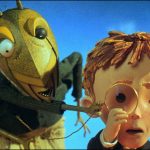
James sneaks away one night and enters a tunnel in the giant peach (the film then transitions to stop-motion animation). Once inside, James meets a group of large insects, who soon set the peach rolling out to sea, and he joins them on a magical journey to New York City, a place he has always dreamed of seeing.
 The insect characters feature an impressive all-star voice cast. Susan Sarandon is Miss Spider, Richard Dreyfuss is the gruff Centipede, Simon Callow (Four Weddings and a Funeral) is Grasshopper, Jane Leeves (Daphne on TV’s Frasier) is Lady Bug, Margolyes as Mrs. Glowworm, and David Thewlis, is the voice of the Earthworm. “He did a remarkable job of this basic coward who’s blind and always imagines things being worse than they really are,” said the director of Thewlis, adding, “He did this amped-up performance, a quivering voice that really fueled the animation.”
There’s another character in James and the Giant Peach that audiences will immediately recognize. In one sequence, James and the insects run across an army of skeletal pirates. Look closely at the pirates, and you’ll notice a cameo that Lane Smith, the film’s character designer, snuck into the movie. “Lane kept putting in this tall, skinny guy against these other shapes,” remembered Selick in ‘96. “I finally said, ‘Well, he keeps looking like Jack Skellington, let’s just put him in the movie.”
Jack Skellington’s tale of The Nightmare Before Christmas is a film that, although not a success during its initial run, has generated a following that few films have. Sadly, this was originally not the case with James and the Giant Peach.
Despite not achieving box-office success initially, the film has since gained a following, helped by home video and its availability on Disney+.
Thirty years later, what audiences appreciate about James and the Giant Peach is reflected in the original review of The New York Times’ film critic Janet Maslin, who wrote: “Together, this prodigiously clever group has come up with expert animated effects and some boldly beautiful sights unlike anything else on screen…”