


Taking care today of some overlooked contributions from the more minor producers of TV fare from the 1960’s to the subject of bullfighting, and from some of the majors who seemed to push limited animation to its limits. Some are respectable, others are shlock. In many instances, it’s easy to see why these titles didn’t instantly come to mind to our readership in the coverage of bullfighter cartoons during the last few weeks on this site. Episodes below are not presented in chronological sequence, but ordered to balance out the good amongst the bad.
 We’ll start off with one of the better entries. The First Bullfight (Jay Ward, Peabody and Sherman (From “Rocky and His Friends”) – air date unknown). Once in a while, Mr. Peabody and Sherman would not meet with a particularly-known figure of history, but be on hand for some history-making event where the precise players seem to be unknown to scholarly research. This is one of those rare instances, with no particular famous names being dropped in the course of the story. Sherman sets the Waybac Machine to 1833 and Cadiz, Spain. He and Peabody arrive in the stands of an arena, as a matador enters the ring. On the opposite side of the arena, a large door opens, with Sherman expecting to see a bull emerge. Instead, what emerges is – a bulldog! The next hour and a half is spent watching the matador throw sticks and the dog retrieving them. At least Sherman is still watching, but Peabody has fallen asleep. So has the rest of the crowd.
Peabody and Sherman confront the arena owner, suggesting that something more ferocious is needed to keep the crowd’s attention – a bull, perhaps? It seems there is only one bull in this neck of the woods, and he won’t come near the arena. Peabody enlists the services of one of the ring’s best matadors to accompany them in quest of the bull. One Porfilio Garbanza is provided, but it is obvious from the start that he is unlikely to be of much help – choosing to equip himself with a butterfly net. He also has a knack of always flashing something red – a handkerchief, socks, and an apple, in his first three efforts – when approaching the bull, so always gets charged upon head-on, with the bull running off into the distance – farther and farther away from Cadiz. Garbanza suggests maybe they should try to catch something easier – like a jackass. “We already have one”, remarks Peabody.
 The bull is again spotted 400 miles away from Cadiz, sitting on a railroad track. Garbanza observes that something better be done, or he’s going to get hit by the Onion Specific locomotive. Peabody sees the train approach, and instructs everyone to jump on board as the train passes. The bull becomes a passenger too, caught on the front of the engine by the train’s cowcatcher. And the train is headed back to Cadiz! All looks fine, until the train is suddenly stopped by a – red – light, and the bull escapes the cowcatcher and charges down a road leading to Seville. Peabody instructs Garbanza and Sherman to get off and wait for him in Seville, while Peabody himself rides the train back to Cadiz. There, he oddly chooses to enter the city’s largest casino. Using calculus, Hector’s arithmetic, and P.S. 39 multiplication, Peabody runs calculations and amasses a fortune at the roulette table, by continuously betting on 21 red. The croupier asks why he doesn’t bet on black. Peabody points out it would just ruin the color scheme of this entire episode. Thus, Peabody not only breaks the bank, but the municipal coffers as well, and becomes the owner of the entire city – exactly what he planned. He offers to give everything back to the city – if they will move the arena to Seville. So instead of the bull coming to the ring, the ring comes to the bull. Sherman and Peabody are on hand for the historic occasion. (Of course, we can only hope they have a larger population of available bulls in Seville than in Cadiz – or else, this sport is going to come to a quick end after the first Moment of Truth.) The bull’s opponent, to Sherman’s surprise, turns out to be a female matador named Barbara, whom Peabody claims was the best of her kind. “I never heard of her”, says Sherman. “You mean to say you never heard of the – Barbara of Seville?” puns Peabody shamelessly, for the curtain line.
 Bully For Bozo (Larry Harmon/Jayark Films, Bozo the Clown, circa 1959) – A fairly early episode in the series, at a point in time when Larry Harmon’s animation unit was still learning its ways and trying to overcome shoestring budgets, resulting in some mammoth animation and continuity errors which plague this production. Bozo and Butch are for reasons unknown found in Mexico (presumably, the circus is on tour?) Butch spots a sleeping vendor taking a siesta against a wall in the plaza, selling small bugles. Butch buys one, then asks Bozo how to play it. “Ya gotta learn to toot your own horn in this world, Butch”, says Bozo, as he plays a few notes proficiently on the instrument. The two are next seen in the stands at the fight arena, waiting to take in a sample of the national pastime. The bull, El Diablo, charges into the arena, and butts the bowing matador. Butch remarks that El Diablo is a savage. “Music has charms to soothe the savage beast”, observes Bozo, and he begins to play more notes on the bugle. The bull hears, and pauses to abandon his charge at the matador, his eyes spinning lazily, and a smile crossing his face, in a trance. Cheers rise from the spectators, and several call for Bozo to fight the bull in place of the matador. Bozo never expected such an idea, and insists no one can get him into the ring to fight. Of course, by the next dissolve, he is pushed into the ring, with matador’s hat and cape.
“Nice bully”, meekly states a hesitant Bozo, with an attempt by his feet to back away, rendered in such poor segmented animation that it appears his lower torso has disconnected from the upper half. Bozo flaps the cape in front of him, and it entwines itself around his ankles and legs like a mummy wrapping, leaving Bozo to hop in slow bounds in an attempt to get away. He receives the butt-end of the bull’s wrath, but by the next shot, is facing the bull, caught at waist level upon the charging bull’s horns. Many shots of Butch are an embarrassment commencing here, as the animators shortcut by using the same drawings of Butch over and over again, disregarding the fact that Butch is smiling when supposedly shouting warnings of danger to Bozo. The bull smashes into one of the wooden barriers, its horns getting stuck in the woodwork, while Bozo slips out and under the bull into the ring. “A guy could get hurt around here”, he quips. The bull scores a point, by flipping his head upwards, uprooting the wooden barrier, and tossing it backwards over his head, where it flattens Bozo. The bull takes some deserved bows before the arena audience.
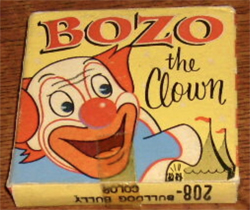 The bull begins to take the upper hand in the event, puncturing a silhouette-shaped hole in Bozo’s cape, and using Bozo as part of an acrobatic act, as the bull lies on his back and tosses Bozo for somersault spins atop his feet. Bozo calls for Butch to toss him the bugle. With a few bars blown of an army bugle call, the bull is again spellbound, and gives Bozo an affectionate slurping kiss. In the process, the bugle is knocked from Bozo’s hand, and the bull steps on it, hopelessly bending it. With no music, the bull snaps out of his spell, and lunges at Bozo again. Bozo dodges, and the bull temporarily conks himself out with impact upon another barrier. Bozo remarks what he’d give to have his horn about now, then suddenly brightens at his own mention of the word “horn’, getting an idea. Reaching out from behind the barrier, Bozo grabs and unscrews from the bull’s head one of his own horns, then blows through it. More music emits, and the bull is pacified again, to the cheers and thrown sombreros of the crowd. In a total continuity error, Bozo and butch ride out of the arena astride the peaceful bull – but Bozo is seen carrying his intact bugle, rather than the bull’s horn. Guess they thought the kids would never notice – but we did.
• Bully For Bozo is at Archive.org
 Also from Larry Harmon is “Bullfighter Bully” (King Features, Popeye, circa 1960 – Paul Fennell, dir.) – At least by this time, Harmon’s animation staff had picked up the quality levels, so the visuals are on a rough parity with middle-level competition. But the film oddly starts out with a glaring soundtrack error, as the stock Popeye theme is not cut into the track on cue, leaving Popeye’s pipe toots about a half-second delayed from their usual rhythm with his theme. “El Diablo” here becomes the name assigned to matador Bluto, rather than the name of the bull. Popeye is not impressed with Bluto’s image on a poster outside the arena, and tweaks the nose of Bluto’s image thereon. “And this is for you, Senor” is heard from behind Popeye, as the fist of Bluto clobbers Popeye down for the humiliation. Bluto kisses Olive’s hand, and declares that he will kill the bull today just for her. Olive wants to go in to watch the bout, but Popeye voices his resistance to the idea, not wanting to see a big bully picking on a bull. Of course, Olive wins this dispute, and Popeye is dragged along, despite stating he can take it or leave it. Olive spots a bovine in a holding pen, and thinks it is the bull, but Popeye points out that it is only a little calf, and steps close to the pen, receiving a few friendly licks on the face from the calf. Olive and Popeye finally take their seats, but Popeye states he hopes the bull wins. As Bluto bows to the crowd, Popeye shouts, “Hooray for the bull”, and pitches a raw egg in Bluto’s face.
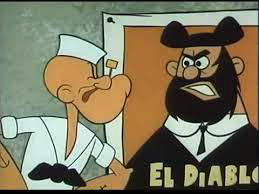 The pen door swings open, while unseen hands pull on a rope to draw out into the area the matador’s opponent. To Olive’s and Popeye’s surprise, it is only the little calf they had seen earlier. This is all the bullying that Popeye can stand. Popeye jumps into the ring, telling Bluto, doesn’t he believe in being kind to dumb animals? Popeye insists Bluto will not fight the little bull – so Bluto fights Popeye instead, using a switchblade sword to cut Popeye’s belt, dropping his pants in front of the crowd to reveal his shorts, then giving Popeye a swift kick in the pants, launching him through the arena wall. A moment later, at the hole made from the impact, a new face appears – a real, full-sized bull who seems to have just happened to be outside, wearing Popeye’s shorts on one horn. Olive has by this time stepped into the ring to take Bluto’s picture, to which Bluto remarks “The pleasure is all yours.” The picture taking is abruptly halted, as both of them observe the new bull charging them. Noting the red of Olive’s standard outfit, Bluto proclaims, “Pardon me. Ladies first”, and picks up Olive bodily, swinging her around as a human cape to avoid the bull’s repeated passes. Popeye returns amidst the zooming blurs of the bull’s repeated charges, quipping “They shouldn’t oughta let them trucks on the highway.” He finally hears Olive’s cries for help, but before he can act, the bull has butted him in the seat of the pants, sending him aloft to land atop a flagpole. Time for the old spinach. From nowhere, a cape appears for the strengthened Popeye to wave, from his position atop the flagpole. The angered bull charges vertically up the pole. We hear an offscreen sock, then Popeye is first to land standing upon the ground at the foot of the pole. “Sometimes ya has to take the bull by the horns”, he tells us, as he suddenly produces a platter and a chef’s hat from nowhere, holds out the plate, and catches as they land five large, king-sized steaks. Bluto smacks his lips at the sight of the feast, and gets his reward – as the five steaks are tossed right in his eyes, followed by a sock from Popeye that sends both bullfighter and steaks flying out of frame. Olive seeks to reward Popeye with a kiss, and Popeye puckers up and closes his eyes. Instead, the little calf pops up between them, and gives Popeye a slurping kiss, then disappears. “Ya sure kisses sweet, Olive”, states a love-struck Popeye, for the fade out.
 Bull Fright (or Olay Down) (Total Television, Tooter Turtle (from “King Leonardo and his Short Subjects” – air date unknown) – This episode may have been produced at the time production of the series was shifting from TV Spots to Gamma Productions in Mexico. Evidence of this is that Mr. Wizard the Lizard is completely off-model, with white locks of hair instead of stringy black, and red robes instead of blue (which makes a mess of things if this film is run with the original standard wraparounds used from the earliest episodes, as the look changes completely for the final stock shots). Presuming this was animated at Gamma, the choice of subject matter would make sense, and may have been suggested by the local animation staff. The episode also breaks with tradition, having a much longer opening sequence between Tooter and the Wizard than I have seen in any other episode, as Tooter tries to convince the Wizard to make him a famous matador like the one he’s seen in a colorful bullfight poster. Wizard warns this is a sport for men, not little turtle boys. But Tooter claims it’s different this time, ‘cause he’s been practicing. All he needs to show his stuff is a cape – and the Wizard’s red tablecloth will do. Of course, there’s a breakfast-ful of dishes and glasses atop it, which come crashing down when Tooter gives the tablecloth a yank. Tooter then asks Wizard to put his fingers on the sides of his temples like horns, and charge him. The Wizard does, catching Tooter’s cape as he passes through. The cape drapes over the Wizard’s head, and he crashes into the table. “You win”, says the muffled voice of the Wizard, as he finally utters the incantation to transport Tooter to the bull ring.
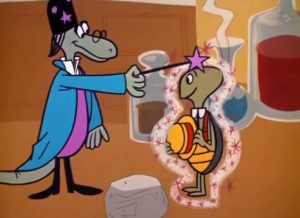 This episode seems to be presented in mildly educational form, as Tooter, and even the Wizard in some of his narration, utter several terms in Spanish, followed by their English translations. Most of the bullfight action is, however, rather routine. Tooter makes several successful bullfight passes, but then turns his back on the bull, and is butted high onto a flagpole. He tries to show his bravery by using a miniature cape, but it gets snagged on one of the bull’s horns, and Tooter is taken along with it for a ride, and a crash into one of the picadors’ barriers. Tooter drops his cape, and challenges the bull to put up his dukes and fight like a man. For a few moments, the two square off against each other like pro boxers, circling each other in the ring and looking for an opening. The bull is the one who finds one, and gets in a lucky punch, knocking Tooter to the sidelines once again. Time for the “Moment of Truth”, as Tooter is handed a sword. He addresses the bull as if dueling, sword against horn. But it is the bull who thrusts to fling Tooter’s weapon away. Tooter is left racing for his life, calling as usual for the help of Mr. Wizard. As always, the magic words, Tooter in a spiral, and “Time for this one to come home.”
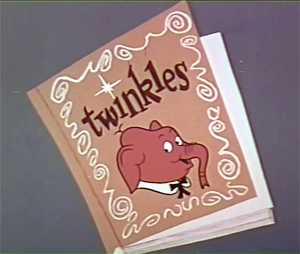 Twinkles and the Bull Fight (Total Television, Twinkles, from episode 3 of “King Leonardo and His Short Subjects” – air date unknown) isn’t much to write home about. This short interstitial, produced for General Mills as a tie in to their cereal with a mini-storybook on the back of the box, basically swipes setup from Disney’s “Mickey’s Rival” (1936). A picnic between Twinkles the magic elephant and Sanford the Parrot, just happening to use a red tablecloth, and set adjacent to the pasture of a mean-tempered bull. Sanford begins to boast that he once was a champion bullfighter, known in Mexico as El Sanfordo. Before Twinkles can get a word in edgewise, Sanford is within the pasture fence, showing off with the tablecloth as a cape. The bull is of course angered and charges, while Sanford gets stage fright and freezes up where he stands, the only thing moving being his knocking knees. Twinkles has to turn to the powers of his magic trunk, reciting the rhyming chant, “Nose, nose, anything goes. Pull that bull up off his toes.” Twinkles trunk transforms into a lariat, and he ropes the bull around the neck, inches shy of his parrot target. Sanford escapes, and Twinkles asks “What happened to El Sanfordo the great matador?” Sanford, unconvincingly, can still throw the bull. “I didn’t have my bullfighting hat on. Otherwise I would have take care of that bull.” Twinkles only smiles.
 The Brave Chipmunks (Format Films, The Alvin Show, 10/25/61) is a musical segment for Dave Seville and the Chipmunks, based off a cut from the Liberty Records LP, “Around the World With the Chipmunks”. On a visit to Mexico (with added animated material showing Alvin wrecking the pottery in a Mexican bazaar), the chipmunks spot a bull ring, and get the notion to fight a bull. Without invitation, they parade into the arena singing, and soon meet with a charging bovine. Alvin bravely waves a red cape, while his two brothers turn chicken quickly and run. Dave races in, rounds up Simon and Theodore, but has a tough time retrieving Alvin, who continues to wave his cape even when picked up by Dave, bringing down the fury of the fiery hooves upon all of them. They ultimately duck behind one of the barriers long enough for the chipmunks to make a discovery, that changes the whole complexion of the match. Their song includes the lines, “We wanted to fight the bulls. We musta been crazy.” They suddenly raise a toast, in the form of three glasses of milk, and conclude that they’re sure glad the bull’s name is “Daisy” – actually, a cow.
 Requiem For a Bull (UPA, Waldo and Presley (from “The Mister Magoo Show”) – possibly 11/10/60). Animation for this one seems to hit a new low for the standards of UPA, with some of the most blatant cheats possible to avoid proper presentation of motion. Manuel Tijuana Guadalajara Tampico Gomez Jr. (a primordial twin to the later model of Dick Tracy’s Go Go Gomez, who prides himself on never missing a chance for pesos) has a problem. He owns El Toro, the world’s fiercest bull. But he can’t book a match with him, because no one is foolish enough to fight him. Waldo and Presley happen to be passing through Mexico, and would love to date some of the local senoritas, but haven’t the pesos. Overhearing their conversation, Manuel poses as a one-man mobile employment agency from a pushcart, offering job opportunities. He pretends to look over listings, not recommending a position to install the electrical fuses in hot tamales – too dangerous. Instead, he recommends the easy job of getting fresh air and standing outside in an arena, while shaking the dust out of an old red cape. To ensure Waldo’s success in the position, Manuel provides him with a book of instructions (actually a copy of Dr. Shlok’s Baby Book). When in the ring, Waldo panics at the first sight of the bull, and darts behind a picador’s barrier. Presley flips through the book, providing him with instructions. Now feeling confident, Waldo re-enters the ring, and on three consecutive charges of the bull, has the beast outfitted in diaper and baby bonnet, fed pablum in a high-chair, and settled in a crib with bottle and rattle. The bull has had enough, and properly assumes the part by crying like a baby, as two attendants wheel his crib out of the ring. Waldo accepts a sack of pesos for winning the match, the cheers of the crowd, and the waving of kisses from what appears to be the loveliest girl in the stands. Presley suggests that now he can easily get a date with the senorita – all he has to do is throw her something. With nothing else readily available, Waldo tosses her the sack of prize money. The “senorita” catches the sack, then unmasks, to reveal Manuel, who addresses the audience. “What I tell you? Manuel Tijuana Guadalajara Tampico Gomez Jr. never misses a chance for pesos.”
• Sorry – No sign of “Requiem For a Bull” online.
 Here’s one I had never seen, which breaks a few series rules and explains a few things. Tacos Tangle (UPA, The Dick Tracy Show, circa 1961 – Ray Patterson, dir.). The formula for UPA’s very loose adaptation of Chester Gould’s famous character was to practically write Tracy out of the scripts, serving only as an assignment coordinator to pass on every case to a regular quartet or so or assistant crimestoppers, each of who solved crime in a comic vein. The series got in trouble in re-syndication for its liberal use of ethnic stereotypes – and this odd crossover episode breaks with tradition, by combining the services of both of its extreme ethnicities in solving the same caper. Joe Jitsu, who might be the last of Tracy’s assistants we would expect to see set South of the border, gets the assignment to trail BB Eyes, who has skipped the country in violation of parole, and is suspected to be up to shady doings at the resort spot of Tacos Island. (A continuity error has all uses of the word “Tacos” in the plural in dialogue, but several signs in the backgrounds refer to the place as “Taco Island”.) Joe just happens to be winging there via plane for a vacation, and agrees to combine business with pleasure.
Again breaking with the conventions of the series (which usually preferred to pair up classic villains from the comics rather than present them in their own individual capers), BB Eyes has no human confederate to work with in this episode. Instead, he partners up with a crooked bull, and poses as Juan Doe, American Bull Expert, to stage rigged bullfights and win cash prizes. He talks the bull into his idea of a 50-50 partnership – BB gets all the money, while the bull gets all the glory. As Joe surveys a poster for the upcoming event in the bull ring and decides to investigate, who should show up as if an old acquaintance of Joe but the same Manuel Tijuana Guadalajara Tampico Gomez Jr. seen in the Waldo and Presley cartoon, but for reasons unknown, now on the right side of the law, as the community’s local sheriff, and also, as pointed out by Jitsu, going under the nickname – Go Go Gomez. (Perhaps Gomez became a lawman because the pesos paid well.) This notably indicates that the Dick Tracy and Mr. Magoo casts exist in the same universe – a fact later to be reinforced in an episode of “The Famous Adventures of Mr. Magoo” in another out-of-the-ordinary crossover entitled, “Magoo Meets Dick Tracy and the Mob”. Jitsu gives Gomez the low-down on his assignment and the suspicious -looking bullfighter depicted on the poster, and Gomez accompanies Jitsu to the bull ring to witness the event for himself.
 At the ring, BB and the bull put on a reasonably fine show, despite the bull being slow to catch on how BB has rigged the event. BB’s sword is made of rubber, and when he jabs, he orders the bull to take a fall. The bull hams up his part with severe overacting, but finally collapses, as BB stands atop him in triumphant pose. The prize money sack is thrown to him, and he attempts to make a dignified exit. However, he steps on the bull’s tail in the process, reviving the supposedly-dead bovine with a painful “YEE-OWCH!” Even Gomez can easily see this event is not on the up and up. BB starts racing for the exit, and orders the bull to take care of Jitsu, who has jumped into the ring to make an arrest. Using his traditional powers in the art of judo, Joe makes quick work of the bull, grabbing his tail and body slamming him to the ground repeatedly, with intermittent remarks of “So sorry”. One final fling of the bull sends him flying across the arena, to land on BB Eyes, preventing his retreat. Back in the states, Tracy appears to greet the plane carrying Jitsu and his prisoner. But Tracy receives more than one villain to take into custody, as Gomez appears in the plane’s doorway, bringing along the bull in handcuffs. Thus, this episode seems to explain how Go Go Gomez became a part of Tracy’s enforcement squad. The film even ends unusually, with both assistants taking their turns in the iris out, Jitsu first wishing the audience his usual, “Sayonara”, then the hand of Gomez yanking the iris over to his side of the screen, allowing him to wish us, “Adios, I theenk.”
 A Bull For Andamo (Cambria, The New Three Stooges, circa 1965-66) – Another typically poor outing from this typically poor series. The Stooges are in the transport business, hauling by truck a bull for delivery to the bull arena. Without much in the way of onscreen visualization or explanation, a rapid ride up and down hill somehow releases the beast from the van. Moe spots the bull next to a tree, and tells his partners to get him – then reverses his command, as the bull is coming of his own accord, to get them. The Stooges dive for safety into a mud hole. Meanwhile, the bull hears cheers from within the arena, and remarks “My fans await”, thus entering the arena of his own choice. The drenched Stooges spot three outfits of dry clothes hanging over a fence, and make a costume change to get dry – not noticing these are matador’s outfits.
 The Stooges enter the arena to get paid, and are of course ushered into the ring in light of their outfits. The bull is happy to find himself facing a familiar three targets, and the typical chase is on. Curley Joe and Moe become upset that the crowd is laughing at their efforts to run away, and Moe decides to turn the tide, stating, “We’ll show ‘em”. In some badly executed and extremely unconvincing shots, the Stooges are suddenly seen riding atop the bull in standing poses all at once, dribbling the bull like a basketball, and finally getting the bull to flip over on his back in surrender at Moe’s inquiry, “Had enough?” The crowd still continues to laugh, not because the Stooges are still chicken, but, as the arena owner observes, they are great bullfight clowns. As they seem to be able to do anything, the arena owner gives command for the release of all the other bulls. The Stooges can see they have overstayed their welcome. Pay or no pay, they make a hasty exit in their van. Mopping their brows in belief they have eluded the stampede, Moe suddenly feels hot breath behind his collar. The original bull has pushed a sliding panel open from the rear of the truck, and is along for the ride, breathing down Moe’s neck, and winking at the camera, for the fade out.
 El Toro (Art Clokey, Gumby, circa 1968), suffers from definite pacing problems, trying to draw about an extra minute or more out of material insufficient to fill a short episode’s length. A fleeing crowd draws the attention of Gumby and Goo, shouting “El Toro”. No mention is made of Gumby either living or visiting Spain or Mexico, but there just happens to be a bull arena close by – and the crowd is running in the opposite direction. That can only mean one thing, surmises Goo – the bull is loose. A pair of horns that appear at Gumby’s elbow convince him that Goo is right. Both he and Goo scurry up a tree, taking seats on an overhanging limb. The bull snorts and paces angrily at the foot of the tree, holding them at bay. Prickle happens by, but upon spotting the bull, plays the situation with overconfidence, insisting that you can never show fear to his kind. In fact, Prickle assumes the bull merely wants to play. The bull disproves his theory, stacking one log atop two others, then busting the top log in two with a karate chop from his horns. “That’s a game?”, remarks Gumby. Still, Prickle tries for a game of hide-and-seek with the bull among a yard full of barrels. The bull demolishes all but one of the wooden obstacles, and when Prickle realizes he’s just run out of hiding places, he too shimmies up the tree to join his friends on the limb, referring to the bull as a “sorehead.” Laughter is heard from on the ground, as Pokey approaches, wondering why the gang are up in a tree looking so silly. But his speech turns to a stammer when he sees what drove them up there, and he too gets halfway up the tree trunk. Prickle remarks that he never knew Pokey could climb trees. “I can’t”, responds Pokey, as he begins to slide down the trunk. But one angry snort from the bull sends Pokey into a leap, which propels him into a position clutching onto the branch with his forward hooves. “Well, you’re a fast learner”, observes Prickle. Four on a branch isn’t a recipe for stability, and the branch cracks, depositing all four on the ground within arms’ reach of the bull. But a new voice is heard – that of a matador, who has caught up with the bull from the arena. “Bad bull”, the matador declares, treating the bull like a disobedient child. “You know the rules. There is no fighting outside the arena”. The bull is grounded, and told he will not be allowed to fight in the ring for two weeks, and to get back there immediately. Without a struggle, the bull meekly slips away in compliance with the orders. Prickle declares the bull nothing but a big bully, while Gumby observes that “If that little guy hadn’t horned in, we’d still be up a tree”.
 Bullfight (Fred Crippen/Pantomime Pictures, Inc., Roger Ramjet, 1965) – Another film that certainly doesn’t spend a dime more on animation than it absolutely has to, yet at least raises a few smiles thanks to the respectable voice casting, and the usual fine performance by Gary Owens as Roger. The Presidente of the small South American country of San Domino (so small, a leaned geographer is shown hunting for it on a globe with a magnifying glass) is busy holding a meeting with his cabinet (a wooden cabinet, that is, with a mysterious voice that emits from within when opened, using the catch phrase of television ventriloquist Senor Wences, “S’all right” – a line also used in the more remembered context of Baba Looey in the closing credits of Quick Draw McGraw as he responds to Quick Draw from inside a stage coach strongbox). One of the Presidente’s aides bursts in (pinning the Presidente under the fallen door), announcing there is an emergency, as the bull ring’s only bullfighter has turned in a hasty resignation rather than fight the terrible El Smasherino. The population will thus have no entertainment tomorrow – and when they have nothing to do, the expected result is, revolution. Only one man can save the day, and the Presidente calls in a favor from Roger Ramjet. He tells Ramjet nothing about the favor asked, except that he will be standing in for a national hero – something Roger thinks is right up his typical alley.
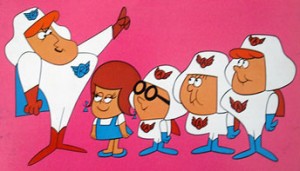 When Ramjet shows up at the bull ring, his first reaction to his opponent is “My, what an enormous cow”. Thinking he is entered in a milking contest, Roger steps out, only to dodge back over the fence when the bull narrowly misses him. The Presidente finally informs Roger that this is a bull. “You mean I’m supposed to milk a bull?”, asks Roger. “You’re supposed to fight a bull”, says the Presidente. “Why, I hardly know him”, says Roger. Nevertheless, he steps back into the ring, asking the Presidente to hold his cape – of course, red. The bull charges, catching his horns in the cape, which drapes over his eyes, causing the bull to smash into the wall. The bull mutters about the pain in his head in his best impression of the reads of Jerry Lewis, while Roger states that the bull has gone too far, as that cape was a present from Bruce Wayne! Roger takes his proton energy pill, holding out his fist as the bull charges again. The stadium shakes from the force of the impact, and we find both the bull and Roger lying temporarily unconscious on the dirt. The Presidente declares the match a draw – so both the bull and Roger are carried out on the shoulders of the fans in a victory parade. Roger’s job done, he bids his goodbyes, blasting the Presidente in the face with his jet exhaust as he takes off. Ay, Carumba!
NEXT WEEK: We’ll look at some more of Hanna-Barbera’s contributions, then we’ll see what else we have leftover.