
 How could this psychologist not pay tribute to this heartfelt animated depiction of Erik Erikson’s Eight-Stage Theory of Psychosocial Development? How could this animation aficionado not recognize a masterwork by John and Faith Hubley, especially on its 50th anniversary? Answer: I couldn’t!
In 1950, Harvard psychologist Erik Erikson proposed that spanned eight stages of human psychosocial development from birth to death, each featuring struggles between opposed concepts. One should note that today, these stages are no longer seen as universal. Since Erikson was American, his ideas are also culture-specific. Also note that competing theories existed: Jean Piaget proposed a four-stage theory of cognitive development as early as 1936.
However, it was Erikson’s conception that caught the attention of prominent director, writer, and animator John Hubley. Together with his talented filmmaker wife Faith, they put Erikson’s ideas into animation. Hubley was, at one time, a leading light of United Productions of America (UPA) and a powerful artistic force at that studio. He was ousted during the Red Scare of the 1950’s and blacklisted. Undercover, Hubley founded Storyboard Inc. (later Hubley Studios) in 1953. John and Faith married in 1955, vowing to make one animated film every year.
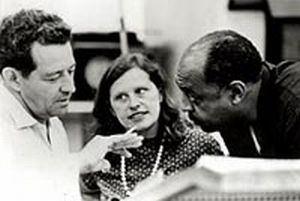
John and Faith Hubley, left, with jazz musician Benny Carter
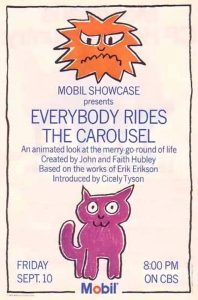
Carousel was not a theatrical feature. Running only 72 minutes, it aired as a television special on CBS on September 10, 1976, after a 10-year search for funding and the approval of a CBS “expert panel.” Hubley, ever the discriminating artist, was never bound by the network’s constraints (nor cinema’s). Actress Cecily Tyson introduced the special.
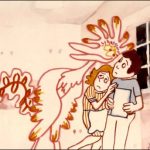
The film itself is never consistent for long in any mode of presentation: there are 2D line drawings, extensive use of still shots, and multimedia elements. The preferred animation technique is watercolor, specifically in backgrounds, but not limited to them. The film, at times, shifts into full abstract art and bounces out again with unpredictable frequency. That is not to say that Carousel is ever incoherent; it just follows no particular aesthetic.
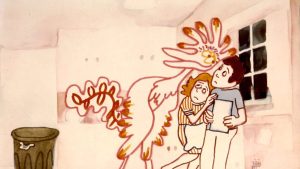 Hubley’s abstract imagination does not always match Erickson’s abstract ideas. Recall that the Hubleys went without a script, depending on improvised dialogue and their own artistic fancy. When Erikson saw the film, he said, “The only thing wrong with it is my terminology.” Indeed, Erikson’s theory is today best described as a starting point. Later theorists resisted compartmentalized approaches to development and the influence of evolving cultural trends such as the PC and social media.
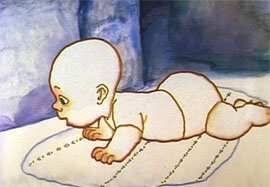
The film opens with a graceful harlequin (Alvin Epstein) introducing us to the Carousel of Life, and its eight horses, each representing an Eriksonian life stage. The first is Trust (represented by an orange cuddly kitten), vs. Mistrust (a disheveled blue one). The story begins with a stunning watercolor sequence of birth from the infant’s POV (Ray Hubley). Each time the mother satisfies his needs, the orange kitten appears on his belly. When the infant feels scared or deprived, the blue one is featured.
The theme of opposing characteristics of the stages, as animated characters, is repeated throughout the film. They sometimes appear internally, beside, or above the protagonist’s head.
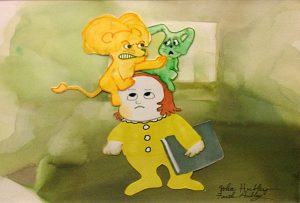 The second stage is Autonomy (an orange lion) vs. Shame and Doubt (a green rabbit). This stage is toddlerhood, where kids learn about boundaries and limitations. A girl is first seen in down shots, emphasizing her incomplete state of development. The lion encourages her to attempt unsafe stunts to prove her independence, but the rabbit always shows up to admonish her. However, when successful potty training or self-feeding happens, the lion is very pleased.
On to Stage Three, Initiative (a flamboyant bird) vs. Guilt (a polka-dotted serpent). A young boy, encouraged by the bird, steals an infant’s red balloon. Guilt overtakes him, but the balloon is snatched in turn by a little girl. The boy later manipulates his mother into multiple “Good Nights” while her impatient husband beckons. This segment is highly reminiscent of the 1956 “Marty Maypo” commercial by Hubley. A young girl draws a picture of her father, which makes her parents laugh. Angered, she fantasizes tossing her father out the window and her mother in the trash. All, however, ends happily.
In Stage Four, Competence struggles with Inferiority (represented by the protagonist shrinking) at school. There are challenges to overcome in learning reading and shop class skills. This segment is more faithful to Erickson’s conceptions. Either Erickson, Hubley, or, more likely, the advisory board ensured that each segment ends on an up note; nobody fails a stage or fails to progress.
Stage Five features Adolescence, or Identity( healthy young figure) Vs. Role Confusion (a humanoid jigsaw puzzle), enacted by four teenagers. This stage is represented by a wild, unpredictable carnival (the trumpet solos by jazz great Dizzy Gillespie are a perfect accompaniment). There are scenes of mirrored reflections of future selves, filing forms, and dealing with bureaucratic outcomes. The first scene is a POV roller coaster ride, symbolizing the wild hormonal swings of this stage. It is most potent as a couple emerges from the tunnel of love, shares a kiss, and inwardly experiences what love is and what it can become.
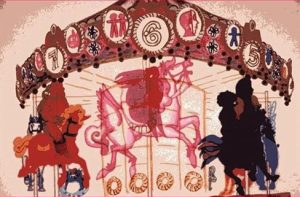 Stage Six represents Young Adulthood, Intimacy Vs. Isolation. This stage, as depicted by the Hubleys, is poignant and features some of the film’s best animation. The focus is on love and finding love (Isolation is not really depicted in any detail). A date in a rowboat brings two young lovers closer when the young man needs a splinter from the oar removed, symbolizing the mutuality of caring and comfort. Shortly after, a captivating dance between abstract figures ensues; during the dance, they exchange body parts, all in continuous flow. It is one of the great animated expressions of two becoming one during the dance of love. (Note: this stage features Meryl Streep’s first film appearance).
Stage Seven is Generativity (bright flowers) Vs. Stagnation (a squat, openmouthed fish). Generativity, according to Erikson, is full adulthood and the realization of responsibility to the world and future generations. Stagnation depicts people with fish for heads but does not follow their actions. The first scenario focuses on a couple having to let go of a college-age daughter. Only the second scenario, in which a couple argues over having a second child, really touches on the theme. This is the most problematic stage for the Hubleys, and I wager it was the source for Erikson’s comment on the film. Had there been a scenario on joining an organization, a school board, or volunteer work, rather than an individual family dilemma, it may have been more impactful.
 Stage Eight represents old age and Integrity (an Owl) Vs. Despair (a meek ghost). Hubley bats .500 here: Integrity, the wisdom, the reckoning with one’s past, and acceptance of death are depicted by two couples. One is a joyful black couple having fun as trick-or-treaters come to the door at Halloween. When the final visitor is Death itself, they declare that they might go someday, but not tonight! The other couple is a constantly bickering elderly couple who are bitter about, well, everything, including each other. Despair at a wasted life does not seem as evident as it should, nor do regrets, nor a lack of acceptance of death.
Carousel employed eighteen animators, including Art Babbit, Phil Duncan, Bill Littlejohn, and Michael Sporn. John and Faith Hubley did backgrounds and layouts. Besides Dizzy Gillespie, William Russo composed the score.
Carousel would be John Hubley’s final film. While working on the 1977 Doonesbury Special and preparing for directing Martin Rosen’s Watership Down (1978), John Hubley passed away during open-heart surgery on February 21, 1977. (Hubley’s designs for the opening sequence were the only remains of his work on Watership Down).
To the Hubleys’ credit, it would be difficult to see how any other animation studio (especially in the 1970s) might have carried this abstract production off. The vocal cast, consisting mostly of the Hubley family and acquaintances, lends the film verisimilitude. If not a perfect translation of Ericksonian concepts, Carousel is worthy enough to be considered one of the Hubleys’ best works.