
It says a lot that The Walt Disney Family Museum hosted an exhibition entitled Bruno Bozzetto: Animation Maestro! in 2013, which included artwork and a screening of Allegro non troppo. This says a lot, because the Italian animator and director is known for his parodies, and his 1976 feature is a not-so-subtle send-up of Walt Disney’s Fantasia (1940). The Museum’s exhibition is just one example of the respect Allegro non troppo has earned through the years.
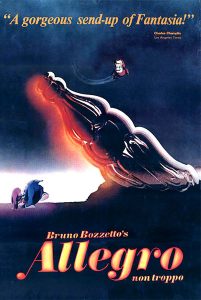 Celebrating its 50th anniversary this month, Allegro non troppo has been embraced by many Disney fans and artists as not just a parody, but also an homage to Walt’s innovative blending of animation and music.
The film opens in black-and-white live action with an emcee, known as “The Presenter” (Maurizio Micheli), who welcomes the audience and lets us know we are about to see animated images set to classical music. He then receives a phone call from someone in California, who tells him the film had already been made once before. The Presenter dismisses this, and later notes that the caller was someone named “Prisney,” or “Grisney.”
During the humorous live-action prelude, he also introduces the audience to the Conductor (Nestor Garay), an orchestra made up of little old ladies, and the Animator (Maurizio Nichetti), who emerges from a dungeon, where he has been chained up.
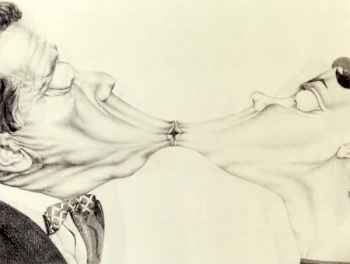
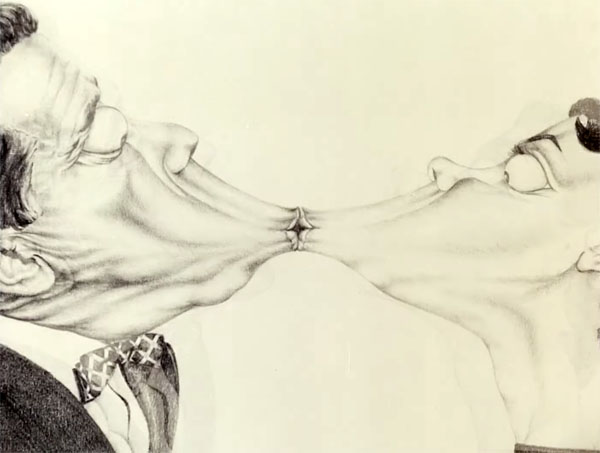
We segue into the animated segments, starting with Claude Debussy’s “Prélude à l’après-midi d’un faune,” where an aging Satyr attempts to look younger, while pursuing a young nymph. A poke at Fantasia’s “The Pastoral Symphony,” however, Allegro non troppo includes much more adult themes and images.
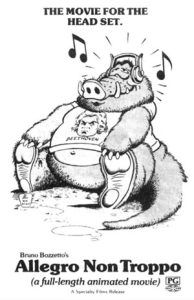 Then comes “Slavonic Dance No. 7, Op 46,” by Antonin Dvořák, where a man living in a cave attempts to build himself a better home, while the other cave dwellers continue to copy him, to his frustration, as he attempts to take matters into his own hands. However, the other residents get their revenge in a funny, “slam to black” conclusion, in this comical statement about conformity.
This is followed by Maurice Ravel’s “Boléro,” which is the backdrop for an odd, yet almost hypnotic tale of how soda left behind in a soda bottle comes to life, morphing into different monsters and alien life forms, in what appears to be a take-off of Fantasia’s “Rite of Spring.”
Up next is “Valse triste,” by Jean Sibelius, which tells a heartbreaking tale of a stray cat in an abandoned building who remembers the people who once lived there and longs for that familial connection.
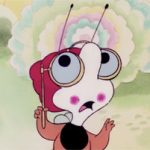 Antonio Vivaldi’s “Concerto in C Minor,” follows this, with the trials and tribulations of a bee who attempts to extract pollen from a flower, while a couple has a romantic picnic right above.
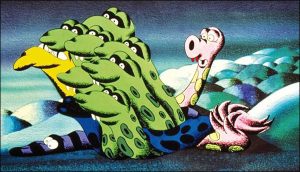
Then, there’s Igor Stravinsky’s “The Firebird” (which, ironically, was also used in Disney’s Fantasia 2000), and tells a different tale of Adam and Eve. Starting in stop-motion and segueing to 2D animation, the Snake offers Adam and Eve the apple, but when they refuse, the Snake eats it. After, the reptile is accosted by demons and a flurry of temptations shown through surrealistic images.
In between each of the musical animated segments is a return to the live-action Presenter, Conductor, and orchestra in some very funny segments and a conclusion, where the Animator turns himself and the theater’s cleaning woman (Maurialuisa Giovannini) into an animated prince and princess.
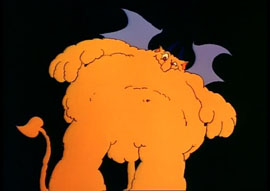 After this, The Presenter phones an animated character, a strange, hulking creature, to look for a fitting finale. The creature searches through a number of miniature theaters, at different animated performances, set to a variety of such music as Franz Liszt’s “Hungarian Rhapsody No. 2,” which ends the film with a series of disastrous images and the finale of the world exploding.
The Presenter then discusses his next project, a story about a woman and seven little men, which, oddly, he will title Sleeping Beauty. As the animated creature watches this unfold, the words “Happy End” fall on him, and the Snake from the Adam and Eve section peers out of the “D.”
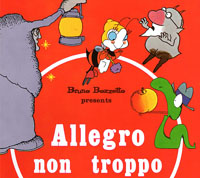 Bozzetto had created the popular animated character Mr. Rossi (who makes a cameo in Allegro non troppo) and his short Tapum! The History of Arms was screened at the Cannes Film Festival in 1958. He’s known for films with an edge, featuring more adult sensibilities and combining satire with animation. Bozzetti parodied Westerns with West and Soda in 1965 and superheroes with 1968’s VIP my Brother Superman. Allegro non troppo (which translates to “fast, but not too fast,” in Italian) is his most well-known film.
The animated sequences in the film are beautifully crafted, each with its own distinct style and tone. Of note is the personality the animators convey, in a comical way with the frustrated cave dweller in the “Slavic Dance,” and in an emotional way through the cat in “Valse triste.”
“Bolero” also features stunning, almost mesmerizing, animation that seems to be in perpetual motion throughout the segment.
 Released in Italy on March 12, 1976, Allegro non troppo would debut in United States theatres the following year, leaving some critics scratching their head, such as Janet Maslin, who wrote in The New York Times: “His [Bozzetto’s] movie is full of clashing colors and incongruous styles, with characters inspired by anything from Keane paintings to herbal shampoo commercials. The best that can be said for such a mélange is that it is genuinely exhausting.”
Much like Fantasia itself, these distinct qualities are what have endeared Allegro non troppo to audiences in the fifty years since its debut. In his book, The Animated Movie Guide, our own Jerry Beck called the film Bozzetto’s “crowning achievement,” stating: “Allegro non troppo is brimming with zany sight gags, exciting visuals, and comic originality. The animation art direction is superb, and the comic timing to the musical beats or to service a joke is masterful.”
GKids is re-releasing the feature in theaters this year. The big screen is certainly the best place to appreciate it. Here’s the brand new 2026 trailer…