

Week two of this special supplement to continue the topic of bullfighter cartoons, begun by Dr. Toon’s pair of articles three weeks ago. We cover today a run of theatricals from 1950 on not written about by the previous contributors, then turn to the first few random examples ot TV cartoons touching the subject but overlooked so far.
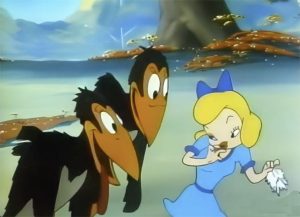 Rival Romeos (Terrytoons/Fox, Heckle and Jeckle, 11/7/50 – Eddie Donnelly, dir.) – A fascinating dip into the psyche of the devious minds of the talking magpies, in their first (and one of the few) episode in which they are pitted against one another, at cross-purposes for the heart of the same gal. Does one have the edge on the other? No, not really – they are pretty evenly-matched, making the battle interesting, in the same manner as the retaliatory turns of Columbia’s Fox could frequently even the score with Crow. Some excellent artwork, superior and character-filled voice reads from Roy Halee, and tight comic timing make this one of the standout highlights of the birds’ career.
Things are off to an inevitable battle when a slick chick of unknown breed drops her hankie flirtatiously in front of the boys. Both dive for it at the same time, disappear in a fight cloud, then emerge from the dust, each holding respective parts of the handkerchief, torn in half. “Is this yours?” they simultaneously ask. They are both invited to the girl’s home. Both magpies melt from internal heat into respective puddles. The boys try to conceal their plans from each other, acting as if the whole thing was just silly. They turn their separate ways, but each heads to opposite doors of the same tree, where they maintain adjoining apartments. Heckle dons a fedora, while Jeckle puts on a straw hat and monocle, and both add a spritz of cologne. Heckle grabs a handful of posies and attempts to exit his room, only to be tripped up at the doorstep by Jeckle, who swipes the flowers. Jeckle is already carrying a gift-wrapped surprise package of his own, and appears with both gifts to knock at the girl’s doorstep. The door to the home opens, where, to our surprise, we find Heckle already inside, who announces, “She’s not in”, then grabs back the posies, slamming the door to present them to the girl. When Jeckle persists in knocking again, Heckle rigs a wire from the electric doorbell to the doorknob, giving Jeckle a powerful multicolor electric shock when he tries the knob. After hearing the sound of an explosion from the shock, Heckle reopens the door, finding Jeckle nowhere to be seen, but his package still on the porch. Heckle now absconds with this too, presenting it also to the girl. However, the box springs open, revealing Jeckle inside, well and sound, and extending his lower lip to add to the effect of his straw hat, in an impression of French romantic lovemaking a la Maurice Chevalier.
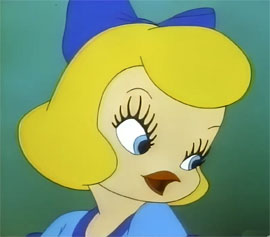 As Jeckle attempts to get comfy with the girl on the sofa, Heckle tells him he’s wanted on the phone outside. A convenient phone booth of sorts has appeared just outside the front door, and Jeckle enters. Heckle slams the booth door behind him, and nails it shut – then lights a skyrocket strapped to the back side of the booth. The entire booth launches straight into space as if destined for orbit. Heckle returns to the living room, seats himself on the opposite end of an ultra-long sofa from the girl, and little-by-little tiptoes his way toward the girl on the tips of his fingers. But before he can reach her, a crash is heard through the roof, and down falls Jeckle into the room, minus the phone booth and seemingly none the worse for wear, just in front of Heckle. “Shall we dance?”, Jeckle asks the girl. This leads to perhaps the best timed and funniest sequence of the film, as Jeckle takes the dance floor with the girl for a waltz. As the two circle the floor, never missing a beat in their steps, Heckle makes all manner of surprise attempts on Jeckle’s life. A swing at Jeckle’s head with a mallet. A thrown stick of dynamite that takes out a section of wall. A snapping bear trap. Five thrown daggers that lodge into the wall. Random swings with a baseball bat, that rebound off the door frames, smacking Heckle himself in the head.
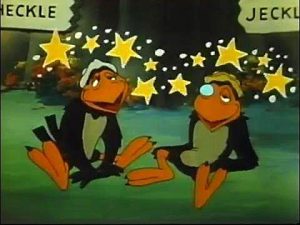 Heckle finally succeeds in throwing a sack over Jeckle, dragging him outside, and packing him in a mailing crate, addressed to Mexico, which is deposited in the local mailbox. Clearly this gag is borrowed from Porky and Charlie Dog’s “Little Orphan Airedale”, with a payoff that Chuck Jones might have played even funnier. A knock at the front door reveals Jeckle returned, in a full Mexican outfit, bringing Heckle “a present from South of the border” – a live bull! The gag backfires, as the bull isn’t too picky about who he chases – especially when Jeckle accidentally kisses the bovine who appears unexpectedly in a doorway. Both magpies wind up on the run, while the girl seems to take the whole idea of a stampede through her living room in stride as good fun entertainment. The magpies race for the front door, smashing through it and taking it with them. The bull catches up from behind, and butts both magpies and the door sky high, sailing in an arc into a nearby pond, leaving the magpies dunked and drenched. The two stand up in the shallow water, their hats gone, and only Jeckle’s monocle remaining. “That settles it”, says Heckle, “I’m through with women for good.” “Me too, old boy”, says Jeckle, and the two extend hands for a handshake, their friendship restored. An iris out almost closes. But the respective hands of the magpies reach out for the edge of the circle, just preventing it from shutting entirely. They have spotted something out of the corner of their eyes, and push the circle back to pop their heads through – oogling a strutting buxom canary strutting like Mae West on the audience side of the screen. The magpies are smitten again, and thrust the iris open, long enough to allow us to see them again return to their apartments to doll up. Both birds are seen simultaneously in a split-screen shot, hats restored and applying the cologne again, as they turn toward the audience, Heckle remarking, “Here we go again.” They simultaneously race outside, colliding with one another, and end the film in a heap on the ground, seeing stars in a happy daze.
 Looks like no one has yet addressed Cat Tamale (Famous/Paramount, Noveltoon (Herman and Katnip), 11/9/51 – Seymour Kneitel, dir.). It’s the usual problem for Herman’s cousins. Katnip keeps them from raiding the ice box. And for at least the second, possibly the third time, one mouse falls victim to the cat – we just never get to meet cousin Louie, the mouse always designated in every film to kick the bucket. This is worse than being the added fourth member of an expedition to the surface in any early episode of “Star Trek”. Herman returns via flight (on the back of a bird) from a vacation in Mexico. (Would it have killed him to bring the extended family along on his trip, rather than leaving them for weeks to starve? For once, Herman really has the death of Louie to place responsibility for upon his own head!) Herman assures the gang that he’s learned all kinds of tricks for dealing with “El Gato” while in Mexico. But Katnip is wily, placing a half-gallon-or-so bottle at the opening of the mousehole, and bottling Herman inside as he emerges. As Katnip tries to suck Herman up with a strong inhale at the bottle’s mouth, Herman prepares a change of Katnip’s diet, substituting for dinner a bag of Mexican jumping beans. Katnip bounces between floor and ceiling, in impacts that strongly suggest imitation of the animation from the twin-magnets sequence from Robert McKimson’s Goofy Gophers epic, “A Ham In a Role”. Herman opens a floor drain, and lets Katnip fall in, then closes the drain lid. However, it’s an easy task for Katnip to slither back in through the piping in the kitchen sink. Herman dives into his miniature suitcase, and when Katnip opens it, Herman has acquired the attire of a miniature bullfighter.
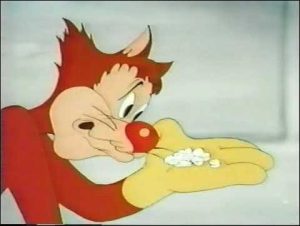 With deft moves of his sword, Herman carves away all but the stubs of Katnip’s two front fangs. (There’s a new first in dentistry.) Herman begins waving a red cape in front of Katnip. A cute shot shows us the twin reflections of Herman within Katnip’s eyes, as the reflections become conscious of each other, and each reflection-mouse reaches his arm across the bridge of Katnip’s snout, shaking the hand of the other in friendship. Long before Sylvester fell prey to the same urges in “Mexican Cat Dance”, Katnip in effect becomes the bull, snorting and charging at the mini-matador. Herman first rolls himself up in his cape like a windowshade, allowing Katnip to pass underneath, and slam into a waterpipe, shaping it into his silhouette. Herman lures the cat into a second charge into a set of kitchen cupboards, where several knives and a meat cleaver narrowly miss making their own brand of cutting comments upon the cat’s anatomy. Finally, Herman waves the cape while standing in front of an automatic washer and wringer. Katnip gets caught in the mechanism, and is pressed through the wringer like a flattened shirt. Herman accordingly neatly folds Katnip into a rectangular bundle, slips same into a mailing envelope, and addresses the parcel to China, tossing it out the window into a nearby mailbox. The fiesta is on, or so Herman thinks, as Katnip sneaks up behind him, still wearing the mailbox around his torso. He succeeds in reaching out one paw, grabbing Herman, and inserting the mouse in his mouth. Should we feed Katnip more Mexican jumping beans? No, not twice in the same cartoon – besides, Herman probably used up his total supply over two minutes ago. Instead, while still inside Katnip’s mouth, Herman pulls from his pocket a bottle of tabasco sauce, and liberally empties its contents upon Katnip’s tongue. Woww! Katnip’s whole head turns volcanic red, and he dives for the nearest receptacle of water – the washing machine. While the cat is not pressed this time, Herman adds another step to Katnip’s washday regimen, by pouring into the water a good dose of starch, then switching on the machine. Katnip soon finds himself covered head to toe in the stuff, and, while he leaps out and trues to chase Herman, his steps become slower and slower, until the starch hardens completely, freezing Katnip in his tracks. Herman playfully tests the hardness, flicking a finger at one of Katnip’s whiskers, which rigidly snaps off. The film ends with the contents of the refrigerator devoured by the mice, and Herman strumming a small guitar while lounging across Katnip’s tongue, while the cat’s helpless jaws remain petrified in starch, rendering him of no further threat to anyone.
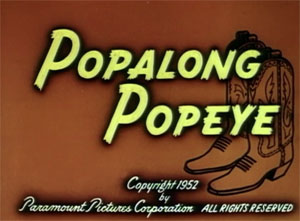 Popalong Popeye (Famous/Paramount, Popeye, 8/29/52 – Seymour Kneitel, dir.) takes the notion of “bull fighting” to a new level, abandoning traditional Spanish rules, and transforming it into a boxing event in the square “ring” of a wester corral. This cartoon-within-a-cartoon finds Western rancher Popeye explaining to Pip-Eye, Pup-Eye, and Peep-Eye (we never are quite sure who is the missing fourth brother in these later films) why eating spinach was necessary to him becoming a rootin’-tootin’ cowboy. In a flashback, Popeye appears as a city-dressed “dude”, seeking the position of cowpuncher at a ranch supervised by Foreman Bluto. Bluto as usual views Popeye as the total tenderfoot, so sets him up in one corner of a square corral, tying on his wrist boxing gloves. “You want to be a cowpuncher “, Bluto reminds him, and introduces Popeye to his opponent – a huge bovine in cape and boxing trunks in the opposite corner, named “Bully Boy”. After a shock take, determined Popeye steps into the ring with his dukes raised. But Billy Boy merely rests one of his gloved hoofs on Popeye’s chin and holds the sailor at calves-length, leaving Popeye swinging wild haymakers that don’t come within a foot of reaching his opponent’s breadbasket. Popeye finally tries an upper cut into Bully’s chin. The blow has no effect, except to pleat Popeye’s drooping arm into accordion bellows. Then Bully hooks his horns into the back side of Popeye’s belt, and uses the suspended sailor as a punching bag for a good workout.
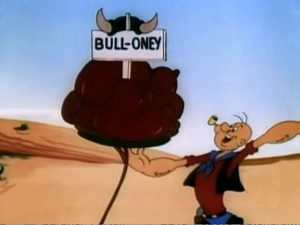
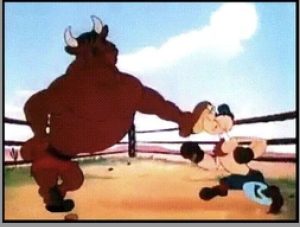 A final sock from Bully loosens Popeye’s belt from Bully’s horns, and sends the sailor sailing through the air, his head landing within the knothole of a rain barrel, while his spinach can sails out of his pocket, landing afloat atop the barrel’s water, with three feet of H2O between the floating can and Popeye’s underwater lips. This proves to be only a temporary problem to our hero, who sucks the spinach can into the water with an inhale through his pipe, and gets his lunch. Bursting forth from the barrel, Popeye’s clothing is magically transformed by the spinach from city duds to a first-class western ensemble. Bluto can’t believe his eyes, and attempts to keep Popeye at bay by releasing another bull from his corral. Using a lariat which has magically come with Popeye’s new outfit, Popeye fashions the rope into a series of four interconnected loops, then tosses the rope over the charging bull’s torso. Popeye gives the rope a tug, drawing the hogtied bull toward him. A left to the jaw, and the bull flies upwards into the air. Another tug on the rope, and it tightens upon the bull, compressing him into a string of five sausages. Popeye catches the string of sausages in a spiral atop the rope loop of his lariat, followed by the bull’s now detached horns, and a small sign which has appeared from nowhere, reading “Bull-oney”. “Free lunch on the house” declares Popeye. And of course, Bluto is vanquished, caught up with by Popeye walking atop a stream of bullets from Bluto’s continuously-shooting six-shooter, and socking Bluto into a batch of branding irons, much in the same manner as in the previous “Rodeo Romeo”.
 One would think the cartoon ends there, but in an unusual move for Famous, we’ve been set up with a false ending. For perhaps the only time in the series, another peril awaits Popeye. The kids still aren’t convinced by Popeye’s story, and have disappeared from the ranch kitchen. Popeye finds them outside, about to release his wildest bucking bronco, and remarking among themselves that they’ll prove they can be real cowboys without spinach. Popeye leaps in to try to prevent the peril, but too late. The corral gate swings open, and the bronco charges out, catching Popeye on his back, and bucking in his wildest untamed fashion to throw Popeye for serious damage. Popeye desperately tries to hold on, but even the kids can easily see that he needs help. So, they do what Popeye had suggested all along. Back to the ranch house, and eat their spinach. The kids flex their arm muscles, each of which transforms into the shape of a letter, spelling out in sequence “TNT”. Two nephews lay out a pair of curved boards retrieved from the sides of a barrel, each of which has two sets of protruding nails pointing upwards from the inward curve at key positions. The third nephew socks the bronco in the air. Both Popeye and the horse fly, but the horse lands first, his hooves hitting straight on the nails protruding from the boards, and lodging fast. Popeye comes down, landing astride the horse’s back, and the nephews jump on behind him – to ride the world’s only live rocking horse.
• Best print of “Popalong Popeye” is at DailyMotion.
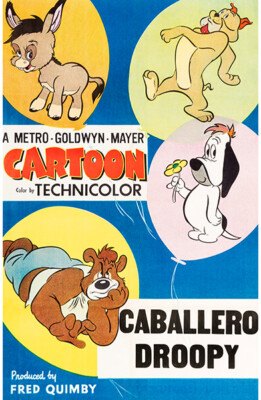 Caballero Droopy (MGM, Droopy, 9/27/52 – Dick Lundy, dir.) – I have never heard any explanation offered as to why this cartoon exists. It has the standout (like a sore thumb) reputation of being the only Droopy cartoon produced during Tex Avery’s tenure at MGM which Avery did not direct. Why? Cross-assignments of directors at MGM were an extreme rarity, with few trespasses of any personnel into another director’s normal venue. For example, no Tom and Jerry episode until the in-house studio closed was ever directed by anyone but William Hanna and Joseph Barbera. Barney Bear was the studio’s problem child in maintaining a directorship, but Hanna and Barbera were only called upon to direct one Barney cartoon (“The Bear and the Bean”) as a stopgap while other directors were being considered to helm the series. Dick Lundy, upon his move to the studio from Walter Lantz, would be the final director chosen to produce the Barneys. But before the release of his first comeback film for Barney (“The Little Wise Quacker”), this odd Droopy short came out. Where was Avery? Hard to say, as the number of Avery shorts released in 1952 dropped to three titles (all quite excellent), half the number released in 1951, and included no Droopy shorts. In 1953, Avery would again produce only three titles for release, but one of them was the memorable Droopy short, “Three Little Pups”.
It is not overly evident that Avery felt any desire to temporarily abandon the character, but perhaps some managerial edict had dictated the cutback in his number of productions, and he simply thought the script material for “Magical Maestro”, “One Cab’s Family”, and “Rock-a-Bye Bear” was superior in quality to anything offered him for Droopy that season. (Studio records show that some script ideas for Droopy, including one called “Droopy Dog Returns”, were never produced and rejected as unsatisfactory.) Perhaps the script for “Caballero Droopy” was one Avery did not find appealing, but management insisted that someone had to produce a Droopy short to fill out the season. It would seem doubtful that Lundy, aware as most of Hollywood was of Tex’s marvelous reputation, would have asked intentionally for a Droopy cartoon as his first assignment at the studio, or have the ego to sincerely believe he could out-direct Avery with the character. It seems more likely that the assignment was given to him as an audition film, or tryout, to see if he could fit into the MGM mold before officially reopening the Barney Bear series, which might have seemed a distribution risk and resulted in a “wasted” film in the event Lundy had not worked out, and only one new Barney short had been produced. Once the top brass were satisfied with Lundy, it would be okay to green-light the new Barney series with the confidence that a series of shorts could be marketed – no doubt the intended reason Lundy’s services were obtained in the first place. Had Lundy been a bad fit for the studio, the produced Droopy short could still be marketed as part of the package distributors had grown to expect, even if it was lacking in quality. Thus, Lundy was probably intentionally saddled with one of the weaker Droopy scripts, something Avery didn’t want to touch, and, under these adverse circumstances, can’t be said to have done a half-bad job in getting the most out of the property that one could reasonably expect. Still, for anyone used to the sharpness of Avery timing and his unique style of gags, “Caballero Droopy” leaves a taste in one’s mouth that it is definitely not an Avery-quality production – even if you watched it without catching the unusual director’s credit on the title card.
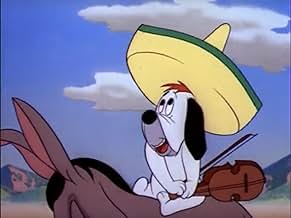 Droopy rides a burro and plays an off-key violin, intending to serenade a beautifil senorita in a nearby villa. He is held up by a bandit known as the Crisco Kid (pun on the famous literary, film and radio character, “The Cisco Kid”, crossing in the name of a still-existing vegetable shortening). This bandit doesn’t seem to be looking for money as he rifles through Droopy’s wallet, but is more interested in finding the kind of information one might keep in a little black book – namely, where to find the sweet muchachas. One look at a picture of Droopy’s intended sweetheart, and the Kid goes ga-ga (but without the trademark wild takes and claxon horn sound effects one might have expected from Avery – the writers probably leaving the reaction a question mark, intending that Tex fill in his own visual gag here). A scene at this point probably turned Avery off from the start – a repeat of one of his own past gags, by winding up the burro’s ears, then sending him off, ticking and clanking like a mechanical toy. Avery would have known this idea had all too recently appeared in the similar context of his own “Senor Droopy” about three seasons ago, and might have disapproved of its reuse so quickly.
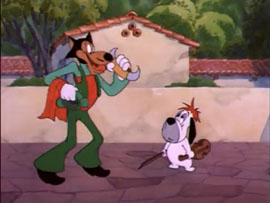 The Kid arrives at the villa and the senorita’s balcony, but Droopy seems to pop up playing his violin every time the Kid begins strumming his guitar. The Kid stuffs Droopy into the Droop’s own sombrero, then tosses the hat away. The hat spins in the air like a Frisbee, and returns ike a boomerang, knocking the Kid’s own hat off a bench and taking its place. So, when the Kid puts on his hat and plays, Droopy appears playing violin and tapping out a few flamenco steps, right on top of the Kid’s head. (The sequence is a bit prolonged in the Kid’s slow-realization of the situation – something Avery probably would have worked on to tighten timing.) The Kid drops Droopy down a well, but the Droop pops out again from the spout of a marble fountain. At last, a first gag has a bit of an Avery mark to it, as the Kid removes Droopy from the fountain by lifting not Droopy from the water, but the spout of water with Droopy still atop it off the top of the fountain. The Kid places Droopy on one end of a teeterboard, and drops a heavy iron weight on the board’s other end to launch him into the sky. It only gives Droopy a rise to the level of the senorita’s balcony, where the senorita plants a kiss on Droopy’s cheek. In one of the better gags (though a bit inconsistent with previous reactions of Droop to a kiss in other cartoons), Droopy remarks to the audience, “You know what? That’s unsanitary”, and sprays his face with a spritzer of antiseptic. It is unknown where Droopy goes by the next shot, as we never see him either step onto the balcony or land back on the ground. Nonetheless, the Kid observes that the teeterboard can get him to the balcony, so stands on the board himself, tossing the iron weight onto the board’s opposite end. He overshoots, and is propelled into the sky, planting a kiss on a passing buzzard instead of the senorita. The buzzard belts him back to the plaza below, landing him back on the board, and propelling the iron weight out of frame to a height unknown. Changing tactics, ad in another gag that would have been Avery-worthy, the Kid grabs a small stack of two boxes, climbs atop it, then keeps taking the bottom box out to stack atop the other box, allowing him to climb atop higher and higher, even though nothing but air is providing a foundation below the stack. He finally reaches the balcony, and puckers up to steal a kiss – as the iron weight re-enters the scene in free fall, clobbering and flattening him under his sombrero.
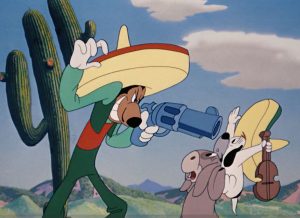 Another Avery-worth gag finds Droopy now standing upon a balcony adjacent to the senorita’s, again playing his violin. The kid inserts a saw in the flooring below where Droopy is standing, and curs out a hole around his feet. In a reversal of gravity, the balcony and all of its support structure fall down upon the Kid, while the small circle of wood cut out around Droopy’s feet remains airborne by unknown force to support him where he stands. Below, the balcony railings have curled around the dizzy Kid to resemble a birdcage. The next sequence is overly long and would have needed timing improvement has Avery used it, as the Kid asks Droopy for a dance, then tosses him around rolled up in a cape. A couple of his tosses unwind Droopy into the holding pen of “El Toro”, then wrap him up again for a return to the Kid. On the second try, the one returned to the Kid in wrappings isn’t Droopy, but the bull – who pounds the Kid and his sombrero into the shape of a yellow flattened pancake. In a gag Avery would have likely retained, Droopy incongruously enters the shot wearing a chef’s hat, and uses a spatula to flip the “pancake” over on the pavement! Now, as the Kid puts it, comes the “final act”. Carrying a cape, a matador’s hat, and a detached pair of bull’s horns fashioned to wear as a cap, he challenges Droopy to fight the bull to see who wins the Senorita. An odd idea, as he seems to only want to play-act the fight with one of them acting as the bull with the false horns, when you would think a real villain would want to actually place Droopy in mortal peril. Droopy wants to be first to play the bull, padding his part with very non-threatening sounds of “Snort, snort. Moo.” A few passable gags have the Kid fashion his cape moves as the rolling up of a windowshade, the parting of drapes, and the waving of a flag at a racetrack. Now, the parts are reversed, and the Kid plays the bull. As the kid charges, Droopy climbs atop the cape, allowing the Kid to pass underneath. He is unable to effectively apply the brakes, and skids into the pen of the real El Toro. The bull charges, carrying the Kid on his horns and slamming right through a pen wall, out through the countryside and onto some railroad tracks. A modern train approaches in the opposite direction at full speed. The inevitable collision occurs, the force of which warps ad distorts the train into the form of a battered old steam locomotive, where we find the bull and the Kid riding in a heap on the rear of the old-fashioned caboose, pausing to wave goodbye to the audience for the iris out. While the closing gag was somewhat clever, its setup seemed somewhat contrived with the fake bullfight, and it also felt disappointing in that there was no on-screen resolution of what happened with Droopy and the senorita, and no curtain line for Droopy. These again were probably points Avery disliked, again potentially accounting for why this script fell into Lundy’s hands. There would be no repeats of taking creative control of the series away from Avery until Avery ultimately left the studio.
• CABALLERO DROOPY is on DailyMotion
Just for the sake of completeness, it should be noted that the bullfighting sequence of Famous Studios’ Fiesta Time was reused verbatim in the cheater Noveltoon, Sportickles, in 1958.
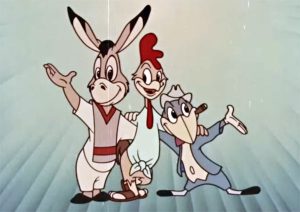 Manolin the Bullfighter (Manolin Torero) (Dibujos Animados, S.A.,1962 – Emery Hawkins, dir.) – I know next to nothing about the background of this series of productions, either made or distributed in Mexico, the few of which have surfaced seeming to have popped up on the internet only within about the last year or so. Considering their relatively small number of available titles, their theatrical-like full main titles, and their relatively full animation (supervised by the great Emery Hawkins), I am presuming these shorts found some life on theatrical screens in Mexican or Spanish language cinemas. Most of the other shorts which have surfaced in the Manolin series (the title character being a Mexican rooster, looking somewhat like a cross between Panchito Pistolas of the Three Caballeros and Disney’s 7up mascot, Fresh-Up Freddy) include a character who does not appear in this one, in the form of a definitely Russian wolf and seem to contain an agenda as soft-sell propaganda to avoid communism and the Russian way. This one, however, is the first I’ve encountered that seems to have no particular propaganda message, and is pretty strictly entertainment. Fortunately, all copies of these films which I have as yet found posted online were dubbed at some time with decently-produced English soundtracks, though onscreen writing in various scenes is not translated by subtitle or otherwise. It might be curious to view one at some point in its native Spanish language, to see how well the original voice casting fared in comparison to the translation.
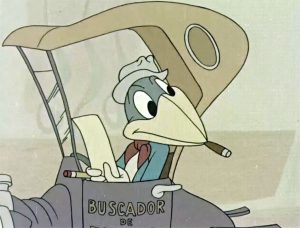 A character who may have had the formal name Armando Lios, but whom I’ll simply call ‘the Crow’ (as he looks quite similar to Columbia’s more well-known character of that name), typically the sharpie and con-man of the series, is puttering around Mexico in his older-model car, on the side of which he advertises himself as a promoter of bullfights and bullfighters. He briefly pauses to look over a list of prospective clients he would like to sign up for the bull ring. However, Crow’s reputation seems to have preceded him, as every likely candidate for matador has refused to sign with him (every name on the list accompanied by the notation “No firma” – loosely translated, “Has not signed”). Just then, something attracts Crow’s attention. A small crowd of villagers has gathered around a clearing and are cheering on the antics of Manolin, who is showing off and attracting attention by engaging in a mock bullfight as matador, with his regular companion in the series, Burrito, faking charges at him with a stuffed bull’s head mounted on the end of a wheelbarrow. As Manolin plunges a sword in the fake bull neck for the “Moment of Truth”, the Crow, having no other pro-candidates to turn to, sees imaginary dollar signs flash around his head, and also sees Manolin as a standing giant golden dollar sign. The fast-talking begins, Crow declaring Manolin to be a great matador, and urging him to sign a contract on the dotted line. Burrito, after having wheeled the wheelbarrow away, overhears, and does not approve of such a wild idea. He tells Manolin not to do it, as he is not a real torero. “Yes he is. Sign”, insists Crow. A shouting match ensues, with Burrito hollering “No” in one of Manolin’s ears, while the Crow hollers “Yes” in the other. The Crow finally shouts so forcefully, a gust of wind shoots through Manolin’s head, and a cloud of old dust is blown out the other ear into Burrito’s face, doubling Burrito up in a coughing jag. While Burrito is bent over, Crow places the contract upon Burrito’s back as a table, and Manolin signs.
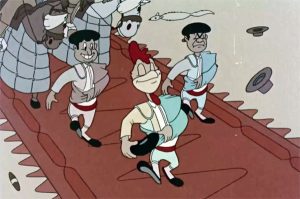 Crow takes Manolin to the big city. Burrito winds up tagging along, expecting that his services will be needed to play a fake bull again in order for Manolin to make a decent (and safe) showing of himself. Burrito is left alone to wait at the foot of one of the pillars of a swank hotel, so tall its top appears to reach the sky, while Crow has Manolin make a grand entrance along the red carpet leading inside. (He pulls the old Top Cat trick, lining up his own old car behind one of the passenger doors of a long limousine parked in front of the hotel, then merely walking through and out the other side of the limo with Manolin to make him appear to be a visiting V.I.P.) A press conference is arranged, and Manolin answers the question “How many bulls have you killed?” with “322 and a half, in round numbers.” Crow is soon able to arrange a match in the arena, given heavy publicity over radio broadcast and on posters, advertising Manolito and 6 brave bulls.” “Brave bulls?”, squawks Manolin upon seeing the poster. “That is just the hook”, says Crow, reminding him he will really be fighting Burrito in a costume. A clever shot places Manolin at the opposite end of a long corridor from Crow, with a long strip of red fabric held between them. Manolin goes into a spin with one end of the fabric pinned to his waist, and winds himself up to Crow’s position, thus donning the traditional waist sash of a matador. He and Crow drive to the arena in a real rented limousine this time – one of those models so long, it has to bend in the middle to get around corners. (Some more expensive Tex Avery-style animation could have been used here to better get across the effect.) After Manolin disembarks to enter the arena, Crow presses a release button on the car’s trunk, which pops open to reveal Burrito as passenger, compressed into a wedge shape to fit in the trunk compartment. Crow hooks Burrito around the neck with the end of a walking cane, and unceremoniously drags him inside, tossing him inside a small room within the dressing area where he will not be noticed.
 Manolin makes a regal entrance into the center of the arena, accompanied by a parade of picadors. Burrito pounds on the door of his small enclosure, wondering why he has not been sought out before Manolin’s exposure to the crowd. Crow finally appears, carrying an old, well-worn and ill-fitting bull costume for Burrito to put on. Burrito decides things are going too far, and turns his back on Crow, folding his arms in stubborn defiance, and stating “I refuse to play a part in this fraudulent mockery.” “Very well, but remember, your friend will have to fight a real bull”, responds Crow. What choice does Burrito have? With a dour expression of hopelessness and humiliation, Burrito tugs onto himself the drooping suit. To improve the appearance, Crow pulls out a bicycle pump, and begins pumping air into the suit with its hose. Burrito begins to look as if he more properly is filling out the suit, but Crow keeps pumping, until Burrito’s suit becomes round like a balloon, and Burrito floats in the air helplessly, close to the ceiling. Crow yanks out the hose end, and apparently, the costume is equipped with an air valve that shuts, leaving Burrito still floating, while Crow waves a bye-bye to him and slams the exit door again. Through the opening of a tiny skylight window above the door, Burrito shouts after him, “Villain! Assassin!”
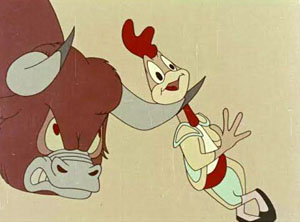
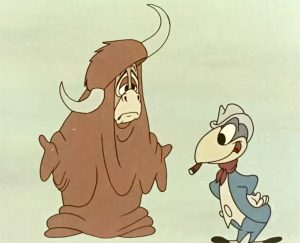 In the ring, the corral doors smash open from the inner impact of a ferocious bull charging it, and the bull and Manolin get their first looks at each other. This view is not what Manolin was expecting, and he panics in terror, running for the fence. But Crow appears from the other side of the railing, and informs him not to worry, as that is only his old friend Burrito inside. Manolin is fooled into envisioning a view of Burrito inside the bull’s skin, and suddenly develops the same sense of swagger he had back in his own village. Strutting out into the center of the ring, he bravely waves his cape, allowing the bull to make a perfect pass at him at close range. The bull charges again – but this time not only charges off with Manolin’s hat, but catches one horn on Manolin’s red waist sash, unwinding him in a spin as quickly as Manolin had first put the garment on. Manolin becomes denuded of his feathers in the spinning, but somehow maintains his composure, acquiring a small traffic whistle from nowhere, and assuming the role of a traffic cop in a “stop-and-go pass”, beckoning the bull to charge, then stopping him cold with a blow on the whistle, allowing the cross-traffic of a picador’s horse to pass.
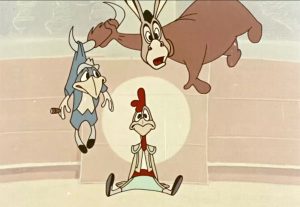 Back in the dressing rooms, Burrito is trying to escape his small room through the skylight window, but doesn’t fit. He finally locates the air valve on the end of the costume’s tail, releasing a small jet of air, which deflates his suit enough to slip through the window, and also propels him out into the arena. Manolin has by now somehow regained his feathers and most of his bullfighter suit, and gives new meaning to the expression “cocky”, by setting himself up in a situation no other matador would dare face. With two large nails, he hammers both of his shoes into a firm fastening into the ground. Then, he tears up his cape, reducing it in dimensions to the size of a small pocket handkerchief. “No, no, no!”, shouts an arena announcer, unable to watch. “Yes, yes, yes”, shouts Crow, goading on the action from behind one of the wooden barriers on the sidelines. Who should float into the scene, staring him in the face, but Burrito, still in the partially-inflated bull costume. Crow feigns a smile and tries for a hasty exit, but Burrito removes the fake bull horns from his own head, catching Crow’s outfit with one of the horn tips, and holds Crow aloft with him. Manolin has by now encouraged the bull to charge again with a wave of his “hankie”, and performs what the arena announcer describes as an “underpass”, getting the bull to dive headfirst into the ground, proceed in a semicircle around him while tunneling, then pop up out of the dirt, into the air, and land on his head.
Manolin removes the real bull’s horns, holding them like a telephone receiver, and “dials up” the bull by spinning the bull’s eyes like an old rotary-dial phone. He tells the bull that they must now ready themselves for “the kill’, and to make it look good. Suddenly, Manolin spots the floating Burrito and Crow on the sidelines. “Hi, Burrito”, waves Manolin – then turns green at the realization that Burrito can’t be in two places at once. All games are over, as Manolin runs, cringing with his back against the wooden barrier under Burrito and Crow, awaiting his fate as the bull prepares to charge. To save the situation, Burrito does some quick thinking and moving, grabbing the collars of both Crow and Manolin with both hands, and mixing them together in a whirlwind blur. In an instant, costumes have been switched, and Crow finds himself standing before the wooden barrier, dressed in Manolin’s torero outfit. Whoever wears the suit receives the charge, and Bull hits Crow full force, busting a hole right through the barrier, the arena fence, and the bull ring wall, and charging off down the nearest road in close pursuit of Crow, over the horizon. Manolin and Burrito look on through the hole in the wall, then Burrito gives Manolin a stern glance, as if to say, “See? I told you so.” Manolin bushes red with chagrin, but finally offers Burrito his extended hand, and the two patch up their differences with a firm handshake of friendship, for the fade out.
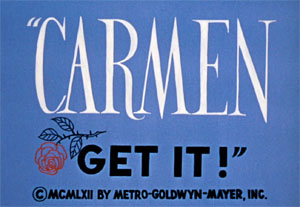 Carmen Get It (Rembrandt Films/MGM, Tom and Jerry, 12/21/62 – Gene Deitch, dir.) – The last and one of the best of Gene Deitch’s season of producing Tom and Jerry shorts on a farm-out basis for MGM. A chase through the busy city (including past a visible Loew’s and Apollo theaters) brings Tom and Jerry to the Metropolitan Opera house, where the orchestra is warming up for an evening production of “Carmen”. While Jerry is able to slip in unnoticed, Tom has to resort to subterfuge to get past security, obtaining from nowhere a tuxedo to mingle among the orchestra members, and also obtaining from heaven knows where a giant bass fiddle case to carry inside. Inside the case is a series of multiple smaller cases for stringed instruments (arranged like a Russian nested doll), the last housing a mere violin – but a special one. Concealed inside its woodwork is a tape recorder, with a tape spooled up with a complete recording of the violin part for the Carmen score. Tom won’t have to worry about his lack of musical ability in order to stick around and hunt down Jerry.
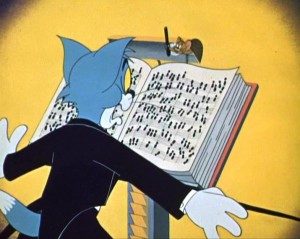 Tom soon spots sigs of his quarry – incriminating footprints leading to a mousehole in the orchestra pit. Coating his bow with a rubbing of fine cheese, Tom, while pretending to play, waves the bow in front of the mousehole, luring Jerry out with the scent. Tom whacks violently upon Jerry’s head with the bow, and briefly catches Jerry up in the bow’s fabric. Tom sadistically presses the bow on his violin strings with all his might, producing some notes through Jerry’s friction upon the strings that sound like wood sawing over the tape recording. But Jerry escapes the torture, by slipping inside the narrow sound holes in the violin’s woodwork. Once inside, he spots the tape recorder mechanism, and sabotages Tom’s plans, by turning the playback speed up to top level. The shrill, chipmunk-speeded violin squeals that emit from the instrument disrupt the whole overture, and raise the easily-provoked fury of the orchestra’s conductor. Tom displays a sheepish grin, holding out the still self-playing violin to reveal its secret, in an effort to avoid blame with an “I didn’t do it”-style pantomime. The conductor is not amused, and does his best impression of Quick Draw McGraw’s El Kabong, smashing the violin over Tom’s head.
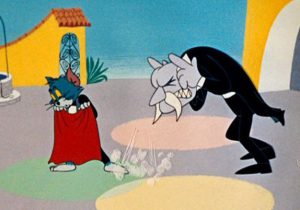 Jerry evades Tom by slipping up the conductor’s trouser leg and into the back of his tuxedo, just as the conductor is reaching the overture’s strains of the Toreador Song. The conductor begins to helplessly twitch from the tickling of Jerry climbing upon him, producing the first conducting of the aria in a rock and roll beat. Jerry is tossed out of the conductor’s sleeve, and eventually, the conductor takes five with a water pitcher to sooth his jangled nerves before the curtain on the main performance goes up. Jerry spots a new way to get Tom in further trouble. A trail of ants is visiting the open lunchbox of one of the orchestra members. Jerry grabs up a piccolo and plays the part of the pied piper, musically inducing the ants to march up the side of the conductor’s podium, and onto a pair of plank sheet music pages within the conductor’s music book. The ants spread out across the pages, until they are positioned across the blank music staffs, appearing for all the world like the written notes of an orchestral score. Now all Jerry needs to do is reveal his position, and lure Tom to chase him up to the podium. As Tom does, he is mistaken for a guest conductor, and the spotlight is placed upon him. The audience applauds, the orchestra springs to life to await his commands, and Tom feels compelled to go through with the charade to save a world of embarrassment. Taking up a baton, Tom begins further strains of the overture, competently directing the tempo. Then, the film takes improbable yet clever cartoon license with reality. At Jerry’s signal, the ants start rearranging themselves upon the pages. Never mind that no change would be simultaneously happening upon the sheet music of the orchestra members’ music stands – but somehow, Tom finds himself conducting musical pieces Bizet never would have considered for the score, including “American Patrol”, “Yankee Doodle”, “Dixie”, and “A Hot Time In the Old Town Tonight”. Needless to say, the returning conductor is peeved. And when the curtain rises and Carmen enters, only to have her entire performance grind to a screeching (and screaming) halt as she observes the horrifying sight of Jerry, dancing a flamenco on the stage in a miniature toreador suit, the conductor flips his wig. Seeming to notice only Tom appearing out of the prompter’s box to snatch up Jerry, the conductor places all the blame for the evening’s disaster upon him. Bending his head low and placing a protruding finger of each hand along the side of his temples, the enraged conductor assumes the moves and mannerisms of a bull pawing the dirt, setting himself for a charge at Tom. Terrified Thomas steps cautiously backwards, blindly reaching with one arm behind him in hopes of laying hands upon some defensive weapon. Jerry fills his hand with something Tom wasn’t expecting – a bullfighter’s cape. The opera thus goes on, of sorts, without singing, as the conductor lunges repeatedly in mad charges at Tom, while Tom rivals the great Manolete in evasive moves with his cape. Jerry, now atop the podium in a miniature tuxedo (amazing how these characters accomplish these instant costume changes, without a dresser), conducts the orchestra in bullfight music that transforms into the closing notes of the Tom and Jerry theme, and takes a bow as several of the ants return to the sheet music, arranging themselves to spell out to the audience. “The End”.
• CARMEN GET IT is on DailyMotion.
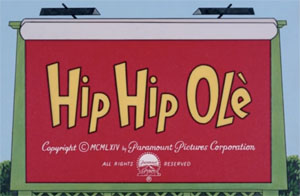 Hip Hip Ole (Paramount, Swifty and Shorty, 11/64 – Seymour Kneitel, dir.) – Monologue comedian Eddie Lawrence (“The Old Philosopher”, “Abner the Baseball”) provides the script for his pair of ever-warring adversaries in their constant battle of words and wits. Shorty has received a present from his wife, intended for use at a party they are attending this evening. Shorty doesn’t even know what the gift is, and attempts to exchange it at Swifty’s costume and novelty shop, for something exciting or good for a few laughs. Swifty informs him the gift is a fine bullfighter’s cape, and attempts to convince him to keep it with his usual brand of fast double-talk. He tries to show Shorty that the gift is exciting, by assuming himself the role of a matador, and having Shorty charge him while pretending to be a bull. Shorty stumbles at the conclusion of the charge, falling flat on the floor. Shorty thinks little of Swifty’s determination to have him keep the cape, asking, “Where am I gonna get a bull?” “Use your wife” suggests Swifty. “A female bull?” observes Shorty. “They’re the best kind”, responds Swifty – “Mean!” Swifty attempts to evoke Shorty’s sense of excitement at the atmosphere of the Corrida, the cheers of the crowd, and the admiration of the beautiful senoritas. “Ain’t ya’ got no romance in your soul?” asks Swifty. Shorty points out a fact demonstrating that romance is dead – “I’m married.” Swifty tries again, handing Shorty the cape and playing the bull’s part himself. “Use your imagination”, says Swifty when Shorty points out he doesn’t look like a bull. “You don’t inspire me”, quips back Shorty.
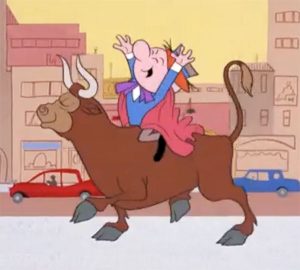 After several unsuccessful attempts to talk the stubborn Shorty into an exchange for items of much lesser value than the cape, Swifty insists that he will prove the cape means excitement, and tells Shorty to wait in the shop while he attends to something next door. Swifty’s next-door neighbor runs a pet shop, and seems to specialize in some out of the ordinary specimens. Swifty asks a favor, seeking to borrow “Pancho” to teach a problem customer a lesson. The pet shop owner agrees, but advises Swifty to be careful, as Pancho is a “wild one”. Of course, Pancho turns out to be a live bull. Terrified Swifty is forced to find his inner bravery, dodging charge after charge of the bull in best matador fashion, while sadistic Swifty sits atop his sales counter, eating popcorn as a spectator and shouting “Ole.” As the bull passes the counter after a charge, he doesn’t take well to Swifty’s shouts and doubling up in laughter, so turns, and impacts Swifty in the rear with his horns. Swifty is thrown across the shop, crashing through a set of display shelves, and knocked cold. The bull and Shorty become instant friends, and Shorty leaves the shop, wearing the cape and riding astride the bull, stating, “Come on, Pancho, we’re going to a party”, and imitating the tooting of a bullfight ring trumpet as he departs.
Now for a first few random selections from television production. Perhaps (at least for those of us who grew up with them) two of the better-remembered instances of bullfighting appearing in television animation would be within the repeated opening credits of two favorites of Saturday Morning lineups: Total Television’s “Tennessee Tuxedo and his Tales”, and Hanna-Barbera’s “Secret Squirrel”. The Tennessee Tuxedo opening has been circulating recently with an alternate soundtrack of the theme sung by a mixed chorus, versus the version I remember which included interjections by the original voices of Tennessee (Don Adams) and Chumley. The version with the cast-member voices is imbedded below. In the sequence, Tennessee appears as a bullfighter, holding before him a long cape on which appears his name. The chorus is encouraging the viewers to “See, see, see”, Tennessee Tuxedo, while Chumley’s voice converts the phrase to “Si, si si.” Unfortunately, the bull is coming the other way, approaching from behind. One butt, and Tennessee is launched into the sky, but descends slowly, holding the corners of the cape for use as a parachute.
The Secret Squirrel credits touted, among the character’s many abilities, his skill as a master of disguise, which “Takes him many places. He’s a squirrel of many faces”. This emphasis is a bit curious, as in the actual run of cartoon scripts, use of disguises was rarely resorted to by the squirrel. Nevertheless, the credits show Secret appearing as a Royal Guardsman, a Scotsman, an Indian, impersonating the Sphinx in Egypt (must be a pocket model of the sculpture), and even wearing multiple masks of himself. The final shot shows from a rear view a bullfighter, waving a cape in a pass past an angry bull. As the bull charges through the cape, the matador briefly turns, and we discover Secret’s face protruding from the neck of the matador costume. The bull skids to a stop in front of the camera, blocking all view of the matador. To make things totally confusing, the bull’s head pops off, revealing it too is Secret inside a costume! (So how did he manage to charge upon himself?) Secret raises a finger to his lips, signaling the audience to hush in quiet secrecy, while he jumps out of the suit, appearing in his own garments, to tiptoe away mysteriously into the night.
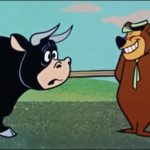
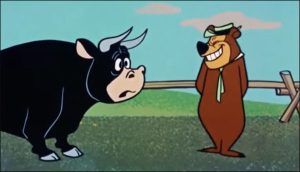 We’ll close this week with one of the earliest of qualifying television cartoons, Yogi Bear’s Big Bad Bully (from “The Huckleberry Hound Show” – Hanna-Barbera, 10/23/58). A passing bee’s flight alerts Yogi and Boo Boo that honey is nearby. But the hive is hanging from a tree in the middle of a cow pasture, and within that pasture resides – an angry bull. Need we say more as to plotline? A briefly running gag has Yogi butted by the bull on his first two entries into the pasture. Each time, he lands inside a nearby barn, and emerges from within astride the back of a small and frantically-squealing pig. The first time, the pig ducks under a low fence railing, and Yogi gets soundly conked in the back of the head upon hitting the rail. The second time, Yogi is ready for it, ducking just in time. But as he raises his head happily, looking back at the railing he narrowly missed, the pig carries him smack into a low-mounted mailbox on a pole, for another clanging and painful collision. Yogi tries some sneaky strategy, managing to tie the bull’s tail in a knot around a wooden stake in the ground. Yogi then appears in front of the bull, taunting him with a string of bad bovine puns. When the bull notices he’s tied and can’t charge, he merely yanks with his tail, pulling the stake out of the ground, and conks Yogi over the head with it.
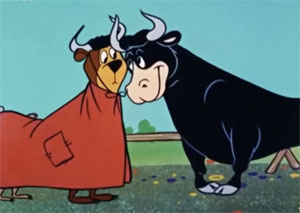 Disguise isn’t the ticket, as Yogi finds out posing as a traveling bush, but unintentionally sneezing away all of his protective foliage. Sharing an old cowhide with Boo Boo, Yogi poses as a cow, receiving compliments and overtures from the love-struck bull. But when the bears try to slip away to obtain their sweet and sticky prize, the bull steps on the trailing tail of their costume, as he remarks, “What’s your hurry?” The cowhide falls, and the jig is up. Both bears run for anywhere the bull isn’t, but the bovine remains right on their tail. Yogi suddenly appears with an old piece of red fabric, of proper size to double as a bullfighter’s cape. “Toro, Ha!”, he repeatedly shouts. The bull races past him in a first charge, his horn tearing away the bottom half of the cape. A second charge halves the size of the remaining fabric again, leaving Yogi with a red hankie to wave. “Nice Toro”, Yogi remarks meekly, as the bull returns for a third charge. This time, instead of taking out more of the fabric, the bull charges off with Yogi, leaving the hankie briefly aloft in mid-air, then settling to the ground. Yogi rides the bull’s horns, until the beast collides with the bee tree. The hive is dislodged, and falls upon the bull’s horns. “Oh, NO!”, reacts the bull. Unseen to our eyes, the bull somehow dislodges the hive from his head, but too late to avoid bringing on the wrath of the resident bees. Yogi, Boo Boo, and the bull all dive in the nearest mill pond to avoid a stinging finish. Yogi and Boo Boo rise from the water first, thinking at least they’ve gotten rid of that bull bully. The bull rises from the water between them. “That’s what you think.” The film should have then closed with the characters racing off in a pursuit to the fade to black – but for no apparent reason, Yogi and Boo Boo are merely permitted to run away, while the bull drains water out of his horns, and remarks with no apparent emotion, “Those crazy mixed-up bears.”
• “Big Bad Bully” is on Facebook.
NEXT TIME: More TV toreros.