
If you enjoyed the first part of this series (posted yesterday), you’ll shout “Ole” for this installment.
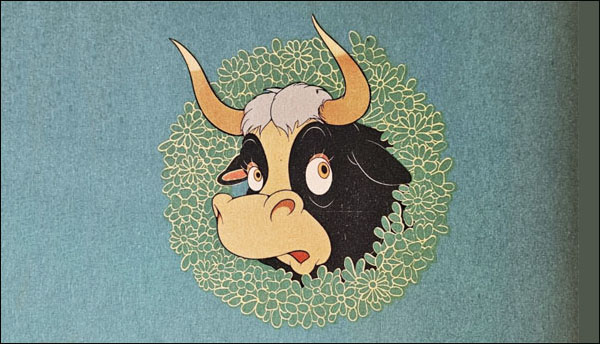
Jumping ahead to 1938, we find Dick Rickard directing Ferdinand the Bull for Disney Studios. Young bull Ferdinand loves to sit under a cork tree sniffing flowers, despite his mother’s entreaties (voiced by Walt Disney) to play with other bulls. Later, full-grown, he unfortunately sits on a bee when scouts come to select bulls and goes wild, so he’s chosen for a big bullfight (the matador is a caricature of Walt Disney). The matador is tossed a bouquet, but all Ferdinand wants to do is sniff it. The frustrated matador is reduced to tears, and Ferdinand is returned to his home, where there are cork trees and flowers forever. The end.
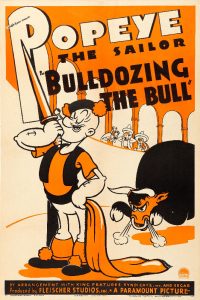 Popeye, where have you been? He appears in the 1938 Fleischer short Bulldozing the Bull, directed by Willard Bowsky. Popeye is offered a free ticket to a bullfight but declines because of his stance against animal cruelty. His mind quickly changes when sexy señorita Olive Oyl shows up. After accidentally sitting in the toreador’s box, he is reluctantly escorted to the ring (Jack Mercer’s ad libs are priceless). Popeye’s attempts to reason with the bull get him pummeled. Olive comes to his rescue, but the bull chases her! Spinach time! Popeye whomps the bull, but refuses to land the killing sword thrust. The bull, overjoyed, takes Popeye and Olive on a ride around the ring. “Don’t be no bullfighter, ‘cause kindness is righter says Popeye the Sailor Man!”
• Check out this classic Popeye short on MeTV TOONS, or on Warner Bros. Home Video – or here.
Ay Carumba! We pick up the study in 1939 with Terrytoons stinker A Bully Romance starring Gandy Goose and directed by Eddie Donally. This cartoon features poor animation, a laughable story, and does not even take place in a bullfighting arena or ring. Gandy relates a flashback to a past trip to Mexico, where, within moments of arrival, he is dancing with and wooing a señorita goose. They go into her home and are immediately accosted by her papa, who demands that the price of marriage (already?) is defeating a bull.
They keep one in their house behind a curtain! Gandy and the bull race around the residence, partially wrecking it (and papa). The bull runs into a wall and, dazed, surrenders. Back in the present time, Gandy finishes relating his story, opens a door, and a bull immediately chases him offscreen. No mas, Mr. Terry!
Bullfighting toons get better when The Timid Toreador takes to the ring in 1940 under the direction of madman Bob Clampett, with Norm McCabe co-directing. The title character is a slimmer Porky Pig. The cartoon is loaded with then-popular references such as the Brown Sombrero, a bull named Slapsy Maxie Rosenbull, and a final shot of Porky morphing into Oliver Hardy. Porky is selling what appears to be the hottest tamales on Earth. After he inexplicably wanders into the bullfight ring, he’s in trouble: Slapsy has run off the matador and smashed a picador into his horse, resulting in a centaur. Porky seems doomed until Slapsy eats Porky’s entire box of tamales after jeering at the snacks. Well, that move really blew things up!
Woody Woodpecker dons the sword and cape in 1942, in “The Hollywood Matador”, directed by Alex Lovy for Lantz Studios. Woody is still in his garish 1940 Ben Hardaway design before Art Heinemann streamlined him. Woody is an established matador from the beginning (BTW: nothing in this toon references Hollywood except the Earl Carrol Theater quote over the entrance). Oxnard the Terrible is his foe. While the gags are nothing special (and some take too long), the animation of the furious bull is good. In the end, Oxnard and Woody bullrush (sorry) each other head-on. When the dust clears, Woody is selling bull burgers at the center ring. Tex Avery could have directed this cartoon in half its length.
When it comes to Throwing the Bull, you need Mighty Mouse for the job. Or do you? This 1946 cartoon, directed by Connie Rasinski for Terrytoons, is a virtual remake of the 1935 Terrytoon “The Bull Fight,” including the climactic scene, reanimated to put Mighty Mouse in Puddy Pup’s place. Never knew ‘ol Puddy was that strong, did ya? The highlights of the cartoon are Roy Halee’s singing and a lovely señorita mouse, most likely the work of Rasinski himself.
He may not seem like much of a matador, but Tex Avery’s Droopy is not to be underestimated in the 1949 MGM short Señor Droopy. Señor Droopy from Guadalupe and the Avery Wolf take on a savage bull, with the winner awarded anything he wants. Both the Wolf and Droopy are in love with beautiful singer/actress Lina Romay, but the bull is out to deny them both. Avery’s surrealistic gags are abundant. Some of the best include the Wolf performing several humiliating magic tricks on the bull, the bull’s hilarious disdain for Droopy, and Droopy’s violent, deadpan victory after the bull has destroyed the Wolf and then defaces Droopy’s magazine photo of Romay. “You know what? That makes me mad.” It turns out in the live-action finish that Ms. Romay is quite enamored of Droopy!
Famous Studios produced Fiesta Time in 1950, directed by Seymour Knietel. Only the final minute of this short featured a bullfight, which the matador wins by hiding a tombstone that reads “El Toro” behind his cape. Bash! Ole. This Screen Songs bouncing ball sing-along was considered a “lost” cartoon, but you can find it on the 2006 Harveytoons compilation DVD.
You can feel bad for El Toro Pantso, since he must take on Heckle and Jeckle in the 1951 Terrytoon Bulldozing the Bull, directed by Eddie Donnaly. The magpies start as tamale vendors, selling “ice cold, red hot tamales.” Caught by the ticket taker, they disguise themselves as toreadors and then guess what? After teasing the bull with a red-cape-and-ethnic-dancers routine, Jeckle pulls the bull’s hide off, revealing a cut of meat chart. Jeckle, after a kick in the butt, declares, “Of course, you know, this means war!” (Jeckle and Bugs Bunny must have been fans of Groucho Marx). The birds gain control of the bull and use him to chase the ticket taker. After a tussle in a cloud of dust (with some cute gags thrown in), it’s the ticket taker being chased by Pantso out of the arena, with Heckle and Jeckle showered with hats. About time Terry made a decent, funny bullfighting cartoon!
Goofy, who shows you “how to” do every sport the wrong way, takes on the sport of bullfighting in the 1953 Disney cartoon For Whom the Bulls Toil, directed by Jack Kinney. Goofy, driving his sloppy jalopy into Mexico, encounters a bull in the middle of the road. The locals note his attempts to dislodge it, and the word spreads. His adorers spirit The Goof away to the bullfighting arena, where they outfit him as a matador. There have been many stronger Goofy cartoons under Kinney’s direction; most of the footage shows Goofy running and howling in terror. The bull finally entangles himself in Goofy’s suspenders, and when Goofy tries to flee in his car, they snap back like powerful elastic bands. The bull and Goofy are propelled into the stadium wall, pushing the entire structure about 100 yards to the right. Goofy is the winner, and on his way home, he encounters what appears to be a bull once again blocking the road. As Goofy flees, the animal turns around: Aw, it was only a moo-cow!
So, Mr. Selzer? Bullfights aren’t funny? Tell that to Bugs Bunny, who stars in the 1953 classic Bully for Bugs, Directed by Chuck Jones and written by Michael Maltese for Warner Bros. After missing another turn at Albuquerque en route to the Coatella carrot festival, Bugs emerges in a bullfight ring where a savage bull is chasing a terrified matador. The matador does not stop to give Bugs directions. Bugs, the bull’s new target, gets slammed out of the arena. “Of course, you know, this means war!” You bet it does! Bugs returns in matador gear and has an anvil hidden behind his cape.
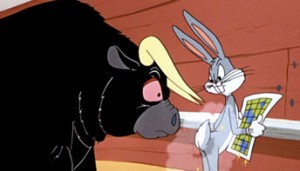 Round One to Bugs. Bugs leads the bull in a silly dance that ends with the bull’s horns fastened to a large board. But the horns are detachable, and Bugs gets clobbered while mocking the bull—Round Two to Toro. Bugs takes Round Three by using the bull’s horns as a slingshot and sending a boulder into Toro’s face. It’s two to one, bull, until the bull bashes Bugs through a wall—tie score. Bugs takes the lead with an infuriating Mexican Hat Dance. Bugs looks to put the fight away with a rifle hidden behind his cape, but the charging bull swallows it and finds that his horns are now pistols! He runs out of ammo, swallows “elephant bullets,” and explodes while Bugs laughs. We’re still tied. The bull charges Bugs so violently that Bugs writes his will, but simply opens the door and watches the bull run for miles. When the bull rushes back, he soars through a Rube Goldberg setup that blows him up and sends him into a wall, defeated. Victory goes to Bugs, who holds a cape that proclaims, “The End.”
This Looney Tunes cartoon deserves a longer description because it is simply the best and funniest bullfighting cartoon of all time. “Bully for Bugs” has all the excellent Jones/Maltese touches: underplayed facial expressions, the bull’s thoughts being evident without a word spoken, minimal movements that speak volumes, coupled with great comic violence. If you see just one of these bullfighting cartoons, it should be this one.
• To see the Bug Bunny bullfighting classic – CLICK HERE.
It’s a step down to the following classic cartoon, 1955’s Bull Fright starring Casper the Friendly Ghost, directed by Seymour Kneitel for Famous Studios. What? Casper in a bullfighting cartoon? He wouldn’t fight a butterfly! What he can do, however, is train Pancho, a baby bull who yearns to be like his tough, confident Papa, who is a star in the bullfighting ring. After some training mishaps, the scene cuts to a real bullfight featuring Papa, with Casper and Pancho in attendance. Papa is dazed after running into a wall, and Casper rides Pancho into the arena to confront the matador. Animator Myron Waldman succeeds in making Casper look angrier and more threatening than in any other cartoon, but why bother? We all know what happens when the matador sees “El Spirito!” right? Need I bother to add that Papa is now proud of his little son? Ay, Hermano!
Want to get A Bum Steer? Check out this 1957 Terrytoon directed by Mannie Davis and Gene Deitch. Beefy Bull (a.k.a. Rocky Toriano) is hanging up his horns after an undefeated career. Side note: Beefy’s professional name is a play on boxer Rocky Marciano, who also retired undefeated. Marciano was from my hometown, Brockton, Massachusetts, where he was affectionately known as “The Brockton Bomber.” These facts are infinitely more interesting than this cartoon. Young Beefy Jr. wants to follow in Dad’s footsteps, but Mama forbids it and commands him to practice music.
Meanwhile, a world-famous bullslinger, Panhandle Pete, calls Beefy out of retirement with an irresistible offer. The fight is on, and Pete confuses Beefy with lasso rope tricks before body-slamming him. Mama, horrified, turns off the TV as Junior lights out for the stadium. As Beefy is about to become bullburgers, Junior (too) easily saves the day. Have we seen this movie before?
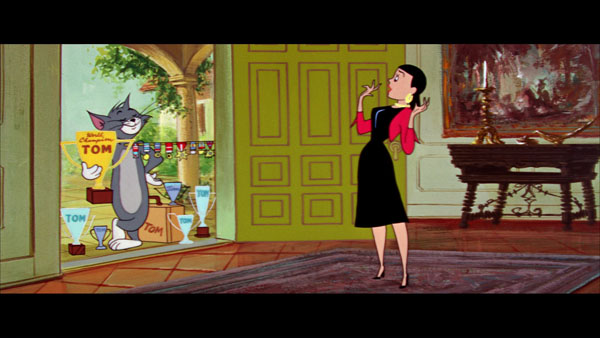
Tom and Jerry, where have you been? Turns out Jerry has moved to a Mexican villa along with a (fully pictured) female owner and a goofy orange cat. This event must have happened in 1957, because that’s the date of the cartoon Mucho Mouse, directed by Bill Hanna and Joe Barbera for MGM. Jerry is now El Magnifico, and the orange cat, directed to catch him, is clearly no match for the mouse. The lady of the house hires Olympic, U.S., and World Champion Mouse Catcher Tom, who arrives bedecked in trophies and medals. The battle begins with Tom firing Jerry out of a cannon, but the undaunted mouse returns. Tom alters his form to resemble a bull while Jerry plays matador. Tom ends up with a jug smashed over his head and a sliding crash into a wall. Jerry then does the bull-disappearing-into-the/cape gag and spills Tom to the floor. After Tom’s defeat, the lady of the house returns to find Tom and the orange cat playing guitars as Jerry pilfers more food. Six cartoons later, the MGM Hanna Barbera theatrical series of Tom and Jerry cartoons would end.
1965 seemed like a good place to end the “classic” era of bullfighting cartoons, and who better to close the show than the Pink Panther? In Bully for Pink, directed by Hawley Pratt for DePatie/Freleng, Pink imagines himself as a matador, but the cape he finds is a moth-eaten rag. Pink sees Marvelo the Magician exiting a building with his “Magic Cape,” which Pink pilfers.
At the bullfighting arena, a fierce bull awaits, but the cape begins using him as a magic act, including the bull-disappearing-into-the-cape-act, from which an angry rabbit emerges. When the cape is tossed away. Pink is in trouble, but he retrieves it in time to put the bull (and the angry rabbit) to sleep. Another dive into the magic cape produces half a bull on exiting. Using the cape, Pink restores the grateful bull just in time for a swarm of moths eat “The End” into the cape. A high-quality cartoon with good gags ends our 22-film survey.
Did I miss any? Please post the titles of any I may have overlooked in the Comments section below. Adios!