
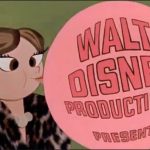
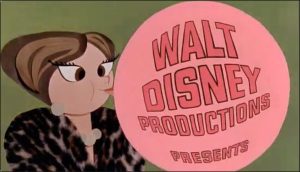
from the opening titles of “Freaky Friday” (1976)
Disney was so renowned for so many aspects of animation, the delightful titles created for a select group of live-action features are sometimes overlooked, though they involved the same legendary creative minds behind the classic films and theme park attractions.
Animation was also used as an accent for some live-action films. In That Darn Cat, a bulldog’s frustration is expressed on screen as little “expletive” symbols quickly spinning into the film’s title. Line drawings of menacing search dogs leap and bark at the open to Escape to Witch Mountain (the movement of which suggests a scene in 101 Dalmatians).
There were also main titles in which the camera panned and zoomed over superb artwork, the kind of thing that iMovie calls the “Ken Burns effect.” These films include The Happiest Millionaire (by Oscar-winning visual effects artist Alan Maley, who was also painting art for Buena Vista record albums at the time), and Bedknobs and Broomsticks by David Jonas (Back to the Future II, Indiana Jones and the Last Crusade).
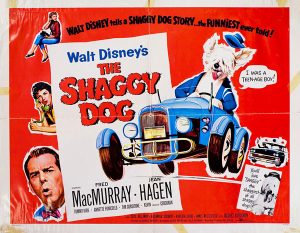 We’re going to look at most of the titles that are largely animated in various ways. The animation was often modest but consistently inventive. The first such main title kicked off 1959’s The Shaggy Dog. Not only was this Walt Disney’s first live-action “high-concept” feature, this budget-priced hit did not do the expensive Sleeping Beauty any favors, as it ushered in a form of Disney product that offered cartoon-like fantasy yielding a massive return in investment.
Bill Justice and X Atencio, now part of Walt’s inner circle as WED Imagineers, were the fathers of Disney stop-motion. The same year, they won Disney an Oscar for Noah’s Ark (1959), in which household objects were artfully woven into articulated figures. For The Shaggy Dog, they must have made Roy O. Disney especially happy by animating carpet swatches and bulletin board lettering. It was still a joy, combined with the title tune by Paul J. Smith and Gil George (Walt’s nurse Hazel, who created lyrics for dozens of tunes).
Here is the title as it appeared in the movie:
And this is the record album in which Paul Frees voiced Shaggy as a recording star, with the theme sung by Roberta Shore of The Mickey Mouse Club and The Virginian.
In 1961, the same year they animated the battle sequence for Babes in Toyland featuring the toy soldiers that would reappear in 1964’s Mary Poppins, Bill and X created one of their most beloved titles for The Parent Trap starring Hayley Mills. Like Toyland, the title sequence featured Tommy Sands and Annette on the soundtrack. Tutti Camarata arranged and produced the slightly different vinyl version, and likely also worked uncredited on the title arrangements.
The Sherman Brothers were now ascending at the studio, supplying songs for films, TV and soon Disneyland. This Walt Disney Presents devoted half of one episode to the animation and recording of The Parent Trap main title:
Bon Voyage was a somewhat ambitious, lengthy comedy released in 1962, in which Fred MacMurray, Jane Wyman, and their TV-sitcom style family go on a Paris vacation. The Sherman’s peppy song was accompanied by titles showing vacation paraphernalia, sometimes animated and sometimes not.
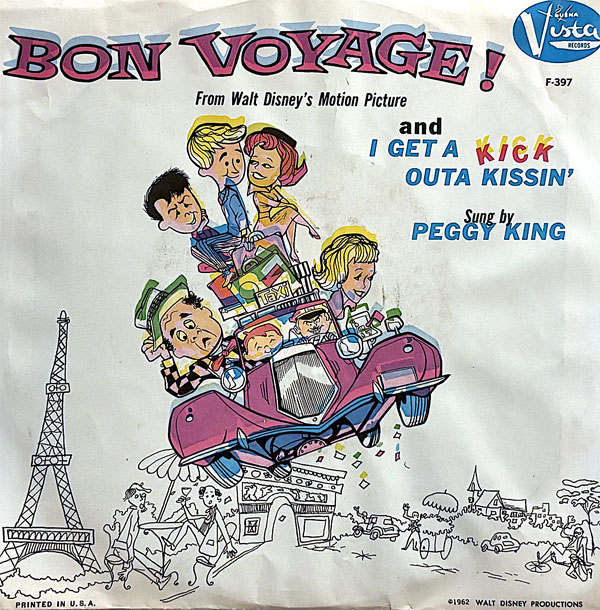
Disney’s Buena Vista label released its own version by popular big-band and early television singing star Peggy King.
Wonderful World of Color animated star Professor Ludwig Von Drake’s sole big-screen credit was the Oscar-nominated 1962 featurette, A Symposium on Popular Songs, which was detailed in this Animation Spin. Bill and X animated segments using “found objects” and paper cutouts. The cutouts took on the enchanting visage of Annette for the titles of The Misadventures of Merlin Jones in 1964. The song also appeared on Annette’s Muscle Beach Party album.
Emil and the Detectives (1964), one of Disney’s overseas productions, may be little known today, but when it was premiering on The Wonderful World of Color, Scholastic Books offered it in my elementary school, and I read it in anticipation. Walter Slezak narrated the Disneyland story album. The DePatie-Freleng-esque titles explained how to pronounce “Emil” to American kids.
The Adventures of Bullwhip Griffin (1967) bestowed upon Roddy McDowell the delightful lead role (a rarity except for films like Lord Love a Duck). The Shermans wrote several songs for this wild west comedy, the only Disney film in which Suzanne Pleshette sings (and it’s included on the story album). Among the highlights of this film are the “titles and things,” various animated special effects and amusing title cards, courtesy of Ward Kimball: These “things” anticipate Kimball’s work on the Oscar-winning featurette It’s Tough to Be a Bird (1969) and General Motors’ “World of Motion” attraction at the original Epcot park (now “Test Track”).
It’s Tough to Be a Bird was a tough act to follow, but The Computer Wore Tennis Shoes managed to be followed by two sequels and teen stardom for Kurt Russell (and an on-screen role by Frank Welker as a Medfield College student. Disney background designer and matte painter Alan Maley did the animated graphics to start the show. The song was written by Bruce Belland of The Four Freshman, and Disney composer Robert F. Brunner, whose numerous Disney scores are seriously under-released.
The soundtrack of the theme song was released as a single, backed with Annette’s “Merlin Jones” song.
If you’ve seen the TV series Breaking Bad, take a look at 1971’s The Million Dollar Duck and marvel at the similarities. Dean Jones plays a disillusioned scientist whose early promise has not been realized. He has difficulty relating to his son, who does not respect him. He discovers a way to make a fortune, which his lawyer advises to hide from the IRS, even though a federal agent lives right next door. Just saying. The treatment was written by “Hazel” creator Ted Key. Ward Kimball and Ted Berman (The Fox and the Hound) provided the titles.
Fred MacMurray’s last film for the Disney studio was 1973’s Charley and the Angel, a fantasy-dramedy with Harry Morgan, Kurt Russell and Cloris Leachman. Like so many Disney films of this era, it was brimming with character actors, from George O’Hanlon and Susan Tolsky to Barbara Nichols and Bob Hastings. The titles by John L. Jensen (Winnie the Pooh and Tigger Too, Die Hard) and Jack Boyd (Mary Poppins, Sleeping Beauty) were very simple, reminiscent of the golden age film titles with small drawings that accented the text. Sadly, the memorable Andrews Sisters tribute, “Livin’ One Day at a Time” by Shane Tatum and Ed Scott, was never released on vinyl.
The Strongest Man in the World (1975) had some of the coolest titles in the Disney gallery of such art. Not only were they cleverly hand-drawn, but Bob Brunner’s super groovy “Love American Style”-type music should have found its way to vinyl. The wonderful Eve Arden graced this, the last in the Kurt Russell/Medfield trilogy. Art Stevens (Snow White and he Seven Dwarfs, Peter Pan) and Guy Deel (The Lion King) did the art.
Perhaps the most British of all UK-filmed features, the campy farce One of Our Dinosaurs is Missing (1975), stars Helen Hayes, Peter Ustinov and various comedy veterans who would be instantly recognizable to English audiences, like Joan Sims and Derek Nimmo, as well as Jon Pertwee (Doctor Who) and Roy Kinnear (Veruca Salt’s doormat dad). The catchy score is by the legendary Ron Goodwin (Those Magnificent Men in Their Flying Machines) and it was written and produced by none other than Poppins and Love Bug scribe Bill Walsh and director Robert Stevenson. The titles were created by Ted Berman (co-director, The Fox and The Hound).
Disney was leaning heavily into situation comedies with veteran TV actors in the late seventies. No Deposit, No Return (1976) starring Darren McGavin (The Night Stalker), Don Knotts (during his five-year success streak at Disney), and Barbara Feldon (Get Smart). The titles were by Art Stevens and Terry Walsh (Cats Don’t Dance)
High-concept comedies had become such a staple of the studio by 1976 that the big Christmas release was The Shaggy D.A., a sequel to the 1959 hit (yes, I have the View-Master packet for this and several others in this article). Dean Jones performs the title song in a “Music Man” patter style. Titles by Guy Deel, Stan Green (Who Framed Roger Rabbit) and Ed Garbert (The Black Cauldron). Anyone have a photo taken with the Shaggy D.A. costumed character that appeared at Disney theme parks?
Freaky Friday starred Jodie Foster (a month after the wide release of Taxi Driver) and Barbara Harris, a major Broadway star. Co-founder or Chicago’s Second City improv group and a real coup for Disney films, she also sings the title song with an uncredited vocalist. It was written by Al Kasha and Joel Hirchshorn, Oscar winners for “The Morning After” from The Poseidon Adventure and soon-to-be nominees for “Candle on the Water” in Pete’s Dragon. Titles by Art Stevens and John L. Jensen.
Merrill Osmond of The Osmond Brothers recorded “I’d Like to Be You for a Day” for Buena Vista Records.
Barbara Harris returned to the Disney lot for The North Avenue Irregulars (1979). The critics were largely favorable about this film, especially its seasoned cast of actors led by Edward Herrmann and Susan Clark. John L. Jensen and Art Stevens did the title sequence.
Animated titles were less frequent by the eighties and nineties. The ones for Honey, I Shrunk the Kids (1989) were a nostalgic throwback to heyday of animated titles (which Pixar also did very well). A lot of this sort of thing was now being done outside the Disney Studios, in this case by uncredited Mark M. Pompian (Stargate) and artist Bruce Schindler at Kroyer Studios. The theme is a lively tribute to Raymond Scott’s “Powerhouse” by James Horner, whose score was released on CD by Intrada ten years later.
These Electric Company-like titles for Honey, I Blew Up the Kid (1992) were designed by Penelope Gottlieb, who worked on several Disney and Touchstone films of the era, and produced by Bob Kurtz (Kurtz and Friends). Bruce Broughton’s score, which was adapted for the Epcot “Honey I Shrunk the Audience” attraction, was released the same year by Intrada.
How about this for a bizarre twist of fate? Several Disney live-action theatrical features of the nineties included animated main titles but were based on non-Disney cartoons. 1997’s George of the Jungle starred Brendan Fraser, not watching out for that tree. The titles were set to a nice rendition of Stan Worth and Sheldon Allman’s TV theme. However, the Kurtz and Friends-produced titles did not depict the Jay Ward character image, undoubtedly due to copyright. Walt Disney Records released a CD with the title song, a few score tracks by Marc Shaiman, and a collection of pop tunes.
Imagine what UPA people like John Hubley and Steve Bosustow would have thought when their most famous creation was presented in cartoon form in the titles of a live action “re-imagining,” all from the Disney studio? The first three minutes of 1997’s Mr. Magoo features the cartoon image of Magoo, produced by Yowza! Animation in Ontario. Magoo is voiced by Greg Burson. The live-action feature with Leslie Neilsen that followed did not fare well critically or financially. Michael Tavera’s score was released as a promo CD by his talent agency.
By 1999, CG had already come to stay as the 2000s approached. A CG animated main title was apropos for Inspector Gadget in this live-action version. Created by San Francisco designer Carla Swanson, the sequence does not show the copyrighted character as he appeared in the cartoon series, just his hands. Matthew Broderick played the lead in this film, French Stewart (Third Rock from the Sun) took the role for the home video follow-up. At any rate, the signature theme music credited to Shuki Levy and Haim Saban is included.