
Through the years, a number of cartoon short subjects have provided romantic stories that pair as perfectly with Valentine’s Day as roses and a heart-shaped box of chocolates. Previous Valentine’s Day articles have looked back at TV specials in 2023 and 2024 . Here, what follows are just three of many cartoon shorts, from several studios during the Golden Age o Hollywood, that could be essential viewing on February 14th.
Let Me Call You Sweetheart (1932) – The Fleischer Studio
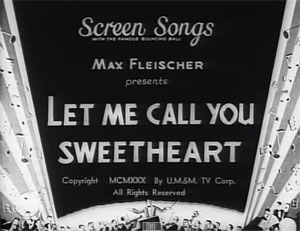 This “Screen Songs” short, directed by Dave Fleischer, featured none other than Ethel Merman, who appears in a live-action opening.
The short then transitions to animation, with Betty Boop (Mae Questel) dressed as a housekeeper, pushing a baby in a stroller. She stops with the carriage to read a book, and Bimbo (Billy Murray), the police officer in the park, is attracted to Betty and comes over to talk with her, but she snubs him. The bench then comes to life and invites Bimbo to sit down next to Betty, but she is still not interested. Bimbo then pulls Betty close and kicks the stroller, with the baby inside of it, away.
The carriage rolls down the hill and into the water, where the baby begins rowing it, while a fish tells the baby to “stroke.” The baby then gets out of the water and begins walking through the park, stealing a hot dog from a vendor and playing with the water out of a fountain. The water winds up spraying the statue of Cupid atop the fountain, and Cupid shoots his arrow back toward Betty and Bimbo, who are now more amorous than they were before. The arrow pierces the two hearts above their head.
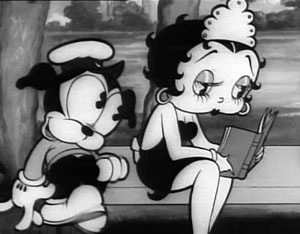 In the next scene, it’s night and dark in the park. The baby shines a light on Bimbo and Betty, and as the light goes out, Bimbo says, “Let me call you sweetheart, Betty.”
Ethel Merman then returns in a live-action sequence to sing the title song, inviting the audience to sing along and follow the bouncing ball over the lyrics.
The short then returns to animation for an offbeat sequence where a bird lays three eggs. One of the eggs sprouts arms, cracking the two other eggs open and then cracking itself open. After which, three yolks transform into three chicks.
A cat comes along and begins singing “Let Me Call You Sweetheart,” in Ethel Merman’s voice, and then begins chasing the chicks. We return to Ethel Merman singing the last line of “Let Me Call You Sweetheart” as the short ends.
This short is filled with Fleischer-style gags throughout (the baby carriage’s wheels turn into feet and begin walking when Betty decides to stop and powder her nose). As always with the studio’s work the animation is all very inventive. “Let Me Call You Sweetheart” makes for less romantic and more surrealistic Valentine’s Day viewing.
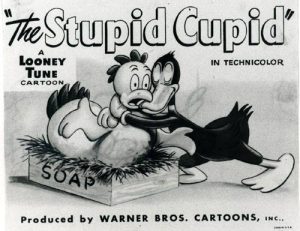 The Stupid Cupid (1944) – Warner Bros.
This short opens with Elmer Fudd (voiced by Frank Graham), as Cupid, frolicking and flying through a field. He takes one of his suction-cupped arrows, aims at and hits a bird, who not only flies off and finds his significant other, but also builds a house in a nest within seconds.
Elmer Cupid then does the same for a horse, who soars off in a blur and kisses a female horse, then neighs and flips around in love.
Elmer Cupid even has the power to make peace, as he shoots an arrow at a feuding dog and cat. After being hit, the dog begins talking like Charles Boyer, saying “I love you,” over and over. The cat replies, “Now, I’ve seen everything,” and, shockingly, pulls out a pistol and shoots themselves repeatedly as all of their nine lives disappear.
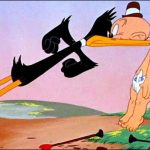
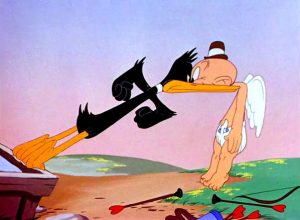 Elmer Cupid then attempts to shoot and arrow at Daffy Duck (Mel Blanc) as he bathes in a barnyard trough. Daffy rebukes, saying that Cupid hit him last year and shows an album that features a photo of a shotgun wedding and lots of pictures of kids. He tells Elmer Cupid to “take a powder” and fires Cupid off with his own bow and arrow.
The undaunted Elmer Cupid returns with a gigantic bow and arrow and fires it at Daffy, causing the duck to become amorous toward a chicken, chasing her through the barnyard, until her husband, a rooster, confronts him.
Daffy asks for forgiveness and blames “that stupid Cupid.” He is forgiven and begins walking away, until Elmer Cupid hits him again, and Daffy soars back into the barn and begins kissing the chicken again, coming in between her and the rooster, as the short ends.
Directed by Frank Tashlin, who would go on to helm such live-action films as Will Success Spoil Rock Hunter (1957), and written by Warren Foster, a king of cartoon gags, Stupid Cupid is filled with fast paced humor that whirs by as fast as the characters themselves (Daffy’s photos of his kids include one child with two heads and an egg that hasn’t hatched, yet). It’s also interesting and fun to see Elmer here take a turn as the antagonist. Stupid Cupid is all-out fun, so indicative of this Looney Tunes era that it makes for an outlandish Valentine’s Day alternative.
Johnnie Fedora and Alice Bluebonnet (1946) – Disney
Originally featured in Make Mine Music (1946) and later released as a short, this is “A Love Story Sung by The Andrews Sisters.”
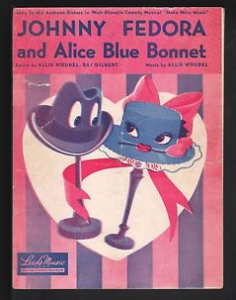 The two title characters, anthropomorphized hats, meet in the window of a department store. Johnnie “would serenade Alice of a beautiful palace, of a beautiful hatbox for two.”
But Alice is purchased from the window, leaving Johnnie alone and in despair. Johnnie is eventually purchased, and while out atop a man’s head, he searches for Alice, who sees him and calls out one day amidst a crowd.
Johnnie catches the wind and flies after Alice but gets lost in the breeze and is tossed around the city streets. Now, a disheveled hat, he is picked up by a disheveled gentleman, and Johnnie soon finds himself in a bar brawl.
He’s left by the trash and once again blows around the wintry city streets. Still yearning for Alice, he returns to the department store window. From here, he’s about to be washed down a sewer, when an iceman rescues him, cuts holes in his brim and places him atop the horse that pulls the ice truck…and Alice is on the horse right next to him, in the short’s happy ending.
Directed by Jack Kinney, Johnnie Fedora and Alice Bluebonnet is filled with lovely, full animation, as well as well-crafted backgrounds of a turn-of-the-last-century setting in New York City.
Also, animators, such as Cliff Norberg and John Sibley, were able to craft Johnnie and Alice as full personalities (not easy to do with headwear).
Johnnie Fedora and Alice Bluebonnet also provides a nice message, as The Andrews Sisters sing at the conclusion:
“You Johnnie Fedoras, you Alice Bluebonnets
Whenever you find yourself blue
You’ll find it’s June in December, if you’ll just remember
That true love will come smiling through.”
And so there is an eclectic trio of classic cartoon shorts to pair with your Valentine’s Day. Of course, there are so many more “love”-ly shorts out there – feel free to mention some of your favorites in the comments.