
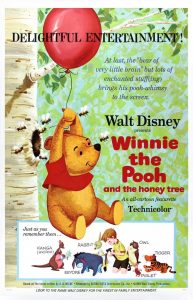
 It was in 1961 that Walt Disney secured the film rights to author A.A. Milne’s Winnie the Pooh stories, and there was a different vision for bringing these to the screen.
Winnie the Pooh and the “Hundred Acre Wood” residents first appeared in the 1924 book, When We Were Young, written by A.A. Milne and illustrated by E.H. Shepard. They were loved by many, including Walt’s daughters, Diane and Sharon, as Walt’s wife, Lillian, would read the stories to the girls.
Initially, there were plans for a feature-length animated film, based on Milne’s work, at the Disney Studio. However, Walt changed these plans to a “featurette.”
Jim Fanning, Disney historian and one of the authors of the book, Winnie the Pooh: The Hundred Acre Wood Comic Collection, Vol 1, provides some background behind this: “Perhaps he was leery after the similarly episodic Alice in Wonderland presented such problems in that feature, which was also a box office disappointment. The main reason, however, is not so much that the stories couldn’t sustain a feature, but that Walt was concerned that Winnie the Pooh was not well known enough to American audiences to bring in the sizeable audiences that a feature would require. He felt he had to gradually introduce the characters to the US market.”
This was done with the featurette Winnie the Pooh and the Honey Tree, celebrating its 60th anniversary this month.
Directed by Wolfgang Reitherman, the short film opens with an introduction as we see what appears to be Christopher Robin’s bedroom (in live-action). From here, we are introduced, through song, to the residents of The Hundred Acre Wood, as pages turn in a book.
We meet Pooh Bear, who is hungry for some honey, but his cupboard is empty. He sees a bee flying into a tree, and knows that means there is honey to be found. Borrowing a balloon from Christopher Robin, he covers himself in mud and disguises himself as a “little black rain cloud,” attempting to float up to the beehive inside the tree.
However, the bees attack, flying after both Pooh and Christopher Robin, chasing them away.
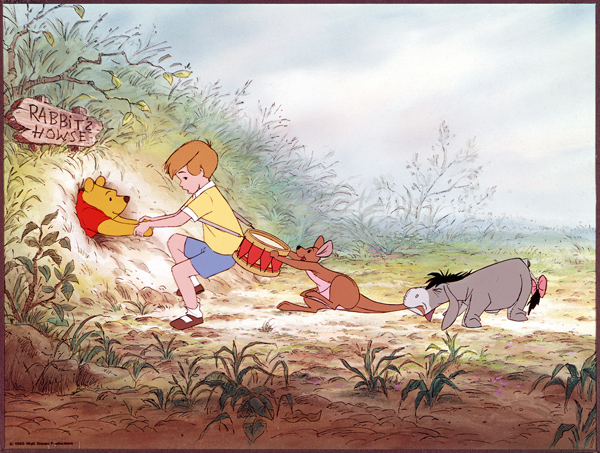
Undaunted in his search for honey, Pooh pays a visit to his friend Rabbit, who has honey on hand, and Pooh Bear eats the whole jar, which causes him to gain so much weight in a short period of time that he gets himself stuck in the entrance of the home (to the dismay of the poor, nervous Rabbit).
Christopher Robin assesses the situation and notes that the only real solution is to allow Pooh to lose some weight, so that he can fit through. Rabbit tries to make the best of the condition, decorating the other half of Winnie the Pooh, inside his house, with a frame, makeshift horns, and a face.
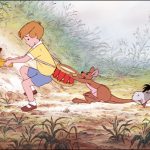
One day, Pooh Bear finally shakes loose, and Christopher Robin and the gang pull from the outside, while Rabbit pushes from inside. Winnie the Pooh pops loose, soars through the air, and lands in the beehive filled with honey high in the tree, and Pooh gladly partakes in the honey as the short ends.,
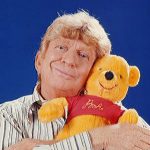 SCast as Winnie-the-Pooh was actor Sterling Holloway. When Winnie the Pooh and the Honey Tree was in production, Holloway was already a Disney voice veteran, having brought his talents to the characters of Mr. Stork in 1941’s Dumbo, Adult Flower in Bambi (1942), the Cheshire Cat in Alice in Wonderland (1953), as well as the narrator of the “Pablo the Cold Blooded” segment in The Three Caballeros (1944), the “Peter and the Wolf” section of Make Mine Music (1946) and in a number of short subjects, including Lambert the Sheepish Lion (1952) and Ben and Me (1953). He would go on to also voice Kaa the snake in The Jungle Book (1967) and Roquefort the mouse in 1970’s The Aristocats.
“I think that there are several reasons at play in the casting of Sterling Holloway as Winnie the Pooh,” says Jim. “We know that Holloway was one of Walt’s favorite voice actors, and that undoubtedly has to do with the uniqueness of the actor’s voice. I think the unusual sound of his voice tickled Walt. And there are natural things that Holloway would do, such as chuckle while delivering a line, that fit perfectly with Pooh’s personality.
“His singular-sounding voice also has a whimsical feel to it, and whimsy is what it’s all about, especially as Walt looked at it. There is a childlike quality to Sterling’s voice. And that’s perfect for Pooh. Also, there is a tremendous amount of dialogue from the first of the A.A. Milne stories that the featurette is based on. So, it was going to be very important to have a special delivery of all that dialogue.”
Winnie the Pooh and the Honey Tree also includes a “who’s who” of stellar voice actors who made contributions at Disney and other studios, including Junius Matthews as Rabbit, Barbara Luddy as Kanga, Hal Smith as Owl, Howard Morris as Gopher (he’s not in the book, ya know), Sebastian Cabot as the Narrator, and Clint Howard as Roo. Additionally, animator and story artist Ralph Wright voiced Eeyore, and the director’s son, Bruce Reitherman, voiced Christopher Robin.
Additional Disney Legends, Richard and Robert Sherman (along with producer, Salvador “Tutti” Camarata), provided the songs, which included “Up Down, Touch the Ground,” “Rumbly in My Tumbly,” “Little Black Rain Cloud,” and the classic, and oh-so-comforting “Winnie-the-Pooh” opening song.
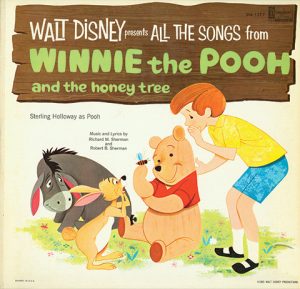 In their book, Walt’s Time From Before to Beyond, the Sherman Brothers write about their work on this first Winnie-the-Pooh short, and how they had challenges connecting with the story, until they discussed it with Tony Walton, the English-born costume designer, who was currently working on Mary Poppins.
Walton enthusiastically discussed the character with Richard and Robert for three hours, as The Brothers wrote: “He explained how he had been a chubby little boy and had felt very insecure. But Winnie the Pooh was his buddy, because Pooh was pudgy and proud of it. Pooh was probably the only character in the world who exercised to gain weight! Pooh was a wonderful, lovable friend who would never let you down or turn his back on you.
“Soon, we started to fall in love with Pooh ourselves. Our songs for Winnie the Pooh were really a love affair, thanks to A.A. Milne and Tony Walton, who loved him as a little boy.”
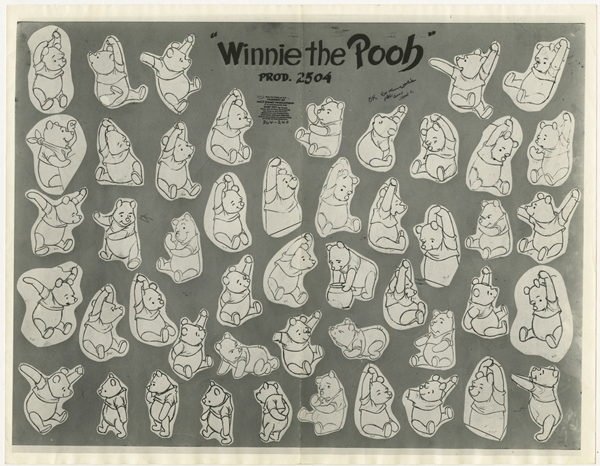
In addition to The Sherman Brothers, Winnie the Pooh and the Honey Tree features the work of several other legendary artists. “I think that part of the lasting legacy is that this is a rare showcase for the character animators who usually worked under the directing animators, that is, the Nine Old Men,” notes Jim, adding that the featurette allows us to “celebrate the great skill of these rarely acknowledged animators, veterans such as Eric Cleworth, Hal King and John Sibley, who animated most of this production.”
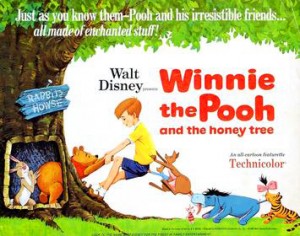 Their work can be seen in how the personalities of characters such as Winnie the Pooh and Eeyore shine through in this short film, as well as in the well-choreographed comedy in the sequences between Pooh Bear and Rabbit.
Winnie the Pooh and the Honey Tree was released on February 4, 1966, on a double bill with Disney’s live-action The Ugly Dachshund. The short was popular enough to inspire two additional featurettes,1968’s Winnie the Pooh and the Blustery Day (which won an Oscar) and Winnie the Pooh and Tigger Too (1974). All three shorts were then combined into segments for the full-length feature, The Many Adventures of Winnie the Pooh (1977).
Winnie the Pooh and the Honey Tree would also begin a long-standing relationship between A.A. Milne’s characters and Disney, that continues to this day, resulting in additional theatrical features, TV series, direct-to-video movies, theme park attractions and characters, as well as enough merchandise to fill The Hundred Acre Wood.
Sixty years later, thanks to Winnie the Pooh and the Honey Tree, this is a significant, and beloved, legacy for a “Silly Ol’ Bear.”