

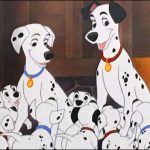
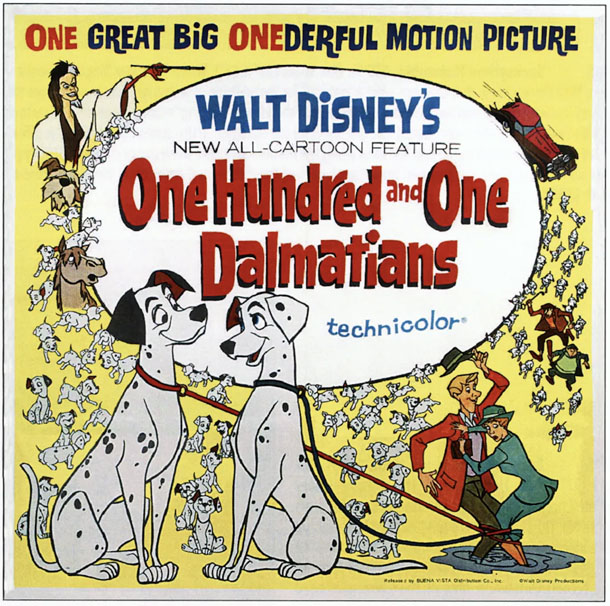
When One Hundred and One Dalmatians debuted on January 25, 1961, it introduced a much different look for a Disney animated feature.
During production, Ken Anderson, art director of One Hundred and One Dalmatians, took inspiration from Ronald Searle, a cartoonist whose work had appeared in magazines such as The New Yorker and Life. Backgrounds in the film adopted a much more contemporary style, resembling modern art, and represented a tonal shift from traditional Disney background paintings.
 This style of One Hundred and One Dalmatians, celebrating its 65th anniversary this month, was very prevalent in animation at the time and was first introduced by United Productions of America Studios. It’s one of the many unique aspects of the film that made it such a hit.
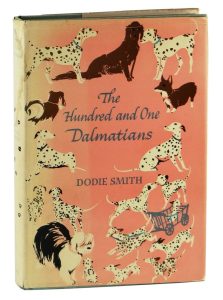
Walt Disney purchased the rights to the novel, The Hundred and One Dalmatians, by Dodie Smith, a year after the book was published in 1956. Walt gave the book to story artist Bill Peet and tasked him with writing a screenplay before any storyboarding would be done. This was a first for a Disney animated feature.
In the film, dalmatians Pongo (actor Rod Taylor) and Perdita (actresses Cate Baure and Lisa Daniels) and their “pet humans,” husband and wife Roger (Ben Wright) and Anita (Lisa Davis) Radcliffe await Perdita’s delivery of their litter of puppies, but then, Anita’s former schoolmate Cruella De Vil (Betty Lou Gerson) emerges, looking to “adopt” the puppies (with nefarious plans to make a spotted dalmatian fur coat).
Cruella hires two dim-witted henchmen, Jasper (J. Pat O’Malley) and Horace (Fred Worlock), to kidnap Pongo and Perdita’s fifteen puppies. Pongo and Perdita run away from home to find their puppies. When they arrive at Cruella’s dilapidated lair, “Hell Hall,” they see them along with a slew of other dalmatian puppies (in all, 101 to be exact).
As Pongo, Perdita, and all the puppies escape, they are pursued by Cruella, Horace, and Jasper in an exciting car chase before they make it home again, with all 101 puppies, to Roger and Anita.
One Hundred and One Dalmatians, directed by Wolfgang Reitherman, Hamilton Luske, and Clyde Geronimi, came with the daunting task of drawing and animating spots on the dalmatians (the total number of spots in the film was 6,469,952).
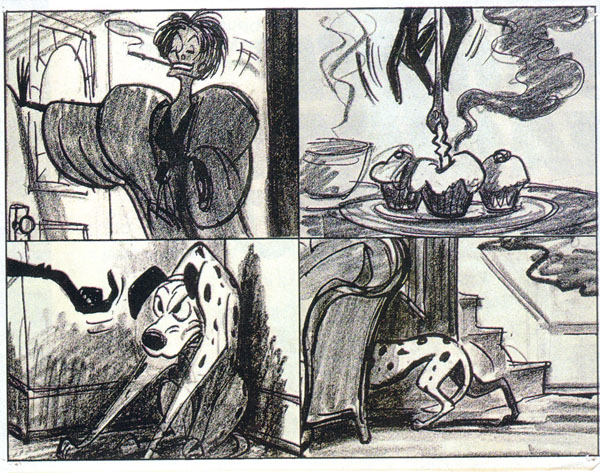
Disney artists initiated a new process called Xerography, developed by Ub Iwerks, to assist with this. The animator’s drawings were copied (Xeroxed) onto clear animation cels, which were then painted and placed over the backgrounds and photographed. This saved time and money and preserved much of the animator’s original drawings.
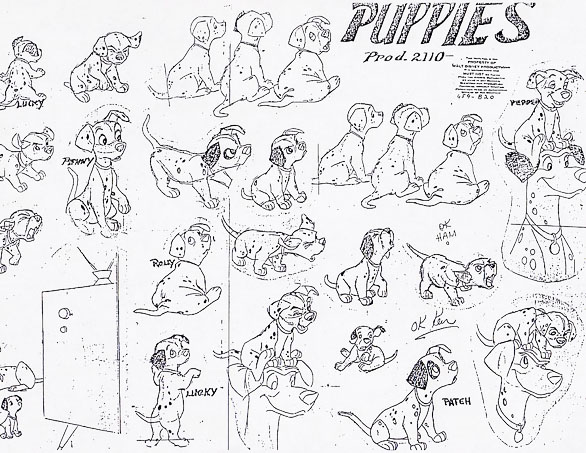
This process gave the film another very different look, with the characters taking on a “rougher, sketchier” appearance.
One Hundred and One Dalmatians also introduced the world to Cruella De Vil, brought to the screen by the immense talents of master animator Marc Davis, who had animated such other icons as Tinker Bell in 1953’s Peter Pan and Maleficent and Princess Aurora in Sleeping Beauty. Cruella served as Davis’ last animation assignment before transitioning to work on Disney’s theme parks, where he was among the first of a team that would eventually be called Imagineers. Here, he joined the creative crew that brought us It’s a Small World, the Haunted Mansion, and more.
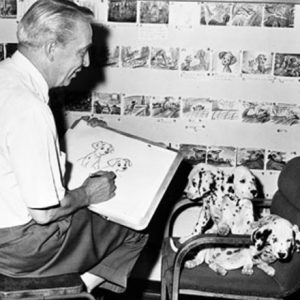
Eric Larson sketches a Dalmatian.
Thanks to this work and that of other members of Walt’s Nine Old Men, including Frank Thomas, Ollie Johnston, Milt Kahl, John Lounsbery, and Eric Larson, One Hundred and One Dalmatians was a box-office success, becoming the 20th-highest-grossing film that year.
It was remade in live action in 1996, with a script by Home Alone’s John Hughes, featuring Glenn Close as Cruella, and was also a hit, inspiring a sequel, 102 Dalmatians, in 2000.
Disney also produced a 101 Dalmatians animated TV Series that ran on ABC from 1997 to 1998. And in 2011, Oscar winner Emma Stone starred as Cruella in a live-action “origin story” for the character.
It’s all part of a long-lasting legacy and more proof why, from its style to its story to its villain, One Hundred and One Dalmatians is still seen as one of Disney’s most popular and beloved animated films, sixty-five years later.