
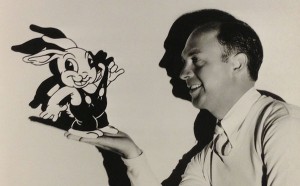
 The onset of 1938 marked several changes in the output of Walter Lantz – along with a public recognition in the cartoons of the distancing of the studio from the former influence of Carl Laemmle. Now, cartoons would begin to bear the banner, “A New Universal Cartoon”, not so much to say that the cartoon content was new, but that the studio itself was under “New” management. It made sense that when these films were distributed to television, the original titles would be shed – after all, who would believe by said time that old black and white cartoons were “new” from reading the titles? Further changes, more substantial to the cartoons themselves, were afoot – as Oswald was on his last legs, despite his lucky rabbit feet.
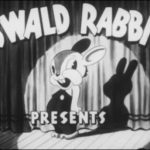
He would disappear from animated form and regular appearances in 1938, yet take the position of a figurehead in a title card (inaccurately copied for many of the TV reissues) depicting him standing motionless before a theater curtain, with prominent lettering above him reading “Oswald Rabbit Presents” – to introduce cartoons that had nothing to do with him, either one-shots or experiments in varies short-lived mini-series, as Lantz continued to probe in all directions to find a substitute series for Oswald.
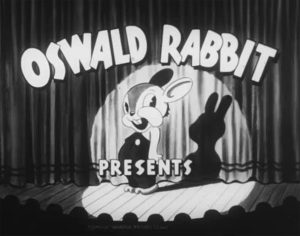 The “presenting” role was a rather late and lame imitation of the way Mickey Mouse’s name had been used to introduce Silly Symphonies, and how Columbia still, concurrently with the Lantz works, continued to place the words “Scrappy Presents” above Color Rhapsodies. It is doubtful by this time that anyone really cared if Oswald had anything to do with presenting the pictures or not, and the practice didn’t last long. Meanwhile, with Meany, Miny, and Moe having also run their course, Lantz looked for new avenues for recurring characters, relying heavily upon newly-promoted director Alex Lovy to come up with inspirations. Two of his early ideas produced a number of films, but do not appear to have gleaned much overall favor with the public, leaving no lasting impression, such that their number of episodes should probably be accounted for as merely a stopgap measure, rather than any indication of public satisfaction.
Nevertheless, they are not without their charm – a series of Mello-Dramas starring Nellie, and a character quite similar in nature to what would become a recurring product for rival Warner Brothers within a season – Baby Face Mouse, a sort of second-cousin to what Warner would release as Sniffles, with perhaps a nod to Harman-Ising’s Little Cheeser.
The Mysterious Jug (11/29/37) – Oswald and Doxie go treasure hunting in a local junkyard, and run across the goods and chattels of Mysto the Magician. They unleash a small spirit from a magic bottle. (Didn’t their mothers tell them not to mess with spirits?) The sprite is a magician himself, and brings several inanimate objects to life with a small magic wand, including a devil off a deviled ham can. The devil absconds with the wand, shrinking Oswald to his size, and for a brief moment reducing Doxie to sausages. Ozzie fights back with a bow and arrow safety pin, and the wand is eventually recovered, the sprite setting things right again. Songs: “Footloose and Fancy Free” a popular song of 1935. Recorded for Decca by the Dorsey Brothers orchestra, which at the time still had both Dorseys. Smith Ballew got it for Melotone, Perfect, et al. Angelo Ferdinando and his Great Northern Hotel Orchestra did the Bluebird version. Henry King issued a royal blue Columbia (embed below). Jack Hylton recorded an HMV version.
The Dumb Cluck (12/20/37) – Aside from a couple of shots of tennis playing between Oswald and Doxie, this film is virtually turned over to Oswald’s new supporting character, the Dumb Cluck, who is promoting an automatic fire department, consisting of himself, a semi-mechanized hook and ladder truck, and an elephant as water pumper. His dress rehearsal for Oswald generates more laughs from the rabbit than respect. When the cluck thinks he’s spotted a real fire, a downhill run to the scene turns the elephant loose on roller skates, crashing through a barn and several buildings. The pachyderm’s water blast from his trunk merely quenches a dose of bad cooking from a lady’s kitchen. The elephant somehow winds up compressed in a collision, then is inflated by the Cluck’s hooking up of a bagpipe to his trunk. The elephant takes off like a balloon, and is shot down by the Cluck from a blast of an old soldiers’ home cannon. The elephant is left deflated again, and the Cluck changes businesses, displaying the elephant as poster boy for a reducing program. Songs: Royalties were really spread around on this one – to two competing studios. “I’m Sitting High on a Hill Top” was from Fox’s Thanks a Million – a loan-out film for Dick Powell. Powell would wax the song for Decca (below). Guy Lombardo issued a Decca dance version. Jimmy Dorsey also issued a Decca version. Johnny Hamp issued a dime store version for Melotone, Perfect, et al. The Mound City Blue Blowers issued a Decca Champion version. In England, the Casani Club Orchestra directed by Charlie Kinz covered it for Rex.
Also in the score, “Cosi Cosa” was from MGM’s A Night at the Opera, originally performed by Alan Jones with the Marx Brothers. Alan Jones would ultimately issue a studio version for Victor red seal. Jimmy Ray recorded a Bluebird version, likely with Leonard Joy’s orchestra. Xavier Cugat unexpectedly got the Victor black label version. An Italian version was issued by Dino Oliveri’s Orchestra for Disco Gramophono (Victor’s Italian label). Mario Lanza would get his chops on it for a broadcast around the 1940’s.
Boy Meets Dog (possibly unreleased theatrically, circa 1938) – This cartoon was made for intended sponsorship by Ipana toothpaste, and features some unsubtle hints about brushing one’s teeth and massaging one’s gums. It features characters from “Reg’lar Fellers”, a popular comic strip of the day. One of these kids has a father who won’t let him have anything or do anything – No sundaes, no fishing, no dogs. The kid finds a cute black and white pippy, and, although knowing that Dad will not allow it, takes him home. When Dad blows his stack, the kid appears to run away from home to the land of gnomes (depicted in the wallpaper of his bedroom), and arranges to have his dad kidnapped to stand trial before the gnome court. Trial is held, and Daddy is found guilty. The prosecutor wants him to get the guillotine, but the kid, who has been disguised the whole time under a fake beard as the judge, sentences Dad to the Youth Machine. Pop finds himself in a machine that places a baby bonnet on his head, compresses him down to baby size, and attempts to force-feed hum from a baby bottle. The pressing on his lips of the rubber nipple transforms back to reality, where Pop has merely tripped on one of Junior’s things, and is being licked by the puppy. Pop seems to have seen the light, and becomes one of the “fellers”, joining the boy and his friends at the ol’ fishing hole. Songs: A whole sheaf of them, with musical direction by Nat Shilkret, one of Victor’s most prominent house leaders. This cartoon is basically a musical. None of these songs look to be hit material, but they serve a function. Topics range from a number about the old fishing hole, a gum massage anthem at school, and an extended courtroom cantata, full of impersonations of radio stars, including Fred Allen, Joe Penner, and Tommy Mack.
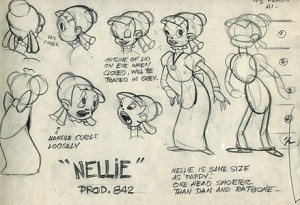 Nellie, the Sewing Machine Girl (4/12/38) – Among the earliest films to call itself “A New Universal Cartoon” and bearing the “Oswald Rabbit Presents” banner. It seemed that most cartoon studios were busy during the late thirties turning out spoofs of melodramas – or at least what they thought were the tropes of melodramas. Between Warner Brothers, Max Fleischer, Van Beiren, Terrytoons, Columbia, and Walter Lantz, many cartoons were produced based on the menage a trois of innocent damsel, dauntless hero, and despicable villain. Many such films wind up at the old saw mill, with its conveyor belts and spinning saw blade. (Apparently, the buzz saw trope dates back to an 1890 play, but with the difference that the hero, not the heroine, was there the one heading for the saw. By at least 1914, the heroine was now the one being conveyed to the spinning blade of doom, with the hero making last-minute rescue in time to save her coiffure.) This cartoon, the first of a mini-series directed by Alex Lovy, has everything you’d expect. The villain captures Nell while she is away from her sewing machine, takes her to the buzz saw, and informs the audience that for his final trick, he will saw a lady in half. The villain ultimately winds up chased by the detached saw. An original song about Nellie is presented in 1890’s style, describing her work as a seamstress. There were probably thousands of Nellies working in sweat shops of the day, such as the Triangle Shirt Waist factory
Happy Scouts (6/20/38) – In what appears to be his last black and white starring role, Oswald, considerably re-designed to resemble what would become his comic strip design for Walter Lantz New Funnies, is leading a troop of scouts through the woods, consisting of the duck quintuplets. Most of the action is being carried by Fooey, as per usual. In a gag predicting Tex Avery, Fooey walks right out of the painted background by taking the wrong path through the woods. Fooey has the usual problems in getting a fire going and roasting a wiener. The rest of the scouts gather around half of a tree they are using for a dinner table, complete with tablecloth, while Fooey bouts with a stubborn fish. Oswald eventually leads the troops back home, while Fooey gets stuck by his neck in the iris out. Song: “Be Prepared”, presumably something by Frank Churchill, Oswald’s marching song based on the boy scout motto.
Barnyard Romeo (8/1/38) – A duck who sounds like Fannie Brice (and who seems to be named Fanny) is in love with a turkey she calls “Cluckie”. She meets him for a date in the park, gobbling down stray popcorn he tosses her from a sack (and then the whole sack all at once by mistake). But Cluckie has an eye for other ladies, and his head is turned by a strutting female peacock (I thought peahens had no tail display, but this one does – in fact, her animation is all too familiar, later recolored and reused in part for the wind-up time bomb in Woody Woodecker’s debut, “Knock Knock”.) Cluckie turns his attentions to the new, Katherine Hepburn-voiced female, while Fanny tries to compete by placing a cactus plant as her plume of distinction on her tail. Cluckie distances himself from the display, claiming he’s never seen her before. But Fanny figures that the peacock may be as fickle as her boyfriend, and impersonates a guitar-strumming gaucho, causing the peacock to dump Cluckie. When Cluckie leaves dejected. Fanny smashes her guitar over the peacock’s head to teach her a lesson. Fanny and Cluckie make up, and Cluckie proposes. A year later, Cluckie slaves over a washtub, with a half-dozen chicks to attend to. Borrowing an ending from Warner Brothers, one of the chicks toys with a feather duster on her tail, playing she’s a peacock, and gets a conk on the head from Mama. Songs: A parody of Fanny Brice’s hit, “My Man”, by the same title but with a completely different melody and lyric, and a Gaucho song whose title cannot be determined, both originals.
Voodoo In Harlem (6/18/28) – A plotless musicale, taking place in the wee small hours within the Lantz animation studio, combining live action (at least in photographic stills) with animation, as a singing horde of cannibal natives materializes from a blob of spilled ink on a fallen sheet of drawing paper, to cavort everywhere within a room full of drawing tables and art supplies. As morning breaks, they retreat to the ink blob, just as a cleaning lady enters to sweep up the mess of papers strewn around the studio. Seeing no purpose for the paper with the ink blob, she, drops all the drawing paper into an incinerator, and the camera follows the wisps of smoke rising from its chimney into the sky, for the fade out. Song: “Voodoo In Harlem”, a catchy minor-key original with a bit of a “Jungle Band” beat. Perhaps this one might have had a chance as a commercial single, had the song been properly promoted.
• If anyone is aware of this cartoon’s availability online – let us know!
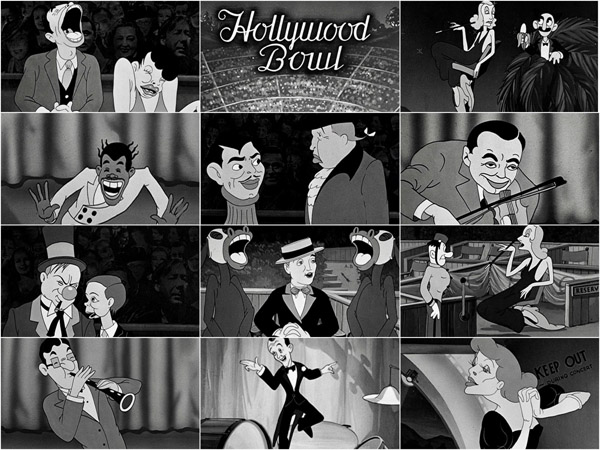
Hollywood Bowl (10/5/38) – A star-studded night at the Hollywood Bowl – though the stars are in the seats, not the sky. Loads of personalities attend the evening concert. Hugh Herbert plays stage manager. Greta Garbo has her seat elevated to tree-top height to be “alone”, only to find Groucho Marz nested in a nearby tree, offering her a banana. Charlie McCarthy exchanges wise cracks with a rather skinny-looking W.C. Fields. Charles Laughton declares Clark Gable’s occupation of his seat “mutiny”. Bing watches from a box with two of his slow horses. Joe E. Brown and Marha Raye exchange howls. Then comes the featured conductor – the inevitable Leopold, preparing his conducting fingers in an electric finger-wave machine. With the added electricity, he conducts without baton a curious performance on a darkened stage, with a box-load of white gloves taking the stage to operate the instruments without human hands, at Leopold’s command. Several old classics are woven into the score, one of them (at least nominally on the sheet music) being presented as Schubert’s Unfinished Symphony. However, as Leopold reaches the last page of the music, the charted score abruptly ends, with a handwritten inscription below reading, “Gone on relief. Franz.” Disgusted at having nothing more to do, Leopold leaves the stage. The Hollywood stars decide this is no way to end the evening’s festivities, and improvise their own wrap-up to the music, in an original number entitled “Swing That Symphony”, with lyric belted out by Martha Raye and Cab Calloway, a piano assist by Fats Waller, clarinet by Benny Goodman, saxophone from Rudy Vallee, Bob Burns playing his “bazooka”, and tap-dancing on drums by Fred Astaire (homage to a number from the recent picture. “A Damsel In Distress”).
NEXT: More from 1938 and ‘39.