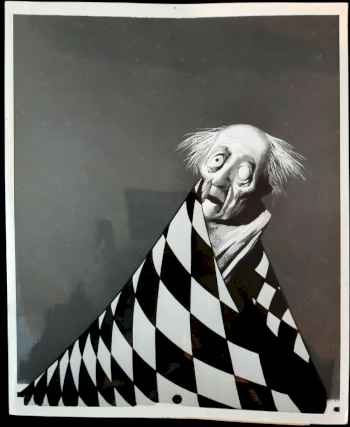


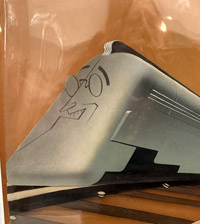
One of Julian’s incredible backgrounds from UPA’s “Tell-Tale Heart” (1953)
Background painters do not attract as much attention in the classic cartoon era as some of their counterparts, such as animators, directors, or voice artists. A handful, such as Maurice Noble, Eyvind Earle, and Tyrus Wong, have attained fame, but one of the most unsung and influential background artists in history was Paul Julian.
From “Hell-Bent For Election”
Julian joined the Schelinger studio in 1939. He spent two years as Chuck Jones’ background painter before joining United Productions of America in 1941, where he remained until 1945 (Julian would spend much of his career switching between the two studios).
During WWII, Julian served in the First Motion Picture Unit, where he worked on several Private SNAFU movies and other war-related projects. Here he met several founders of a fledgling enterprise, Industrial Films (later United Films), including Steve Bosustow. Julian served on a crew under Chuck Jones for the political film Hell-Bent for Election (1944) in support of Franklin Roosevelt. United morphed into United Productions of America, but Julian returned to Warner Bros. in 1945.
Paul Julian reached a peak with Warner from 1945 to 1951. Assigned to Friz Freleng’s production unit, he produced colorful, emphatic background art for many of the Looney Tunes’ outstanding shorts. Some of his notable work includes Back Alley Oproar (1948), Bad Ol’ Putty Tat (1949), and Buccaneer Bunny (1948). In Bad Ol’Putty Tat, an examination of Julian’s work reveals striking use of perspective and canted angles. When the cartoon switches to Granny’s apartment, Julian brings vibrant color to his simplified backgrounds. These talents would serve him well in the next phase of his career. But before departing again for UPA in 1951, Julian would add another hallowed contribution to Looney Tunes history.
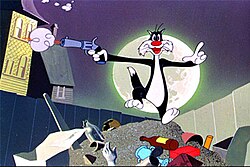
“Back Alley Oproar”
Julian recorded the sound. Speeded up, it became the Road Runner’s voice for the initial cartoon Fast and Furry-ous, and remained that voice for decades, long after Julian departed Warner.
Back at UPA, Julian became a favorite of Producer/Director John Hubley and teamed with him for several well-regarded cartoon shorts. Perhaps the most famous was Hubley’s 1951 masterpiece, Rooty Toot Toot. Not only did Julian tie color to mood, but he also created some of the background work with a craggy, pitted gelatin roller to produce strong backgrounds mirroring the sordid action on the screen.
 The next Hubley-Julian collaboration was The Four Poster (1952), a four-segment film detailing the course of a marriage. This film founded an entire artistic movement in Yugoslavia, the Zagreb School of animation, under the early direction of Dusan Vukotic.
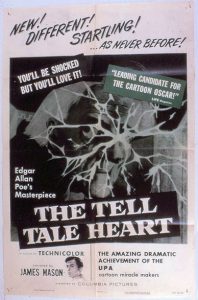
Working with Director Ted Parmalee, Julian produced the visual design and color styling for em>The Tell-Tale Heart in 1953. This unique short, based on Edgar Allen Poe’s short story, featured elements Julian was already proficient in. His eye-catching, angular, tilted designs, creative use of perspective, and stark lines created a horror classic (Julian’s daughter related that her father always had a dark, creepy side. Nowhere is this seen more emphatically than in this film).
When UPA came under suspicion for Communist activity during the infamous Red Scare, Julian was among the accused but cleared after an investigation. In 1964, after working on Mr. Magoo cartoons, Julian left UPA. Julian also worked with non-UPA producer Les Goldman to design em>The Hangman (1964), winner of 15 international film festival awards.
Julian made his way to Hanna-Barbera, where he worked on design for many Saturday Morning shows, including The Herculoids (1966) and two of their feature films. In 1980, Julian was awarded the Winsor McCay Lifetime Achievement Award. After a brief stint with Ruby-Spears, He returned to Hanna-Barbera and remained with them until 1991.
Paul Julian never actually retired. He produced art until he died in 1995 from pneumonia following a heart attack. Today, background art is designed and colored by computers; Paul Julian was a unique artist who did his most outstanding work by hand and deserves appreciation as perhaps the most prestigious background artist of his time.
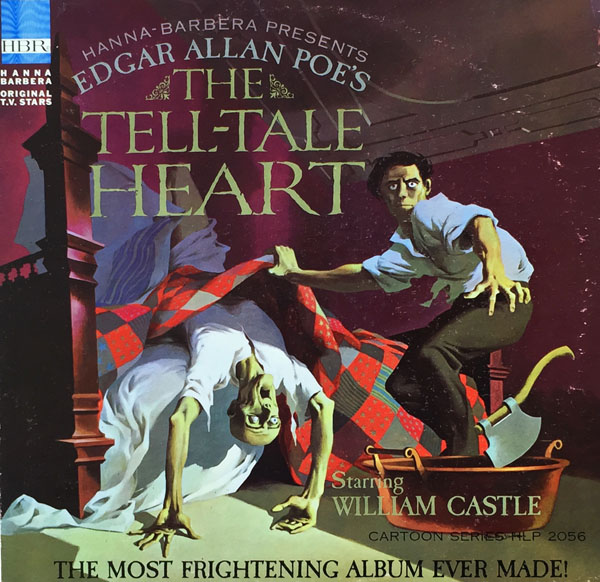
Julian returned to Poe’s “The Tell-Tale Heart” for Hanna Barbera Records. Click to read Greg Ehrbar’s post on this record.