
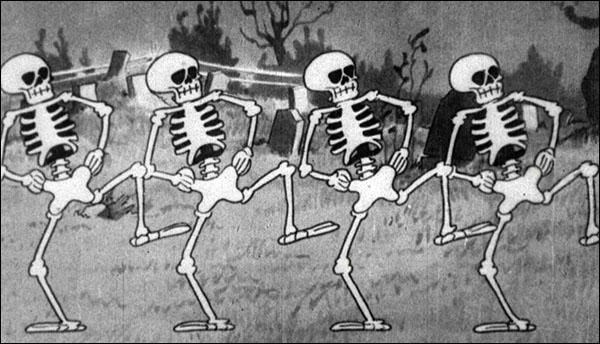
The Skeleton Dance was a monumental achievement in the history of animated cartoons. It was the first Silly Symphony, a cartoon that was a proposal for a “musical novelty” that combined music and animation. The Silly Symphonies became a testing ground for innovations in animated cartoons. The Skeleton Dance also sparked interest in animation among many. Steamboat Willie may have been the cartoon that made Walt Disney into a leading figure in the animation industry, but The Skeleton Dance equally impressed many.
J.B. Kaufman and Russell Merritt’s book on the Silly Symphonies states that the film’s first premiere was at the Carthay Circle with Murnau’s Four Devils on June 10, 1929. I’m not going to go in depth on the history of the film, the late Jim Korkis already did that here and here. Instead, I am going to focus on the reactions by both audiences and notable individuals to the film.
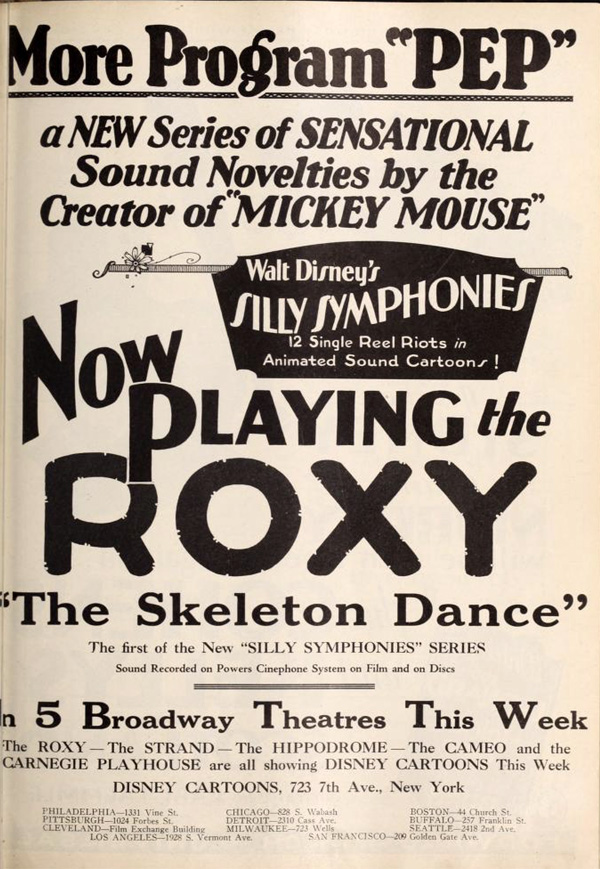
The following photo below is what The Roxy Theatre had to say about the film (click to enlarge):
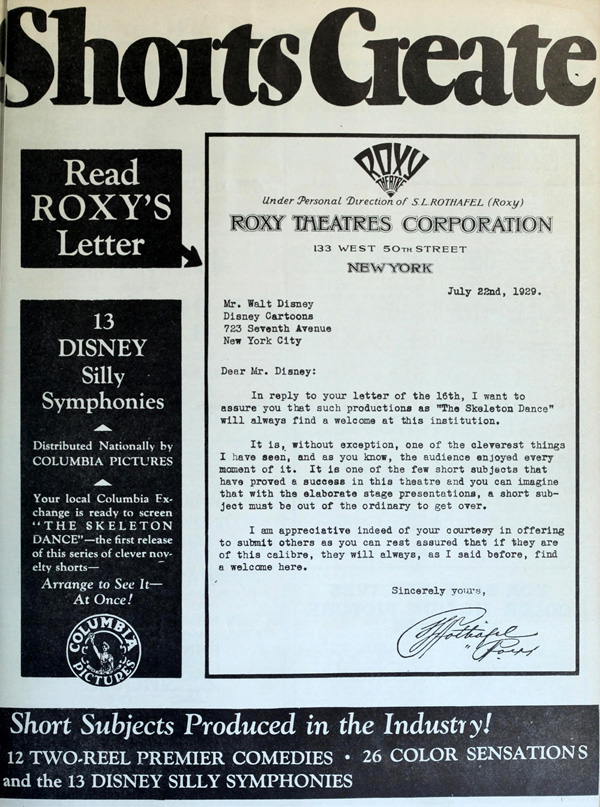
The film returned to The Roxy, which Exhibitors World Herald (misremembering Ub Iwerks’s name) reported saying:
“Congratulations are due to the Walt Disney contingent, whose “Skeleton Dance,” the first of a new series of Silly Symphonies, played at the Roxy last week and is the only picture of any variety to have a return engagement at that house. Those who want to see perfection in the gentle art of timing are advised to visit the Roxy during the week of August 3, the time of its next engagement. There is no plot to “The Skeleton Dance.” It is just a marvelous nightmare come to life and presented for your appreciation on the screen. As far as we can remember, it was drawn by a chap called Ubweriks, who might have been suffering from artistic D.T.’s when he made it.
It got as much applause as anything else on the Roxy program.”
\
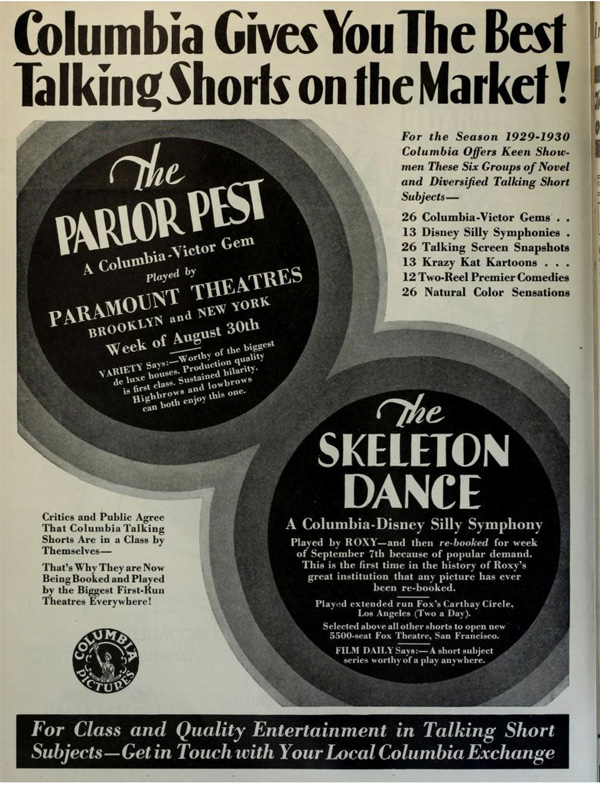
The Exhibitor’s World-Herald also said on September 28:
“If the 13 Disney Silly Symphonies scheduled for release by Columbia, maintain the record established by the first, which is entitled “The Skeleton Dance,” then the series will shatter all achievements in both short and feature length productions. The first played at the Roxy and made such a hit that it was re-booked. During the second engagement, the Roxy featured The Skeleton Dance on the marquee. Never before has the Roxy ever re-booked any production whether short or feature length.”
One person who saw The Skelton Dance at the Roxy was a young Joe Barbera. It would be the film that would make him want to enter the animation industry. Regarding the film Barbera said: “I saw it about seventy miles from the screen, but the impact on me was tremendous, nevertheless. I saw these skeletons dancing in a row and in unison, and I asked myself: How do you do that? How do you make that happen?” (Korkis)
The Skeleton Dance impressed many notable individuals. Ray Bradbury said in the book Bradbury Speaks:
“It was a five-minute lighting bolt that knocked the soul out of my eight-year-old body and vacuumed it back in, bright, clean, refurbished, hyperventilated, new. I loitered all day in the Genesee Theatre just to see that incredible five minutes of drawn terror and delight reinvent itself on the vast screen. Those skeleton acrobats, catapulting their bones about a graveyard and bounding out of tombs and shoving their skulls at a special boy in the front row center, caused him to sit through two performances of some dumb Adolphe Menjou let’s kiss again and cause a run on disgusted boys bolting back and forth to the men’s room and drinking more pop to make more pee. In the middle of this racetrack routine, having seen the skeletons perambulate in syncopation for the third time, my father appeared and dragged me babbling home to a cool reception and a cool dinner.”
Art Babbitt was also impressed and said (in The Comics Journal, 1988):
“My career in animation did not begin at Disney’s. I started animating, very badly, in May of 1924. I did medical films, silent commercials for theaters, and so on. Very simple animation. Then when sound came in I worked with Paul Terry, and I was with him until the spring of 1932. In ’32 1 saw a Disney cartoon, “The Skeleton Dance,” and I knew that was the place where I wanted to work.”
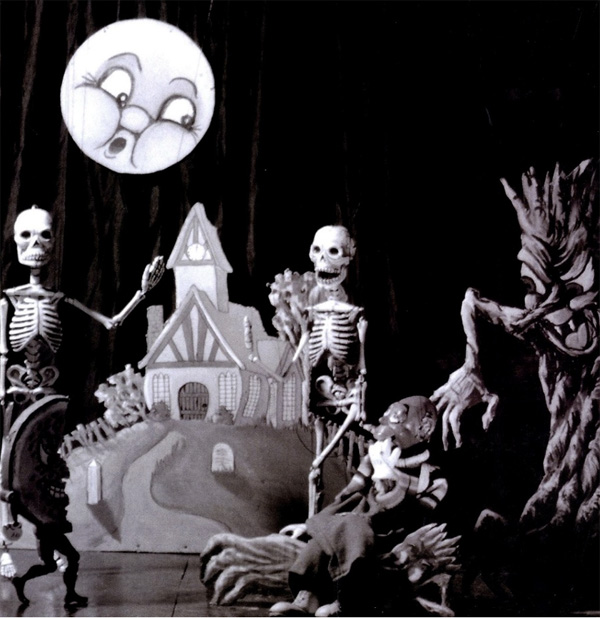
A young Ray Harryhausen was also taken by the film and made puppets of the characters, as seen in this one he made in 1939. He was fascinated by how skeletons could fly apart. Because of this, he made these puppets able to do this on stage.