

Beyond the war, the 1940‘s were an era of continuing change. One new fad was the advent of the superhero comic, with the meteoric rise in popularity of Superman, the man of steel, and later Batman, Captain Marvel, and many others. In at least one instance below, this would provide yet another new goal to reach for a man who was already pretty super to begin with, but not necessarily invincible. Another rising meteor was the star-status of the newest in the radio crooner craze – the overpowering sex-appeal of young Frank Sinatra. This persona would become a staple for caricature by virtually every cartoon studio – but Warner and MGM possibly said it best, with Disney and Paramount runners-up, in four episodes discussed herein where characters attempt to modernize with the times by adapting to the power of “the voice” over women. These and other bows to etiquette, jive culture, and the pure art of women-chasing, round out our survey for the week below.
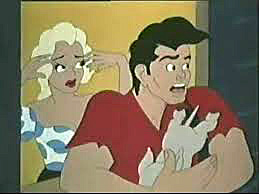 Amoozin’ But Confoozin’ (Screen Gems/Columbia, L’il Abner, 3/3/44 – Sid Marcus, dir.) – In his animation debut, L’il Abner just can’t tolerate his environment any longer. Dogpatch is a non-stop cycle of country dancing, feuds (as two arguing rivals stare down the barrels of their guns, believing them to be not working, and off-screen blow their brains out), and womenfolk (like Mammy Yokum) doing all the work while the men (like Pappy Yokum) snooze all day and get waited on. Abner wishes Dogpatch could offer life like the city folk live in a book entitled “Society and Other People”. And so, he sets off for a one-week jaunt to the city to obtain culture for Dogpatch, traveling by means of a mail sack picked up by a train passing the local station.
Come Tuesday, the train returns, bearing Abner in a cattle car. Anticipating his arrival, all of Dogpatch spruces itself up to receive Abner’s gift of culture. One citizen polishes his bare feet with shoe polish. Another trues to shave off his dense whiskers, only to have them grow in again as fast as he can cut. Everyone meets Abner at the station, who announces that he has brought back the secret to the city folks’ cultured ways. He emerges from the train car, displaying what the townsfolk speculate might be a fishing boat, or maybe a “refrigemerator”. No, it is a “bawthtub”, which Abner demonstrates by diving in wearing an antiquated striped bathing suit, and states that all the city folks use ‘em – occasionally. One of the townsfolk gets the idea Abner is trying to put across – “Are you incineratin’ that we-uns is dirty?” All the menfolk disappear momentarily, then as quickly return to the station, armed with rifles. “We is all insulted”, one of them shouts.
 Bullets start flying, puncturing gaping holes in Abner’s tub, one of them large enough for him to slip his lower torso through, pick up the tub around his waist, and start a-runnin’ through the hills, one step ahead of the shot and shell. Mammy Yokum declares it’s only natural instinct to protect her young-un, and takes off after the mob, outrunning them and getting one jump ahead. As Abner darts through a tunnel in the trunk of a tree, Mammy grabs one of its roots, and with super-human strength, pulls the tree down deeper into the ground, closing off the tunnel and letting the feuders smash face-first into the trunk. Mammy goes to work on the feuders one by one. One she smacks into a solid boulder, disintegrating the rock into powder, and leaving the disoriented hillbilly playing with the sand like a little kid. She brings down a tree atop Hairless Joe, then decks the rest in a circle around her. Another wave of hillbillies takes pot shots at Abner from behind a tree ahead. Abner inverts the tub like a turtle shell, using it as protective armor to avoid the bullets. He slides down a hill, plowing through a hog waller, and turning several pigs into a string of sausages. Daisy Mae waits ahead with a lariat, the other end of the line hooked into a barn’s block and tackle above. She manages to rope Abner, and lift him out of the waller, hopefully to safety. She overhears Abner uttering compliments to someone about having “beautiful eyes”. But the compliment is not to her – Abner has picked up from the mud his favorite pet pig, Salome, and refers to her as “the only light in his life”. Disgusted Daisy lets go of the rope, letting Abner and Salome fall back into the mud. But there, the two seem to be happy together, and the film simply ends with them exchanging smiles at one another.
 Swooner Crooner (Warner, Porky Pig, 5/6/44 – Frank Tashlin, dir.) – As if production demands weren’t tough enough on cartoon hens in the past, Porky Pig really kicks things into high at his “Flockheed Eggcraft Factory” – dedicated to 100% war work. Now the hens don’t get ro merely sit in their comfy box nests on the wall, but punch time clocks, and take their place on a massive line of conveyor belts, where there nests pass over the production area and the hens deliver their “output” through bomb bay doors into the boxing machinery – sometimes in singles, sometimes in dozens of eggs at once. Only one thing can grind the efficiency of this operation to a halt – the number 1 heartthrob of any 40’s bobby-soxer – FRANKIE! A pencil-thin crooning rooster, parodying the youthful image of the great Sinatra, swoons the ladies for a loop, and causes them to abandon their posts, until Porky finds nothing in the nests but signs reading “Absentee”, and others reading “Ditto”. Outside, he witnesses the source of the trouble, and the effect – an entire farmyard of hens fainted dead away.
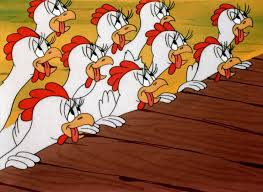 Needing to find an up-to-date solution to keep the hens in production, next day, a want ad in the entertainment section of the paper announces “Rooster Auditions” to keep the hens laying. Porky endures performances by chicken counterparts of Nelson Eddy, Al Jolson, Jimmy Durante, and Cab Calloway – and is entirely unimpressed. But one ray of hope remains – a baritone rooster in Hawaiian shirt, fedora, and smoking a pipe – the feathered equivalent of the earlier-generation idol that started it all – Bing Crosby! A singing competition commences between the “old groaner” and the new poultry on the block. Surprisingly, neither commands a lead over the other. Instead, “Bingle” draws first blood by getting a swooning hen to lay eggs while under his spell, and Frankie proves he can accomplish the same feat by serenading another hen. The egg count gets larger and larger with each new cadenza, some hens laying a pyramid of eggs all at once. And even a newborn chick lays an egg five times its size (responding, “Whew!”). The contest goes on far into the night, until everywhere you look, Porky’s farm is covered with piles and piles of eggs. “Th-that’s swell fellas”, says Porky, asking how they managed to get the hens to lay all those eggs. “It’s very simple, Porky”, the two vocalists respond in unison, and each directs a few characteristic notes at Porky himself in demonstration. Porky breaks into a fit of giggles – and produces the first pile of pig eggs in zoological history! Crammed with sight gags, this little gem earned Warner an Oscar nomination – but alas, no statue.
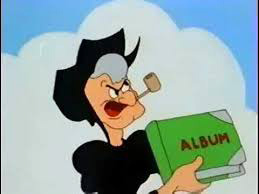
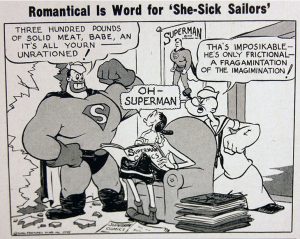 She-Sick Sailors (Paramount/Famous, Popeye, 12/8/44 – Seymour Kneitel,.dir.) – As mentioned above, Popeye is pretty super-human. But can he match the stuff of a strange visitor from another planet? Olive seems to lean toward the latter, as she has taken up reading Superman comics, and swoons at his every act of derring-do, ignoring her powerful boyfriend as if a has-been. Bluto overhears the bickering between them in Olive’s apartment, and sees an opening to get in good with Olive. For one of the few times in his screen career (though the “unkindest cut of all” is not actually witnessed on screen), Bluto shaves off his whiskers (though leaving a visible “5 o’clock shadow”), and rents a set of blue tights and red cape in a somewhat portly size range. While Popeye engages in a heated game of “keep-away” by concealing Olive’s comic book behind his back, an oversize “amazing stranger” bursts through the wall to defend the lady’s honor, dealing Popeye a blow to the chops that crashes him into Olive’s sofa. Blutoman tells Olive he’ll stick to her like glue, and Olive replies with a giggle, “The feeling is mucilage.” Popeye, with his head springing out of the sofa cushions, is shocked. “Well, blow me down. If he ain’t a real humane being!” However, Popeye is as usual up to the challenge, addressing Bluto as “Stupidman”, and insisting that he has to prove he’s the better man than the sailor. “All right, you milk muscled midget, let’s see if you can save the fair damsel”, says Bluto, casually dropping Olive from a window 20 stories above ground. (Makes one wonder how Bluto managed to break through the wall at such a height.) “Wow!”, shouts Popeye, and begins racing at his fastest speed down flight after flight of stairs. Bluto instead uses gravity for speed (of course taking nothing into account as to how he can possibly fall faster than Olive so as to catch up with her), and jumps out the window himself. Miraculously, he does overtake Olive, then pops an umbrella out of the back of his shirt, tied by its handle to his waist, floating the two of them gently to the ground. When Popeye arrives, catcher’s mitt in hand, he merely runs himself in circles into a pretzel knot, looking upwards for someone to save – as Bluto and Olive are already on the ground, laughing at his hapless effort. (A notable continuity error commences from this point in the cartoon, as the “S” insignia on Bluto’s chest disappears entirely for the remainder of the picture once he reaches the ground.) Popeye sighs, “I’m flabberblasted!”
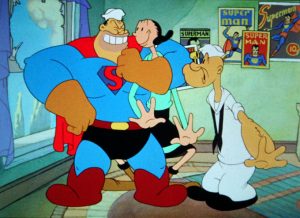 Popeye pursues the strolling couple, and insists that the would-be superhero still hasn’t proved “nothin’” yet. Stepping onto a railroad track, Bluto waits in the path of an oncoming train, seemingly bringing the engine to a stop with the force of only one hand. However, Bluto is well aware of the train’s schedule, and conceals view that the engine has come to a stop using its own brakes, to unload passengers at a station just up the tracks. “If you can dood it, I can dood it”, says Popeye. He stands on the track with one arm outstretched, and tells Bluto to “Let ‘er go.” Bluto glances back at the station, where the conductor is giving the signal for “All aboard”, and releases his hand’s pressure on the engine just as the vehicle builds up steam and takes off. Popeye stands steadfast on the tracks – so much so that he carves a silhouette-shaped hole through the front of the engine, then through and out the caboose for the entire length of the train – leaving him in a wobbling walk on the tracks, with the conductor’s red lantern in his outstretched hand. Bluto guffaws heartily, but Popeye weakly insists he’s still not convinced.
Bluto devises the ultimate test of he-manship. “Dis is something only Superman can do. Pepper me chest with dis’.” He hands Popeye a machine gun. “Th-That’d be moider!” says Popeye. “Yeah…when it’s your turn!”, replies Bluto. As Popeye carries the gun back to a firing position, Bluto ducks behind a tree, and inserts a heavy armor plate within the chest cavity of his costume. Popeye can’t even bear to look as he pulls the trigger – but the bullets indeed bounce off Bluto’s chest as advertised. As Popeye’s eye pops when he takes a peek, Bluto takes the gun and announces, “Now you’re gonna be the big shot.” Popeye attempts to stand with courage to meet the hopeless challenge, throwing out his chest (which wobbles and withers like a wilting leaf to the ground). Olive tries to divert the shot, but Bluto launches a hail of bullets at the helpless sailor, until he falls to the ground. Then Bluto makes off with a struggling, screaming Olive, and for good measure ties her to the railroad track when she refuses to come gracefully.
Popeye, however, is not entirely motionless, and reaches into his shirt, producing his trusty spinach can – riddled with bullets. “Saved by me spinach”, says the sailor, and downs the can’s contents, shrapnel-flavor and all. The vegetable instantly produces a red cape for Popeye, and a large yellow “P” on the chest of his shirt. Back at the tracks, Bluto’s sailor hat falls out from the chest of his costume, revealing his “secret identity”. But a streaking form in the skies prompts the nearly trademark reactions from Olive and Bluto. “Look, up in the sky! It’s an eagle. It’s a rocket. It’s a meteor.” Of course, it’s Popeye, flying with a jet from his pipe. (Just to match Bluto’s continuity error. Popeye’s “P” now disappears from his shirt, too – I guess the alphabet wasn’t the ink-and-paint girls’ specialty.) Bluto pries a boulder loose on a mountaintop to roll at Popeye – but with a blast of super-breath, Popeye blows the boulder back up the mountain, and straight at Bluto. It intercepts him within a grove of nine trees – resulting in a crushing strike with Bluto as the headpin. The score as to who is the strongest is finally settled, with a shot that tells us we should have known the outcome all the time – as it is identical to the ending of the original “Popeye the Sailor” seen back in 1933. Popeye, without sufficient time to untie Olive from the tracks, takes aim with his fist at another oncoming locomotive – and this time demolishes the entire train into rubble, giving us his pipe “toot toot” for the iris out.
• You can watch SHE-SICK-SAILORS on DailyMotion.
 Pluto’s Blue Note (Disney/RKO. Pluto, 12/26/47 – Charles Nichols, dir.) – Yes, the Sinatra craze even went to the dogs. A simple story, but entertainingly presented. Pluto is a frustrated canine, with the will to sing along with the melodies of nature, but not the talent. It seems like everyone around can bat out a melody – birds, bees, and a cricket. But whenever Pluto trues to chime in, his off-key growls and howls either invite the cold shoulder or a round of verbal raspberries. Running out of sources of music in nature to listen to, Pluto is attracted to the strains of a melody coming from a floor-model radio on display outside a music store. Pluto settles in front of the set, and is again inspired to sing along, but is rebuffed by the store’s owner, who drags the set back inside to keep riff-raff like Pluto from hanging around. Pluto waits for a clear moment, and spots where the radio has been moved, deep inside the store. Pluto slips inside, and ducks behind a counter as the owner passes. The owner hangs an “Out to Lunch” sign on the front door, then exits, leaving Pluto a free field together with the radio. Only one problem – the owner never re-plugged in the radio set, so when Pluto turns the set’s knob – nothing.
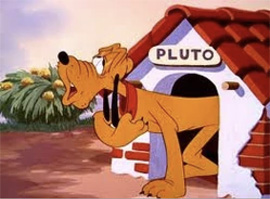 Dejected Pluto settles ino a sulk in front of the silent radio. No music, no fun. His tail droops behind him, while his rear-end bumps the “on” switch of a portable record player. The tip of his tail touches the playing surface of the spinning record – and suddenly, a momentary blare of orchestral music emits from Pluto’s jaw. Pluto is shocked, and covers his mouth with one paw. Bit when he lowers his paw, the music starts again. Another try – and now, it is not music that is heard from Pluto’s mouth, but needle scratch. Pluto’s tail has fallen into the reject groove at the ed of the record. Tuning to look, and lifting his tail off the disc, Pluto gets the idea as to where the sounds have been coming from, and tries an experiment, placing his tail down at the beginning of the record. A lively South-American tune plays from Pluto’s lips, and Pluto dances playfully around to the strains with considerable vigor. (The tune may have been a primary impetus for the creation of this cartoon, apparently being something that was already in the can at the Disney vaults, awaiting use. The tune appears to be titled, “Caxanga”, and was intended for use in an unreleased Donald Duck short storyboarded a few years earlier, entitled “A Brazilian Symphony”, intended as a follow up to “Saludos Amigos” and also featuring both Jose Carioca and Goofy. An elaborate storyboard reconstruction of this short, complete with fully recorded dialog script for Donald by Clarence Nash, and utilizing in part the same music track as the performance in Pluto’s Blue Note, can be found on Youtube.) After the record concludes, Pluto smiles, then gives a wink to the camera, letting us know that he’s got an idea how best to use this surprise ability.
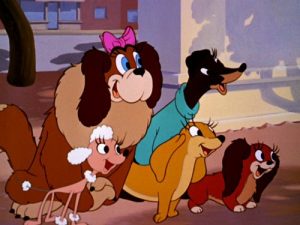 For our final sequence, Pluto reappears out the door of his doghouse, again giving us his secretive wink. He opens his mouth, and the sounds of a vocal impersonation of Frank Sinatra fill the air, crooning a version of the hit love song from “The Three Caballeros”. “You Belong To My Heart”. The birds, bee, and cricket all sit up and take notice, nodding between themselves in approval of Pluto’s new musical ability. What’s more, all the neighborhood female dogs gather at the gate, and begin to sigh and swoon at every love line in the lyric. Pluto does a well-timed lip-sync, and adapts his facial features to emote his lines with feeling. a la ol’ blue eyes. The jig is almost up when the record sticks on the word “belong” inside his doghouse, but Pluto reshifts his tail to avoid the skip just in time, and completes the number without giving his trick away, as the female dogs all fall backwards un a swooning faint. Pluto gives a Sinatra smile to the camera, for the iris out. Nominated for an Academy Award.
• PLUTO’S BLUE NOTE is on Dailymotion
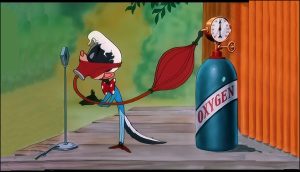 Little ‘Tinker (MGM, 6/15/48 – Tex Avery, dir.) – The Sinatra influence continued, and we couldn’t go without mentioning yet another out-of-place individual caught up in its wake – a little guy by the name of B. O. Skunk, resident of 123 Limburger Lane, who lives in a tall tree where every windowed trunk hole ventilates the interior air with electric fans. B. O. is meticulous in his hygiene, bathing in O-Bouy soap, washing his hair in Shampew, and adding the final touch of cologne (brand name Fleur De Sewer). Yet, all he has to do is walk out his door, and the flowers all wilt on both sides of his walkway. This kind of critter is definitely a longshot for having any attraction to the ladies of the forest, and, no matter what species they may be, all the womenfolk of the woods greet him with a sniff, a scream, and a retreat. Even an old maid rabbit in dire search for “a man” retreats in the same way after one whiff.
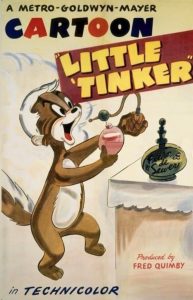 Dan Cupid shows up – but has to make a brief retreat to don a protective gas mask. He hands B. O. a booklet with sure-fire advice on how to get a girl, entitled “Advice to the Love-Worn”, by Beatrice Bare Fax. B. O. follows the advice of several chapters, including a Charles Boyer impersonation, a Romeo and Juliet-style balcony serenade, and finally, a chapter illustrated by a caricature of Frank Sinatra, entitled, “Swoon ‘Em”. Donning a costume labeled “One Frankie suit”. B. O. tightens his waistline until he is pencil-thin behind a bow tie, then steps out onto a forest stage, to perform a full arrangement of Sinatra’s early hit, “All Or Nothing At All”.(though his sheet music bears the title, “Rhapsody in Pew”). An extended (and most memorable) sequence tops even the gags of “Swooner Crooner”, with collapses of the weaker sex to the music, and libido-driven displays of romantic emotion rivaling the wolf’s reactions to Red in “Red Hot Riding Hood”. B. O. meanwhile lampoons the skinniness and seeming weakness of Sinatra, being measured by an undertaker during his performance, and finishing part of his number by performing while encased in an iron lung. The fans finally mob the stage, planting kisses everywhere – but once within smelling range, everyone retreats again, leaving B.O. alone with a stage full of lip-prints.
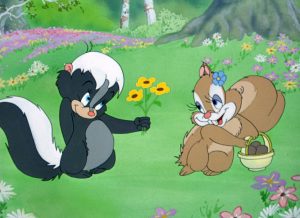 B. O. writes a suicide note, and prepares to take poison. But Cupid reappears, informing him that he failed to read the last lesson – Camouflage”. Spotting a attractive female fox, B. O. pulls out his ears and cheeks in pointed fashion, then paints himself in fox coloration. The trick seems to work, and the girl plants a kiss upon him without rejection. After an Avery-style take of “Wow”, B. O. takes her hand, and happily skips along with her, across a log bridge over a pond. B. O. stumbles upon a protruding branch, and falls into the pond – and the girl does the same. Emerging from the water, B. O. witnesses the embarrassing sight of his fake colors washing off, then looks with worry to see the reaction of the girl. But to his amazement, the same thing is happening on her end of the pond – the girl is really a skunk in disguise too! The amazed couple break into jubilant smiles, and embrace heartily for a kiss, as a heart-shaped iris begins to close upon the scene. But not before B. O. reaches out through the iris, dropping onto the theater stage his love manual, having no further use for it, and passing it on to whoever else may need its advice.
• LITTLE TINKER can be seen on Facebook.
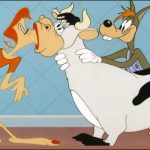
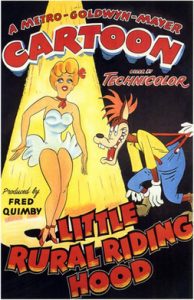 Little Rural Riding Hood (MGM, 9/17/49 = Tex Avery, dir.) – The tale of the country mouse and the cty mouse had been kicking around in cartoons for years, and had already won Disney an Oscar in the mid-thirties. But the Country Wolf and the City Wolf was Avery’s new twist. Of course, what do wolves do in Avery cartoons when they’re not chasing pigs or sheep? Chase girls! However, there’s a lot of differences in style and taste between the country and city varieties. The Country Wolf (voiced by Pinto Colvig) pulls the old routine as Red Riding Hood’s “Grandma” to get within reach of a freckle-faced, no figure, skinny as a rail lumpkin of a female who is the country version of Red, with the intent not to steal her basket of goodies, but to kiss her, and hig her, and love her. Country Red, however slow-witted she may outwardly appear, is fleet of foot, and leads the wolf on a merry chase through the house, including Avery’s oft-used unhinged door gag that opens a new pathway for chasing anywhere it lands, and a mistaken lunge for Red by the wolf that results in him kissing a cow. The wolf finally gets Country Red in his arms, and Red is about to succumb, painting her lips with lipstick and settling back for the nevitabe smooch – when a telegram s delivered to the wolf. It is from his city cousin, who boasts, “Quit wasting your time on that country gal. Come to the big city, and I’ll show you a REAL Red Riding Hood.” A photo is enclosed – of the Red we know and love from Avery’s original “Red Hot Riding Hood”. Country Wolf’s eyes bug out, in the manner that only an Avery character can do. When Country Red still insists, “Kiss me, my fool”, Country Wolf leaves her kissing the cow, and zooms off as fast as his old jalopy will carry him to the big city.
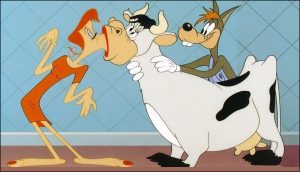 Upon arriving at his cousin’s penthouse apartment, Country Wolf zooms everywhere around the place, looking for that “good-lookin’ babe”, until City Wolf pacifies him, by clunking him on the head with a baseball bat. “Control yourself, cousin”, states City Wolf, informing his cousin that Miss Red is not there, but they will meet her at the club this evening. However, City Wolf infors his cousin of the unfamiliar rules and ways of the city. First, “We do not whistle and shout at the ladies”. And then “It’s top hat and tails, you know.” Country Wolf thus finds himself in a dilemma of etiquette with which he cannot cope That night, as they enter the club, Country Wolf can hardly sit still, hopping around in his chair at a ringside table, and repeatedly muttering, “Bring on the babe.” Though the extremes and gags are new, we know the routine at this point. Red appears, sings, and Country Wolf can’t contain himself, breaking into one ga-ga take after another, each more extreme than the last. (All animation of Red is re-used footage from “Swing Shift Cinderella”. Avery was not prone to producing cheaters, so it is highly likely that the services of Preston Blair were no longer available when this cartoon went into animation stage, and no one else in the studio felt up to the task of animating a new number for Red, resulting in the re-use of old footage. Sadly, this would be the last time that Red would appear in an Avery cartoon.) Finally losing all control, Country Wolf charges headlong for the stage and Red. City Wolf catches hold of his suspenders, places a large mallet within them, then releases the suspenders to bop Country Wolf in the head. City Wolf wheels Country Wolf outside in the manner of a wheelbarrow, with Country Wolf’s head rotating as forward wheel. City Wolf announce that city life is a bit too much for Country Wolf, and offers to “motor” his cousin back to the country in his fancy sedan. Upon arriving back at Country Wolf’s home, the two wolves shake hands, about to part, when who should call out “Howdy, you all”, but Country Red. City Wolf must have been too used to seeing only pretty gals in the city, and for reasons unexplained, goes completely ga-ga in the manner of his cousin at the sight of Country Red. City Wolf charges for the doorway in which Country Red stands, but Country Wolf repeats the identical mallet and wheelbarrow gag to knock out his city cousin, wheeling him back to the car. Reversing roles, Country Wolf states, “Sorry, cousin. This country life is too much for ya’. I’ll have to take you back to the city”, and zooms into a u-turn, the car disappearing down the road toward the distant city skyline, for a likely future of continued girl chasing by Country Wolf, and an iris out.
• LITTLE RURAL RIDING HOOD, slightly speeded and minus opening credits, is on Facebook.
 Jitterbug Jive (Famous/Paramount, Popeye, 7/23/50 – Bill Tytla. dir,) – Long after Tom the Cat’s zoot suit had probably shrunk to nothing. Popeye and Bluto get with the scene – though perhaps not as memorably. Olive is hosting a party, expecting to beep and bop and blow her top with Popeye and Bluto. Popeye arrives first, his arms full of boxes of “parlor games” to liven up the affair. Unfortunately, Popeye is today in his most backwards and antiquated mode, beginning by setting the mood for the festivities with a record of a corny arrangement of a Strauss waltz, and suggesting an opening activity of pulling taffy. A knock at the door allows Olive a chance to exit this sticky situation, allowing the taffy to snap back at Popeye, entwining around his head like a swami’s turban. At the door, we find the “new” Bluto, decked out in a new zoot suit, and in another of his rare occasions, almost clean-shaven, this time leaving a thin moustache, and still with a trace of five o’clock shadow. Bluto slips Olive some skin, and declares. “Let’s get the jernt jumpin’.” Bluto sets himself at an upright piano, and starts pounding out some boogie beats on the ‘88. When Popeye asks who invited him to the party, Bluto remarks at Popeye, “The ol’ cornball himself.” Giving a tug at Popeye’s taffy, Bluto allows the stuff to snap back at Popeye again, driving him into a window-box alcove in the wall, Popeye assuming the alcove’s shape. “What a square!”, chortles Bluto at the sight.
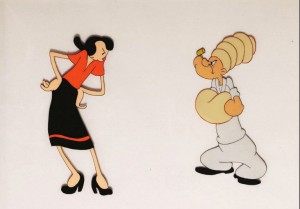
Original cels from “Jitterbug Jive”
• You can watch JITTERBUG JIVE on DailyMotion
 Goofy Goofy Gander (Famous/Paramount, Little Audrey, 8/18.50 – Bill Tytla, dir.) – Snip an idea from here, an idea from there, paste them together, and you’ve got a, sort of, new cartoon. Start out with a borrowed theme from another studio. Terrytoons’ premiere episode of “Nancy”, entitled “School Daze”, revolved around the idea that learning from comic books was more interesting and superior to real life study. Little Audrey is of the same opinion, bored with the class’s assignment to memorize and recite Mother Goose rhymes, and instead conceals, hidden between the pages of her grade school primer, the latest issue of “Phoney Funnies”, a comic book featuring Pin Head and Bird Brain, a pair of would-be crooks. Pin Head calls himself a “sharpie”, with a brow and chin that come to a razor point. Bird Brain is a “stooge” type, with a hairdo resembling a bird’s nest, and a hole in the side of his cranium, providing a bird-house style entrance for an actual bird that lives inside his skull. As Audrey reads of their exploits in a failed attempt upon the gold at Fort Knox, the teacher calls on Audrey to recite. Thoughtlessly picking up from the last line of dialogue of the comic, Audrey assumes a gun moll demeanor, and tells the teacher, “I ain’t talkin’, see?” The kids roar with laughter, while Audrey is sent to the dunce’s corner to study her nursery rhymes, and, totally bored and frustrated, falls asleep. (The same setup from a previous Famous cartoon, “Bored of Education”, starring Little Lulu).
As Audrey dozes, the book in her hands grows in size, and out of its pages flies a lovely, “modern” Mother Goose, strongly resembling the teacher. (More parallels to the growing book in “Bored of Education”, as well as a liberal dip into the world of Fleischer’s “Mother Goose Land” for Betty Boop in 1933.) The Goose provides aerial transportation for Audrey into the world of Mother Goose (much the same as how Betty got there), as Mother Goose explains that those in her land are quite alive and hep to the jive, and that what Audrey sees will open her eyes. Little Boy Blue is fast asleep – on the stage at the “Haystack Club” night spot, but when he awakens blows a bebop wail on his trumpet, while two sheep and a cow provide vocal accompaniment in the style of your choice of current “sister” acts making the circuits. In a rather mature gag for a grade schooler, Mary’s little “lamb” turns out to be a human white-haired sugar daddy – “and everywhere that Mary went, she’d fleece him for his dough”, using her crook cane to steer him into a jewelry shop. Just the kind of role model every mother wants to instill into their juvenile daughters! Little Tommy Tucker sings for his supper – although his day job is street sweeper. However, his face and build are no strangers to the audience, as he is so pencil thin, he is eclipsed by the broom, and emerges as a caricature of Frank Sinatra. He breaks into song with a chorus of “Let’s Get Lost” (another direct lift from the past, using the same number with which he swooned Olive Oyl in “Shape Ahoy”). Audrey and Mother Goose both swoon and faint atop the goose, who flies resolutely onward, toward a fairgrounds atop a tall mountain.
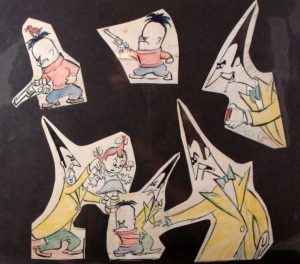 At such grounds, we discover that Audrey is not the only newcomer to this land. From behind a pole emerge, now in fully animated form, comic book refugees Pin Head and Bird Brain, who commit their first crime in the realm by swiping a penny from a tiny pig, and depositing in in a streetcar conductor’s change machine worn on a belt arounf Pin Head’s waist, into a compartment marked “Penny Larceny”. But there is bigger game afoot, as they observe the jackpot of jackpots – a public display of skill by the Goose that Lays the Golden Eggs. Here we have yet another lift from the past, with a reuse of set and animation from previous Noveltoon, “Cilly Goose”, as the goose lays egg after egg to a conga-beat syncopation of the Chicken Reel. Audrey has to put on sunglasses to get close enough to observe the glitter of the egg pile. Pin Head and Bird Brain pull out a pair of “gats”, and announce a “stick-up”. Audrey instantly recognizes them, and comments that they don’t belong in here. The crooks hijack a long sedan, placing the eggs in the rear, and their source, the goose, in the rear seat with Bird Brain to hold her hostage, then careen down a spiral mountain road to make a getaway (taking a brief detour through Humpty Dumpty’s wall, where the famous egg does not crack, as he remarks in Edward G. Robinson’s voice and face that he’s “hard-boiled”). Audrey races to the rescue, borrowing Mother Goose’s flying goose, and Boy Blue’s horn. She swoops in closer and closer to the crooks’ car. The crooks fire a spray of bullets in Audrey’s direction (not having the “bird-brains” to shoot the goose down and take out the pilot at the same time). The bird in Bird-Brain’s head even adds to the fire, by pitching eggs from its nest. Audrey twists Boy Blue’s horn into a U-shape, catching the bullets in the bell of the horn, then curving them back at the crooks. The villains stop shooting, and Audrey leaps off the goose’s neck into the car, wrestling with the crooks to make an arrest. (By the way, who’s steering to keep the car on the road?) Exit our dream sequence, to find Audrey on the floor in the classroom corner, wrestling the legs of the dunce stool. Teacher is astonished, but Audrey has turned over a new leaf, with a new-found respect for Mother Goose, as up to date after all. From out of Audrey’s hair pops Bird Brain’s bird, declaring, “She’s hep to the jive. Mother Goose is sure alive.” Audrey of couse breaks into her trademark laugh at this interjection, for the iris out.
NEXT WEEK: Further into the ‘50’s.