
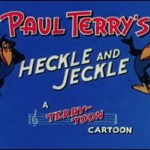
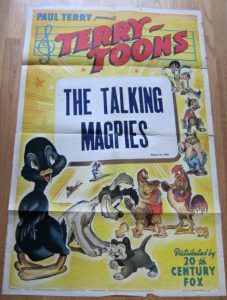
 Getting thrown out of a “Magpie Hotel” just minutes into their first cartoon should have been an indication of what was to come with Heckle and Jeckle.
Eventually, the identical magpies would evolve into a different mischievous pair, one with a British accent, one with a note of New York in his voice. Still, they were different in their debut, The Talking Magpies, from Paul Terry’s Terrytoons, which was released eighty years ago this week on January 4, 1946, and featured a prototype for what would eventually become Heckle and Jeckle.
As the short opens, a magpie husband and wife couple (voiced by Dayton Allen and Tom Morrison) spot the “Magpie Hotel.” Even though there’s a sign that reads “No Vacancies,” they barge in and are thrown out immediately.
After attempts to take over nearby nests don’t work, they arrive at a real estate office, where the agent (Allen, sounding a lot like comedian Hugh Herbert) rents them a nest that’s right outside the window of Farmer Al Falfa (an already established Terrytoons star, voiced by Roy Halee) and his dog, Dimwit (Allen). “Duh, say fellas, the boss asked me if I’d ask you if you’d mind being a little more quiet,” Dimwit innocently asks.
When that doesn’t work, the Farmer takes things into his own hands, first throwing a bowl of water, which is then thrown back, and also results in a broken window.
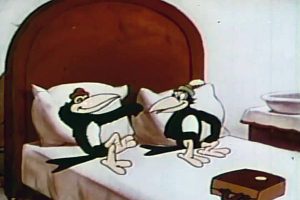 One of the magpies then sneaks into the house and inside the radio, pretending to be a broadcaster asking the question, “Do you have a magpie problem?” The Farmer listens to the faux broadcast exalting the virtues of magpies.
The magpie then pops out of the radio, infuriating the Farmer, who gives chase with his shotgun. Meanwhile, the two magpies lift Dimwit by his ears and tail and land him on the roof. He slides off, crashing on top of Al Falfa.
The magpies now yell from their nest for quiet, and the Farmer climbs a ladder to get them, but a mallet to the head from the magpies knocks him back down. One of the magpies attempts to sell him aspirin for a headache he’s about to have, thanks to another mallet hit.
The Farmer and Dimwit eventually attempt to chop down the tree, but the two magpies, joined by the residents of the hotel, swarm. They all fly inside the house, where the Farmer and Dimwit chase them.
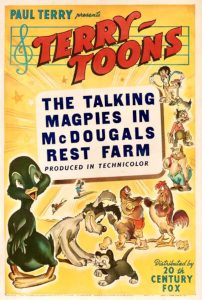
Heckle and Jeckle – still billed as “The Talking Magpies” in their third cartoon, McDOUGAL’S REST FARM (1947)
Directed by Mannie Davis and written by John Foster, The Talking Magpies came about because Paul Terry had an idea for shorts featuring twin characters. The first short planted a seed for what audiences could expect from future Heckle and Jeckle cartoons. They would transition away from the husband-and-wife personas and more to their familiar personalities in The Uninvited Pests, which was released in November of 1946.
Still in The Talking Magpies, there was a lot in place that would become the paradigm for future Heckle and Jeckle shorts, where the two birds would annoy their adversaries throughout, using a variety of well-placed jokes and sight gags.
The Talking Magpies contains a number of these clever moments, including one where the Farmer and Dimwit attempt to hit the magpies as they fly through a door. The Farmer and dog wind up hitting each other on the head, and as they fall to the floor, the magpies come back and say, “That was fun! Let’s do it again!,” and hand them the sticks back.
After their debut, Heckle and Jeckle would star in over 50 shorts for Terrytoons. In 1955, Terrytoons was sold to CBS, and a year later, the debut of The Heckle and Jeckle Cartoon Show aired until 1966, introducing the characters to a whole new generation.
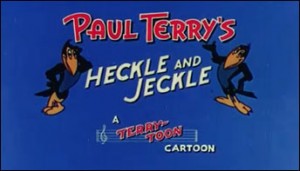 Numerous pieces of merchandise and the cartoons airing in syndication for years after have continued the characters’ popularity.
Today, Heckle and Jeckle have become one of the icons of the golden age of animated cartoon shorts, all thanks to The Talking Magpies, which now celebrates its 80th anniversary.
In Of Mice and Magic: A History of American Animated Cartoons, Leonard Maltin summed up the magpies’ long-lasting career by stating that “…Heckle and Jeckle were the first Terry ‘stars’ who were basically antagonistic. Perhaps they were the studio’s answer to the brash, bombastic cartoon stars at Warner Brothers, MGM, and Walter Lantz during the 1940s. Whatever the reason, their mischievous nature immediately set them apart from such gentle predecessors as Puddy the Pup, Gandy Goose, and even Mighty Mouse.”