
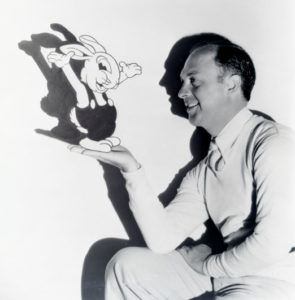
Now that Carl Laemmle and his big “Femily” (as put by Ogden Nash) had left for greener pastures, the people that the bankers had put in charge of Universal’s various departments went along pretty steady. In the cartoon field, Oswald had survived his transition from black rabbit to white rabbit. Lantz was meanwhile trying to come up with a second series that would gain popularity, and put a great deal of effort into the monkeys Meany, Miny, and Moe. The monkeys were now differentiated, having identifying wardrobes and developing individual characteristics. They were often placed in situations closely resembling the Three Stooges, including as golfers, steel workers, stevedores, etc.
 The Unpopular Mechanic (11/6/36) – Inventor/handyman Oswald self-constructs from magazine blueprints a device called a Radioscope Personality Changer, advertised to “Change a wallflower into the life of the party.” Oswald brings the completed device to the family of the dicks to show off, but receives a rather bored reception from pop and mom. Sis just wants to practice her piano rendition of “Chopsticks”, and the duck quintuplets have been sent to bed. Oswald decides this party definitely needs livening up, and begins pointing the radioscope’s directional arrow at the ducks, and turning a dial to select an attribute to cast upon them. Selecting “Jazz” for Sis. Oswald turns the piano practice into a hot, syncopated arrangement, almost exhausting her, and requiring several refresher zaps to keep her going. Before Pop and Mom can complain, Oswald has converted them into a pair of Tango dancers. But the music has awakened Fooey from slumber, who peers out into the living room to get the idea of what is going on. Sneaking up behind the machine’s controls, he resets the dance moves from Tango to Apache. When Oswald realizes something is amiss, Fooey zaps him into becoming a mid-air swimmer (also taking dives under throw rugs). Elmer the Great Dane is zapped into the personality of a monkey, and performs his best impersonation of Tarzan, swinging from the chandeliers. Then, Fooey can’t decide whether he enjoys more having the parents, Oswald and Elmer converted into a hot singing quartette, or changing them to wrestlers – so he alternates between both settings. But wrestler Elmer confronts Fooey, ad ultimately wrecks the machine. As Oswald kicks away the last remnants of the machine, a final zap from its arrow gets Sis playing hot piano again, up in a tree. Songs: a jazzed-up version of Chopsticks, and a Dietrich original, sung in the quartet sequence, which I’ll call “A Jazzy Tune”.
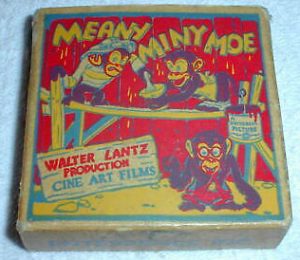 Turkey Dinner (11/30/36) – The first of Meany, Miney, and Moe’s installments under their own series banner, featuring a new theme song composed by new musical director Frank Loesser (of later “Guys and Dolls” fame) and Irving Actman. Possibly for the monkeys’ mutual birthday, a gala dinner is planned. First, some baking is n order. As the characters are meant to somewhat resemble the comedy of the Three Stooges, it is interesting that they predict a gag the Stooges themselves would not perform for another four years – increasing the number of slices of a cake by pimping air into it with a bicycle pump. Moe uses a washing machine to mix pie dough, and its wringer to press out a top for his pie crust. He also predicts a sequence which Goofy at Disney wouldn’t perform until 1940 – battling a stove door that refuses to stay open to admit the pie (Goofy did it with the door of a tugboat boiler). Then comes the matter of a turkey. Meany sharpens an axe to the point of wearing out the grindstone, then tries to coaz a live gobbler to take an ear of corn placed atop a wooden stump. The bird is too fast for him, and all Meany chops is the stump into firewood. He tries again, nailing the corncob down. But in the meanwhile, the gobbler has attempted to pursue a worm through a small length of metal pipe, getting the pipe stuck around his neck, so that when Meany chops, all he hits is metal. All three monkeys pursue the bird outside, but the bird enters their home, and begins wolfing down all the foodstuffs for the dinner. Eventually, he backs into an electric fan, which is the only thing that gets him to leave. The monkeys spend their celebration on stools at the local hamburger stand, settling for convenient fast food. Song: “Sing Sing Sing”, written and first recorded by Louis Prima on Brunswick. Its most famous recording, however, was by Benny Goodman, an arrangement which “growed” from a short dance version to a 9 and one-half minute hazz session on two sides of a 12″ 78 on Victor’s 4 record set, “A Symposiym of Swing” (a set which featured four of Victor’s top jazz bands, also including another rendition which became a hazz standard – Bunny Berigan’s “I Can’t Get Started”). The Goodman version would be expanded to about 12 minutes when the band’s performance at Carnegie Hall was released on Columbia. Vincent Lopez would cover the dance band version for Melotone, Perfect, et all. Louis Prima would re-record a short version with solo work by drummer Bobby Vincent for Majestic in the 1940’s. Goodman would remake the piece for the soundtrack of “The Benny Goodman Story” in the 1950’s, released on Decca..
Everybody Sings (2/22/37) – Welcome to Birdville, where all the modern amenities exist for our feathered friends. And there’s even employment for a rabbit – Oswald, that is, leading his Rhythm Boys at a Birdville dance hall. The hall also features a trio of “chorus gulls”, chiming in on the title number of the picture, an original with lyric by Frank Loesser and melody by Irving Actman. Half the film is a musicale, while the second half focuses on “Three Black Crows”, who sing their own original introductory number, stating their motto of taking whatever they see that they like. The crows raid the town, grabbing every valuable in sight, and finally crash the night club, knocking Oswald out the window in battering-ram style. Oswald returns inside a scarecrow, and scares two of the crows off, but the third sees through his disguise. A pair of birds from Oswald’s band finally capture the crow by hooking him to the end of a player piano roll and reeling him in. The film simply ends with a sign reading, “Yoy are now leaving Birdville.”
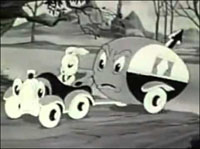 Trailer Thrills (5/3/37) – There seems to have been quite a vogue in cartoons about trailers, and the misadventures of trailer life. Terrytoons, Columbia, and later Disney all got into the act, so why not Lantz? It seems these primitive transportation methods were something of a status symbol – if you could afford one. It begins with Oswald singing an original James Dietrich composition, “Get a Trailer”. Oswald is in possession of a new car and trailer rig (both vehicles personified with facial features). A notable portion of the song lyric states: “You don’t have to pay a cent, to the landlord for the rent. You can even snub the gent – if you get a trailer,” Oswald reaches a road junction with two billboards pointing in different directions – one to the Sea Shore, and the other to Paradise Valley. While the trailer tugs at the car hitch to take the road heading for the sea, Oswald looks at a travel brochure for Paradise Valley, boasting of “Fishing- and how!”, and makes the choice of destinations against the trailer’s wishes. The car and trailer continue to have their differences, and Oswald faces a treacherous path up winding montain roads and over a “Dangerous Bridge – and we don’t mean maybe”, which collapses under them. Oswald and the trailer barely stay on one wheel upon a spiraling road downhill, finally landing in the valley, to find that the travel brochures are woefully out of date, as the entire lake is now a dry river bed. As Oswald takes in this distressing sight, the trailer whacks him on the head with its fender as if to say, “I told you so”, while Oswald performs ballerina steps in a cockeyed daze.
Additional Song spotlighted through a large portion of the musical score is “There’s No Two Ways About It”, introduced by Ella Loga in the Universal musical, “Top of the Town”. Modern viewers will remember this song most as one of the primary production numbers in the Our Gang 2-reel special, “Our Gang Follies of 1938″, for which two songs from the Universal picture were licensed. Logan does not appear to have commercially recorded the piece, but 78’s exist by Frankie Newton and His Uptown Serenaders on Variety with vocal by Slim Gaillard, Russ Morgan on Brunswick, and an interesting Dutch test pressing for an unknown label by Annie De Reuver and the Avko Dans Orkester.
Ostrich Feathers (9/6/37) – Meany, Miny, and Moe stay close to their roots in this one, on an expedition through darkest Africa in search of a small fortune in ostrich feathers. Not too much happens. Meany and Miny spend most of the picture tied to a tree by the boomerang swing of their own bolas, while Moe is left behind at the location of an ostrich egg. He accidentally hatches the ostrich chick, who devours his pants button and telescope. Tying the chick to a wooden stake, Moe returns to the egg shell and crawls inside, lying in wait for Mama. When she returns, he begins plucking out her tail feathers one by one, but is caught in the act. However, Mama thinks he’s her hatchling, kisses him, and calls for Papa. Papa can’t take pride in an offspring so ugly, and tries to kick Moe out of the nest, leading to a disagreement with Mama, and a heated domestic fight. Moe takes advantage of the whirling battle, catching the feathers that fly right from the air for a bundle to take home. But the chick has uprooted the wooden stake from the ground, and returns to the nest. Mama and Papa stop their quarrel, realizing this is their real hatchling, and the monkeys race for the trail, making a hasty exit from Africa, empty handed. Song: “Chant of the Jungle”, a song from the 1929 MGM feature “Untamed” starring Joan Crawdord. Nat Shilkret and the Victor Orchestra performed it on Victor. Paul Specht covered it for Columbia. Joe Veniti and his New Yorkers did a rather commercial version for Okeh, before Venuti and Lang went West with Paul Whiteman to do “The King of Jazz”. Vincent Lopez had the version for Perfect, Banner, et al. Lou Gold’s Orchestra performed it for Gennett. Roy Ingraham and his Orchestra did the Brunswick version. Phil Jones (actually Tom Fulmer) performed a vocal version for Grey Gull and Van Dyke. The Revelers also got a vocal version on Victor. Jesse Crawford performed it on Victor as a pipe organ solo. A late version appeared by Glen Gray on Decca around 1934-35.
The Air Express (9/20/37) – Meany, Miny, and Moe are running an air express service, and carrying a valuable cargo – a million in diamonds. Pilot Moe receives a threat from Meany: “If anything happens to this, it’ll be just too bad for ya,” He also receives added cargo – a live ostrich in a crate. The ostrich pops his head out intermittently, gobbling up everything within reach, and trying for the diamond sack kept within Moe’s trouser pocket, but unable to swallow it completely, due to the hole in the crate being slightly smaller than the diamond sack. The bird busts loose, chasing Moe around the plane, and finally casting him outside, leaving him hanging from the landing gear. The ostrich begins devouring the instrument panel, then receives an electric shock, and also winds up outside, in a balancing act with Moe atop opposite wings. The wings fall out entirely, and the plane crashes, but both passengers survive, Moe caught upon a tree by his suspenders, with the diamonds still in his pocket. The ostrich continues devouring engine parts and the propeller, until Moe presses a starter button, activating the engine within the bird, and launching him into a powered flight to parts unknown. Song: “Borneo”, a 1928 pop song, which seems to have only spawned three recordings: Ben Bernie on Brunswick (below), Frankie Trumbauer on Okeh, and a British HMV version by Jack Hylton’s Orchestra. This would have become known to early jazz record collectors from the Trumbauer version, which features a “chase” chorus by the legendary Bix Beiderbecke. Perhaps this is how the tune came to be remembered by Lantz’s music department, an increasing number of which took an interest over the years in hot musical scores, such as the later work of Darryl Calker.
Lovesick (10/4/37) – Elmer the Great Dane does not appear in this film – but two other doggies do. Oswald seems to have taken the advice of someone singing “Get a long little doggie” – hence we get Doxie, a dachshund. Meanwhile, the neighbor (Henrietta Hen) has acquired a French poodle, and doesn’t want her associating with such a low breed as Doxie. Oswald presents Doxie with a bone, which Doxie takes to Fifi as a sweet. One clever gag has Fifi trying to bury said bone, only to come up with a bone gusher. Oswald notices that all this has placed Doxie off his feed, and takes him to the vet, who identifies the problem as something he can’t treat – love sickness. Oswald thinks he has the cure – posing as a doctor himself, and proposing an immediate operation. Doxie takes off in fright, with some gag mileage from entering an X-Ray machine and revealing a surprisingly “bony” sub-structure. Doxie escapes the vet’s office and runs back home, with appetite restored, chewing away at a bone with typewriter sound effect. Song: “That Foolish Feeling”, another 1936 pop song from the Universal musical, “Top of the Town”, and the second number licensed from said film for use in “Our Gang Follies of 1938″. This number was more widely covered than “There’s No Two Ways About It”, with versions by Tommy Dorsey on Victor (below), Bunny Berigan on Brunswick, Will Osborne on Decca, and Shep Fields on Bluebird.
Keeper of the Lions (10/18/37) – Oswald has gotten himself a new gig – as lion keeper at he local zoo. Through no fault of his own, the lions escape and wreak havoc all over the place. Oswald, assisted by the Dumb Cluck, has to get them back into their cage. The Cluck does come up with an idea, trying to dress up as a “scare-lion”. Oswald finally gets the big cats chasing him in a continuous row (linked by crabs nipping at their noses and tails), and gets a goat to butt the forward lion, compressing the row into a compact mass that resembles a bamboo curtain. Oswald ties the bundle neatly by the lions’ tails, and deposits it back within the cage, untying the tails with a long pole to release them. Song: “I’m the Keeper of the Zoo”, an original, possibly by new music master George Lessner.
NEXT TIME: Into 1938, as things begin to be touted as “New”.