
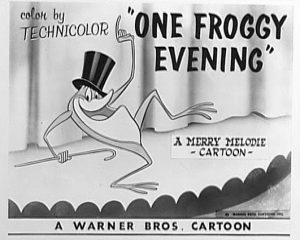
 One Froggy Evening rightly earned the number five spot in Jerry Beck’s 1994 book, The 50 Greatest Cartoons: As Selected by 1,000 Animation Professionals. In the book, film critic Jami Bernard said of the short, “There are only a few enduring silent screen comics who still have impact today, and among them I’d number Chaplin, Keaton, Laurel and Hardy, and Michigan J. Frog.”
High praise and good company indeed. This is still true of the character and director Chuck Jones masterwork of an animated short, One Froggy Evening, which celebrates its 70th anniversary this year.
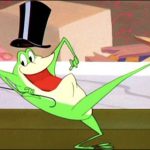
As the Warner Bros. Merrie Melodies short opens, a construction worker comes across a box while demolishing a building. In it, along with paperwork from when the building was erected is a frog, who leaps out. Lethargic at first, the frog then pulls out a top hat and a cane and begins singing and dancing to, “Hello, Ma Baby.”
Seeing this, the construction worker has visons of how this singing frog can make him rich. He goes to a theatrical talent agent where the frog doesn’t perform. They are thrown out of the agency, and as soon as they are, the frog jumps out of the box, once again with top hat and cane performing “The Michigan Rag.”
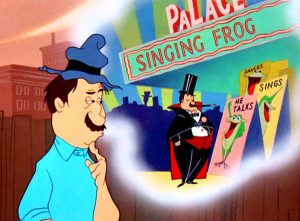 The construction worker bolts back into the agent’s office, but when they both come back, the frog has finished singing and sits there with nothing but a gurgling “ribbit.”
They are both thrown out, again, this time into the street, where the frog performs “Come Back to Éireann.” The construction worker then gets another idea – to rent out an empty theater and goes home to get his life savings out from under his mattress (during which the frog sings, “I’m Just Wild About Harry”).
The theater rented, and cleaned up, complete with signs outside, the frog performs “Throw Him Down McClosky,” to an empty house before opening (while balancing on a high wire).
The poor construction worker is able to get an audience by creating a sign that reads: “Free Beer!” However, with the audience in place, the frog begins singing “Won’t You Come Over to My House,” behind a closed curtain, which the worker is unable to raise. When he eventually does, the frog stops singing.
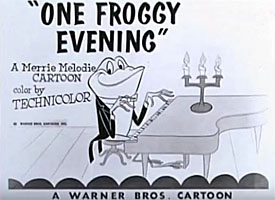 Broke, the construction worker sits on a park bench, with the frog next to him singing “Largo al factotum,” from The Barber of Seville. A police officer comes over, when he hears the singing, at which point the frog has stopped, and when the construction worker points to the frog in blame, it lands him in a “Psychopathic Hospital.”
In his cell, the construction worker sits there, while the frog sings “Please Don’t Talk About Me When I’m Gone.” Back out in the world after this release, the beaten worker spots a building under construction and quickly deposits the box with the frog in a cornerstone and runs away.
We then flash-forward to 2056 A.D., with a futuristic demolition team disintegrating the same building. A construction worker comes across the box with the singing frog and begins having visions of dollar signs. As the short ends, this construction worker is sneaking off with the box, as the saga starts over again.
• To view the complete film – buy it on blu ray on Looney Tunes Platinum Collection, Volume 1
Here is the first two minutes and 40 seconds:
The brilliance of One Froggy Evening, written by Michael Maltese, is how it is told with no dialogue (except for the frog’s singing, from William “Bill” Roberts). Animation in the short, provided by Abe Levitow, Richard Thompson, Ken Harris and Ben Washam, among others, ranges from the subtle (like the construction workers side glances) to overly expressive (each time the frog performs), all of it perfectly underlining the humor.
 In his book, Chuck Reducks, Jones wrote about the choice to make the short without dialogue: “Early storyboards of One Froggy Evening included talking characters, but that just didn’t work. There was no dialogue in the completed film; The only audible voice is the frog’s. Having eliminated all dialogue, I finally realized how I wanted to tell the story. Imposing that discipline on myself made my work tougher, but it helped me pare away the fat to reach the essence of the film, which is that a man discovers a frog who can sing but will not sing in front of anyone else.”
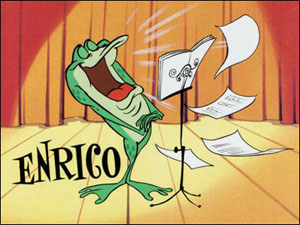
The frog never had a name originally. For the “Coming Attractions” sequence on the 1960 ABC-Network prime time Bugs Bunny Show the amphibian was christened “Enrico”. Jones would later officially name the main character Michigan J. Frog (after the song “The Michigan Rag,” which was written for the short by Milt Franklyn, Maltese and Jones). Michigan would famously become one of the breakout stars of Warner Bros cartoon canon.
He would also later emerge as a major part of pop culture, in 1995, as the mascot of The WB Network and would return in the sequel, Another Froggy Evening, which was produced the same year.
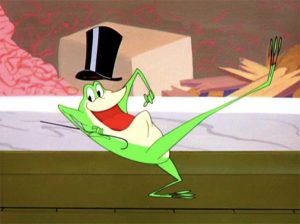 Although a stand-alone short subject, the popularity of and appreciation for One Froggy Evening has continued to grow in the seventy years since its initial release on New Year’s Eve of 1955. In his book, That’s All Folks: The Art of Warner Bros. Animation author Steven Schneider noted what’s behind the appeal of the short: “Magnificently funny, the wildly acclaimed One Froggy Evening says things about the power of greed and hooks up with Jones’ Road Runner films in looking at the mechanics of self-defeat.”
In 1973 film critic Jay Cocks interviewed Chuck Jones for Time magazine (after the interview, Jones added the “J.” to Michigan’s name in honor of Cocks). In his article, Cocks summed up succinctly why One Froggy Evening is still part of animated discussions seven decades later, writing that the short “…comes as close as any cartoon ever has to perfection.”