
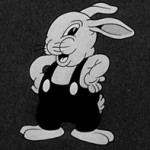
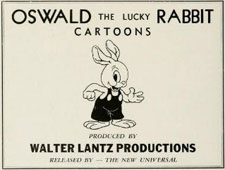
 1935-1936 was an interesting year for Universal pictures. “The Invisible Ray” was attracting the horror audience, and Buck Jones was holding down the Western fort. In the serial field, Flash Gordon was raking in the bucks, even with a budget of $360,000. While all this was going on, the board room at Universal was beginning to look like the setting for a soap opera. A consortium of bankers set their sights on taking over the company, and ousting long-time president Carl Lawmmle. Late in 1936, Universal would have a tremendous success with a young semi-operatic soprano (Deanna Durbin), and they were doing well with another musical – Irene Dunne in “Show Boat”. The cartoon division was going along steadily. Their experiments in color were coming to an end, and their main character, Oswald Rabbit, was transformed into a white rabbit instead of the black rabbit he had been since 1927. Oswald’s cartoons were now often in a barnyard setting, which allowed for the development of a more consistent character, and a stable of supporting characters, including a quintuplet set of ducks, and three mischievous monkeys.
Amateur Broadcast (8/26/35) – This cartoon takes off on the popularity of amateur hour shows, which were ripe over the airwaves in 1935, especially with the established popularity of Major Edward Bowes. Oswald is the master of ceremonies, and a cute little pig is trying to sing the cartoon’s theme song referenced below. A frog also is trying to sing “The Bulldog and the Bullfrog”, in his best Candy Candido style (Candido was currently with Ted Fio Rito’s Orchestra). The frog plays his number as a tough guy, and even produces a bomb that makes a shambles of the stage and the orchestra pit. A lot of gags also get a great deal of mileage out of the stage microphone. Songs: “Opportunity Knocks”, an original probably written by Dietrich. “The Bulldog and the Bullfrog” was recorded by Lawrence Welk on Vocalion (below). Arthur Godrey would issue a children’s version on Columbia Playtime.
The Fox And The Rabbit (9/30/35) – The last Cartune Classic in glorious two-strip Technicolor, and an anticipation of the changes that would be made in the Oswald Rabbit series, with the first appearance of the “white rabbit” design for the character, although not officially credited on screen as Oswald. A little boy rabbit plays hookey from school (via using red ink for a fake case of measles), to plot a raid on a carrot patch. The patch is nothing but a curtain backdrop, used as a lure for young rabbits by a hungry fox. When the rabbit realizes what is happening, he calls for his mother, who comes out with rolling pin in hand. The two rabbits do a number upon the fox, both with the pin and with the help of a hive of bees. Once the rescue has been accomplished, Mama realizes something is not right at the young rabbit’s absence from school, and turns hum sunny-side up for a paddling, leaving an impression of her hand on his bottom. A title song for the film, an original, is sung by the Rhythmettes, plus some heavy use of the Brahms’ Hungarian Dances.
Monkey Wretches (11/11/35) – An Italian-accented man wants to sell three monkeys to a pawnshop run by Oswald. The man wants five dollars, but Oswald will only pay him two. The monkeys, who would later be Christened Meany, Miny, and Moe, do not yet have much personality except for being mischievous. Eventually, Oswald offers to give the man $100 if he’ll take back the monkeys – but the Italian is master of the deal, and keeps getting Oswald to raise the stakes – to $500 to get rid of them! Songs: “Do Like the Monkeys Do”, a spunky original.
The Case of the Lost Sheep (9/9/35) – The Little Bo Peep story gets a modern retelling. The lambs don’t want to eat the health food that Mama Ewe is pushing at them. They say they’d rather starve, and Mama sends them to bed without any supper. One cute lamb (voiced by Bernice Hansell) suggests that they run away from home, so they can get the kind of food they like. There is a predatory wolf in the neighborhood, who’d like to have the lambs over for dinner. Meanwhile Oswald, for the first time in his new white fur in the formal series, plays investigating officer with a Humpty Dumpty style assistant, as Mama Ewe complains that she thinks her offspring have been kidnapped. The kids eventually run back home, escaping the wolf – yet the film never entirely resolves what the youngsters will now accept for their evening meal. Song: “Little Bo Peep”, an expository number sung by the almost-inevitable Rhythmettes.
Slumberland Express (3/9/36) – The idea of a train leading to a land of dreams had been appealing to singers and songwriters for years by the time this cartoon came out. An example would include, “The Sleepy Town Express”, a 1931 pop song (though this does not appear in the film). Oswald and his niece very nearly misses the train, but does manage to get on board before it really starts to take off. In wandering around the land of dreams, Oswald’s niece also stumbles into the land of nightmares, ruled by a spinsterish queen. Oswald is called upon to rescue her from giant bath soap bars, toothpaste tubes, schoolbooks and an inkwell, finally discovering himself back in his own bed, being awakened by his niece. An original title song appears, still presumably written by James Dietrich, couched in terms which children would find idyllic.
The Barnyard Five (4/20/36) – This cartoon introduces a set of duck quintuplets, named Fee, Fi, Fo, Fum, and Fooey. Mother duck is expecting, and papa drake is pacing the floor. When the ducklings hatch (in an unusual manner, from five yolks inside one egg shell), no explanation is offered why Fooey is black, while the other four are white – other than to make him stand out. Inspiration for the series was no doubt the Dionne Quintuplets. The ducklings are prone to the mischief one might expect – especially Fooey, who became a regular comic foil as the series progressed. The closing portion of the film features dinner mischief, as Oswald invites the new arrivals over, via a telegram that borrows the catch-phrase of J. Wellington Wimpy – “You bring the ducks.” Music for the cartoon features quite a bit of hot fiddle, possibly suggesting the repeated presence of the Sons of the Pioneers, though no credit appears to be given. Song: Title indistinct, but an expository number explaining things at the beginning of the cartoon.
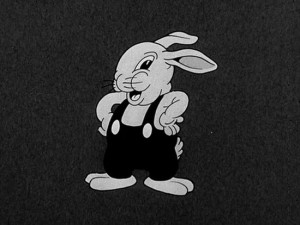 Kiddie Revue (9/21/36) – Oswald plays backstage manager for a kids’ talent show at the local town hall. Things don’t go so smoothly right from the start, as he attempts to set on a record to play the opening number while ringing up the curtain. The curtain doesn’t cooperate in rising, forcing Oswald to reset the record to start again, then give a tug on the curtain rope that tears the fabric sheet right down the middle, finally forcing it to part. A quintette of young girl rabbits who look like spitting images of Oswald’s new facial features (any relation?) perform an ensemble introduction, emerging from flower settings whose petals open, then sink into the floor. The action is reversed as the flowers rise to envelop them again, but the last one won’t rise on cue, instead popping up late to surprise the youngest rabbit and frighten her off the stage. The audience is seen, mostly consisting of more white rabbits who may be members of Oswald’s extended family. Backstage, a little dog with a violin impatiently asks if it’s his turn yet. But two acts are scheduled ahead of him. First, a bagpipe-playing Scottie. The violin dog hurries his act along, by showering him with sneezing powder from the rafters. The results set the bagpipes into a sneezing fit under their own power, and the only way Oswald can silence them is to shoot the bag with a pistol. Next, an elder sister of the duck quintuplets not previously seen (she would make at least one other appearance, in “The Unpopular Mechanic” to be discussed in our next installment, but then apparently be phased out) performs a non-striptease bubble dance with a self-blown soap bubble. The violin dog crabs this act too, popping the sphere with a blow gun. Finally, it is the little dog’s turn (which almost goes awry from the start, as he falls on his fiddle while making his entrance, smashing it, until Oswald supplies a replacement instrument). The performance was not worth waiting for, consisting of a rendition of “Over the Waves” with a ton of clinkers. Sister duck gets revenge by pouring a jar full of ants down the dog’s trousers during the performance, causing the pup to run howling around the hall, spreading the ants to virtually every seat in the house, and sending the audience scattering for the exits as the film closes. Songs: “We’re the Chorus”, sung by the bunny quintette, and “I’m a Little Doll With a Parasol”, an incidental little girl’s number performed by Bernice Hansel before the arrival of the violin dog. Both originals by Dietrich.
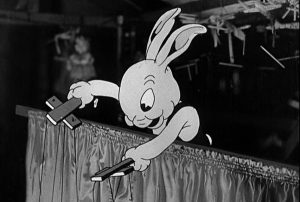 Puppet Show (11/2/36) – A bit of a cheater, though no more so than the average Fleischer Screen Song of the day. Consisting half of animation, and half of live action sequences by guest puppeteers Walton and O’Rourke. The first half is mostly the puppet footage, with occasional views of Oswald manipulating the strings from above. An Arabic number and a Latin dance are followed by a Harlem-style specialty by black puppets, entitled “Swingin’ Sam”, probably another Dietrich original. A flying insect begins to bug Oswald, messing up his string work on the live-action puppets, and causing him to fall backwards and knock himself unconscious backstage. Two black dancer puppets lie limp and unattended on stage, but transform into animated versions, who peek behind the curtain to note their master out cold. One suggests they take this golden opportunity to up and leave this show, but the other cautions that a puppet can’t do anything without someone pulling the strings. “Says you”, says puppet #1, and somehow manages to crawl his way out of the theater alone. Noting his own listlessness, the puppet hatches an idea at the sight of a set of six helium balloons tied together against a wall. Detaching them from their mooring, the puppet ties each string to his head, torso, and all limbs. The bobbing motion of the balloons as he proceeds forward gives him the needed lift to walk and trot in jaunty steps, and he presents himself at the nearest toy shop, trying to get into a toyland revue. However, a little Indian doll spies the ballons, and shoots one with an arrow, deadening one of the puppet’s legs. The toys quickly realize he is a puppet rather than a doll or toy, and find ways to pop the remaining balloons. Helpless on the floor, the puppet is told that his punishment for attempting to deceive them is to be sawed into firewood. The puppet is tied to a table, and a miniature buzz saw descends toward his midriff. Just as his fate seems sealed, the scene dissolves back to the prone Oswald in place of the puppet, as he is stung in the belly by the flying insect, awakening him. Oswald realizes his unfinished task, retrieves the marionette controls from the stage, and finishes out the finale number, for the fade out. Besides “Swingin’ Sam”, a second original ditty is sung by an offscreen chorus, entitled “You Can’t Do a Thing Until They Pull a String”.
NEXT: The monkeys make a move into their own series, while Oswald commences on, next time.