
Spring arrives today. Well, at least according to calendars and meteorologists, it arrives today, March 20, at 10:46 a.m. eastern time.
The weather itself may feel different. As temperatures still chill and snow still falls in some areas. A few weeks ago, there was a celebration of winter-themed cartoons as we looked forward to spring.
Now that it’s arrived, it’s only fitting that we welcome this very welcome season with some spring-theme classic cartoons:
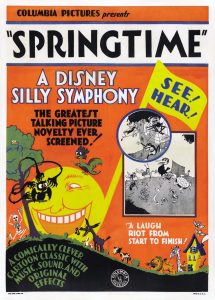 Springtime (1929), Disney
This Disney Silly Symphony, “Drawn by Ub Iwerks,” as the titles inform us, celebrates the colorful season of change in glorious black-and-white.
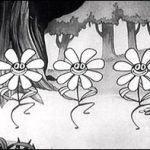
The short opens with the lovely music “Morning Mood” from Edvard Grieg’s Peer Gynt, as three flowers dance, with one flower then coming toward the screen as two ladybugs dance atop its pedals.
We then see a caterpillar dancing through the glen, and it splits into sections, all dancing independently. A crow then comes up behind it and eats each one of the sections.
The crow, wearing his top hat, then dances back to the nest where Mamma is sitting on eggs. The eggs hatch and the little hatchlings get out and immediately start dancing themselves.
A thunderstorm then arrives as lightning threatens a cloud, which tries to duck out of the way of the strikes, but the lightning finally pierces the cloud, and rain comes out of the cloud like a waterfall.
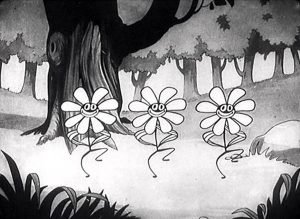 A somewhat bare tree treats the rainfall like a shower, scrubbing its branches like hair, and is then zapped in the rear end by lightning. As the rain stops, two grasshoppers, who have been using mushrooms as umbrellas, come out from underneath and begin dancing around to “Dance of the Hours” by Amilcare Ponchielli.
The two grasshoppers wind up unknowingly jumping into a frog’s mouth, and because they continue to dance, so does the frog. A spider then swings in does its own dance and uses its spider web as a harp.
A group of frogs then continues to dance, but they are tracked by a large water bird. For safety, all the frogs jump inside of each other like nesting eggs and take off, being chased by the bird, who manages to eat all of the frogs, after tossing them in the air. The bird skips through puddles, but the last puddle is deeper, and the bird sinks into the puddle as the cartoon ends.
While it’s typical of this era, with repetitive animation and a series of gags in place of its story, there is very creative animation here, including nice use of perspective and effects (when the frog dances we see its reflection rippling in the water below, which builds to a nice gag where the frog’s reflection seems to do its own dance steps).
Springtime has a vibe that’s as comforting as the season it celebrates.
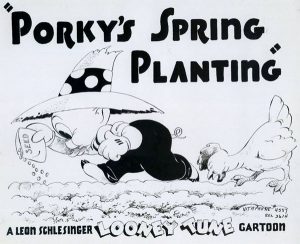 Porky’s Spring Planting (1938), Warner Bros.
Another black and white entry, this one a sequel to the short, Porky’s Garden (1936), with Porky (Mel Blanc) looking to plant his vegetable garden, with assistance from his laconic dog, Streamline.
Streamline (also Blanc) digs the holes with his tail, and Porky rolls the seeds down the dog’s back to plant the garden. However, the chickens next door are hungry and see the garden as a diner (even hanging out a menu sign that reads: “Corn Beet and Cabbage”).
Porky’s efforts to rid his garden of the chickens are useless. He tries swinging a broom, but each time he does, an additional chicken appears. He eventually sends Streamline after the chickens, but they pummel the poor dog.
It all eventually leads Porky to try to come to some sort of agreement with the chickens and to try to get them to agree to creating one garden for himself and one for them. When he asks them what types of vegetables they want, and he mentions corn, the chickens break into an imitation of comedienne Martha Raye, as they declare, “Ohhh yeaaah!”
Directed by Frank Tashlin, this has his ingenious comedic touches throughout. Streamline’s thoughts come through the soundtrack in voice-over, and when Porky asks for the dog’s help, he mutters, “I’ll be able to sleep all day when I get my Social Security!”
Here, the humor is partnered with full animation and, much like Springtime, plays with perspective in the sequences where Porky plows the garden and nicely timed gags with the chickens, making Porky’s Spring Planting an entertaining entry from the title star’s early days.
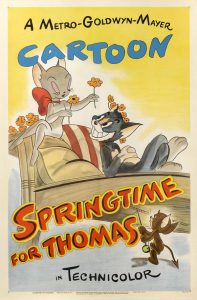 Springtime for Thomas (1946), MGM
As this short opens, Jerry emerges from his mousehole (in the mailbox), ready for the day, and attempts to bother Tom by kicking the cat and pulling his hair out, but Tom simply shushes Jerry away.
Jerry looks out the window and sees what has Tom’s attention – Toodles, the female cat next door, lying out on a lounge chair, reading “Har-Puss Bazaar” magazine. Tom is in love, which is evident by the hearts that appear in his eyes and the fact that he kisses Jerry.
Toodles drops her handkerchief, and Tom buzzes over quickly to get it. She then blows a kiss, which flutters through the air and lands on Tom’s lips.
In a classic cartoon trope, a devil version of Jerry appears to the mouse and tells him that he needs to break up that relationship to save his friendship with Tom.
Jerry forges a letter from Toodles and gives it to an Alley Cat, voiced by Frank Graham (who reads it and notes that Toodles has always admired his physique, which he pronounces “fizzy-queue.”
The Alley Cat immediately goes over and breaks in between Tom and Toodles, throws Tom in the pool and immediately starts serenading Toodles with the song, “Quiéreme mucho.”
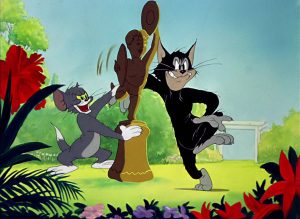 What follows is back and forth between Tom and the Alley Cat. Tom is thrown into a BBQ pit on a rotisserie, and the Alley Cat crashes into a pool that’s been drained of its water. It ends with Tom being ejected from the premises and meeting up with Jerry again.
The two gleefully start chasing each other, until Jerry encounters a female mouse and begins falling in love, as Tom did, as the cartoon ends.
Directed by William Hanna and Joseph Barbera, Springtime for Thomas is well-crafted, with beautiful visuals and lovely backgrounds by Robert Gentle, especially in the opening scene.
With a team of animators that includes Ed Barge and Kenneth Muse, the gags throughout play out perfectly (after Tom is kissed, his heart goes off like a fire alarm, he jumps in the air and is whacked in the head by a mallet from cupid, as the words “Love” appear in his eyes like a slot machine).
Additionally, the cigar-chomping, gruff Alley Cat is a great, additional rival for Tom. In all, Springtime for Thomas is a classic entry from the Golden Age of this legendary cartoon duo.
Just three of the many Springtime-themed cartoons (mention some of yours in the comments below). Once you’ve watched them, summer can’t be far behind.