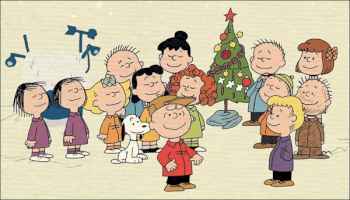

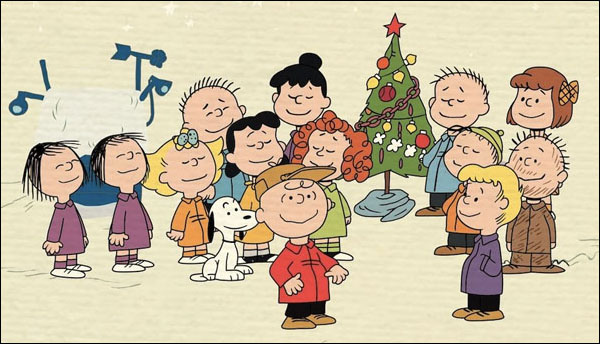
Like the character in its title, A Charlie Brown Christmas didn’t get much respect just before its debut sixty years ago. The CBS network that was about to air the now beloved holiday favorite didn’t have much faith in it.
Executives at the network felt that the pace was too slow, the music didn’t work, and the animation was too simple. Ironically, these are aspects of A Charlie Brown Christmas that have endeared the special to audiences, making it one of the season’s shining stars.
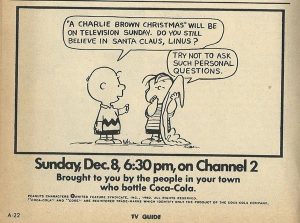
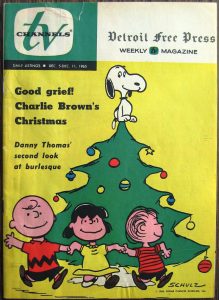 Debuting in 1950, Charles M. Schulz’ Peanuts comic strip had grown to be one of the most popular by the mid-60s. Producer Lee Mendelson had been working with Schulz on a potential documentary about the comic strip when he was approached by the advertising agency McCann-Erickson. They had a client, Coca-Cola, who was looking for a TV holiday special to sponsor.
Mendelson quickly agreed, met with Schulz (known to many as “Sparky”), and animation director Bill Melendez (who had collaborated with Schulz to animate the Peanuts characters for Ford commercials). They hammered out an outline, which was approved, and in six months, they completed A Charlie Brown Christmas.
Anyone who has ever owned a TV is familiar with the story, as the special opens soothingly with images of a gentle snowfall, as the Peanuts characters ice skate on a pond. Over this, we hear the now familiar song, “Christmastime is Here’ (with music by Vince Guaraldi and lyrics by Mendelson). Charlie Brown and Linus walk through the neighborhood to join their friends. As they stop to talk, Charlie Brown confesses, “I think that there must be something wrong with me, Linus. Christmas is coming, but I’m not happy. I don’t feel the way I am supposed to feel.”
 And with this line, a reflective, introspective tone for A Charlie Brown Christmas is set. This was much different from what audiences were used to from holiday fare, and Charlie Brown’s quest for that happiness and meaning continues throughout the special.
After visiting Lucy at her “Psychiatrist booth,” where he discusses his problem, she suggests some involvement and puts Charlie Brown in charge of their Christmas play, as director.
This doesn’t improve his mood, as he becomes even more depressed about the commercialism of Christmas, especially as he assists his sister, Sally, transcribe her letter to Santa (“If it seems too complicated, make it easy on yourself. Just send money. How about tens and twenties?”). Snoopy’s lavish decorating of his doghouse doesn’t help, nor does the fact that none of the other kids pay any attention to Charlie Brown when directing the play.
He decides to get a Christmas tree, but when he goes to the lot, there’s nothing but aluminum trees, which Lucy suggested getting.
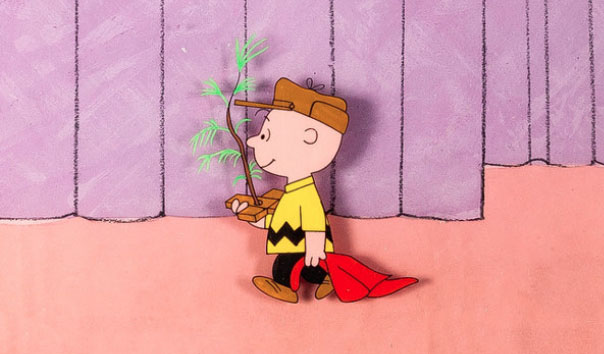
 However, Charlie Brown chooses a live tree – a small, sad-looking twig with only a few pine branches. When he returns, the kids are furious at his choice, and an exasperated Charlie Brown asks if anyone knows what Christmas is all about.
Linus obliges, taking center stage with a spotlight on him and proceeds to recite the Biblical passage from The Gospel according to Luke (2:8-14, King James Version), after which he simply states, “That’s what Christmas is all about, Charlie Brown.”
Charlie Brown then takes the little tree outside, near Snoopy’s doghouse, which has won the first prize for decorating, and he attempts to put an ornament on it. When the tree gives in to the weight, he’s distraught thinking he has killed it, until the entire gang comes along, decorates the tree, and surprises him with a cheer of “Merry Christmas, Charlie Brown!”
They all then sing a chorus of “Hark! The Herald Angels Sing,” as the special ends.
From its more contemplative tone to its focus on religion, A Charlie Brown Christmas was such a departure from previous holiday specials that it immediately connected with audiences, going on to win the Primetime Emmy Award for Outstanding Children’s Program, as well as a Peabody Award.
Something that set it apart was the music in the special and how it was utilized. Pianist Guaraldi’s jazz score includes “Linus and Lucy,’ which all of the kids dance to in a famous sequence. The upbeat piano jazz music has become a standard and almost part of the season’s soundtrack, playing on radio stations alongside traditional Christmas carols.
Additionally, Mendelson, Melendez, and Schulz decided to have children voice the characters, rather than using adult voice actors who sounded like kids, which was standard at the time. The performances of young actors Peter Robbins as Charlie Brown, Christopher Shea as Linus, Tracy Stratford as Lucy, and Kathy Steinberg as Sally, among others, lent another layer of relatability (like Schulz’ strip) to the special.
While many know these voices, there’s a part of A Charlie Brown Christmas they may not be familiar with. In the original opening sequence, Snoopy, Charlie Brown, and Linus are skating. Charlie Brown skids off into a snowbank, knocking snow off a tree, and the title appears. Initially, after this, Linus skid into a sign that reads: “Brought to you by the people in your town who bottle Coca-Cola,” announcing the special’s original sponsor. This portion of A Charlie Brown Christmas hasn’t been shown through the years, as there were different sponsors for repeat viewings.
When it debuted on December 9, 1965, A Charlie Brown Christmas was seen by 45% of television viewers, ranking second in the ratings behind the immensely popular Bonanza.
In the sixty years since, it’s become not just beloved by generations who have handed it down, but it’s also now an expectation of the season and a solid part of our holiday lexicon (describe something as a “Charlie Brown Christmas tree,” and most know what you’re talking about).
In the book, A Charlie Brown Christmas: The Making of a Tradition by Lee Mendelson, when asked why the special has endured, director Bill Melendez said “This little story and the way it’s told is almost as simple and direct as Sparky’s cartoon strip. The message is so gentle, there’s nothing pompous about the story.”
Celebrating its sixtieth anniversary this month, A Charlie Brown Christmas has rightly become like the return of a welcome friend when we watch it each year, as Time magazine critic Richard Burgheim wrote (almost prophetically) in his review of the special when it first debuted: “A Charlie Brown Christmas is one children’s special that bears repeating.”