

Animated cartoon characters have a tendency to get set in their ways. Some of them seem born without certain natural talents that most people take for granted. Others seem to have been around so long, they are used to acting in one particular way, while the world moves on around them into new fads and practices they just don’t understand. (Perhaps this latter tendency stems in part from the fact that cartoon characters generally don’t age – and thus fail to keep up when the times around them call for something new and fresh.) The result of these phenomena is that our favorite stars often find situations where they discover themselves to be the proverbial “fish out of water” (not to be confused with the character of the same name from Disney’s Chicken Little feature), and are forced to rapidly adapt or face utter humiliation. We’ll thus include along this new trail stories of success – and frequent failure – as our favorites battle change head-on, and sometimes are simply left longing for the good ol’ days.
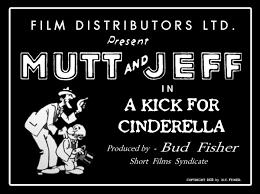 One of the earliest I can find to address a passing fad was Mutt and Jeff’s A Kick For Cinderella (1925). Jeff, as usual, is in a position under the thumb of his erstwhile pal A. Mutt, who leaves him to tend house and dressed in scullery maid’s cap and apron. Jeff has been cheating on his chores of cleaning up the fireplace, by becoming absorbed in a reading of a copy of the story f Cinderella. Mutt meanwhile has dolled up in top hat and tails, and announces that he is off to give a public exhibition of Charleston dancing – an event which is for “fancy steppers” only, definitely leaving Jeff out. Mutt embarks to his destination (in a shot predicting the opening of “Top Cat”, where he appears to be riding in a taxi, but is merely being seen through the window, actually walking in the street directly behind the vehicle), leaving poor downtrodden Jeff begins to weep at his depressing fate, his tears skipping a little dance around his feet.
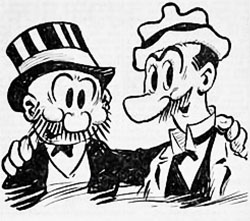 Suddenly, a large flame emerges from the fireplace, taking a stance in the living room, and transforms into a good fairy. She inquires about Jeff’s crying, and learns that he wishes he could go to the Charleston exhibition. A wave of a wand, and Jeff’s maid cap and apron transform into top hat and tails similar to Mutt’s. Another wave, and the stool upon which Jeff sat transforms into a taxi (fancier than the one we saw before, and one that Jeff can realy ride in). Finally, the secret weapon – a magic pair of dancing shoes, with which the fairy promises Jeff can outdance anyone. The usual warning – be back by 12:00, or you will lose everything. A dissolve, and the fairy is gone. Jeff thus makes his society debut, barging in in the middle of Mutt’s best moves on the dance floor, and completely upstaging his act, pushing Mutt off to one side while Jeff gleans all the applause. A furious Mutt grits his teeth, and produces a banana, wolfing down its contents, and tossing the peel onto the floor near Jeff. Jeff is trying to play the “sheik”, as the trending phrase of the day went, adding a little Egyptian to his act by donning a facial veil like an exotic dancing girl. However, he does take a tumble on the banana, resulting in an uproarious laugh from Mutt. Jeff regains his composure, shimmying his way over in Mutt’s direction with the peel in hand, then tosses the oily skin into Mutt’s face. As Jeff turns back toward the attention of the audience, Mutt retaliates by tying the tails of Jeff’s coat in a knot around a potted palm. Jeff finds himself carrying excess weight back onto the dance floor in the form of the plant, just as he notices a clock face high atop a central column of the hall, fast passing the quarter hour before midnight.
Jeff determines he must stop that clock, but is held back from reaching it by his coattails. Jeff reaches into a pocket, and fortunately finds he has somehow remembered to pack his shaving razor, using it to cut the coattails away. Jeff scales the column, and for a few moments engages in battle with the clock hands, attempting to force them to turn backwards, but getting socked on the jaw as the hands double themselves up into fists to deliver a Sunday punch. Jeff finally falls back to the floor, as his fancy duds begin to leave him, one by one, some as if being sucked away by an invisible vacuum, others merely making a slow fade out. Jeff is ultimately left standing before the crowd in only his underwear, and not even able to avert the laughter by fancy footwork, due to the disappearance of his magic shoes. Unable to effectively cover his modesty, Jeff gives up, and sprawls upon the floor in a crying jag. The scene transforms via dissolve back to the living room and fireplace where we first found Jeff – everything was a dream, including the Charleston exhibition, as Mutt appears, not in top hat and tails, but in nightcap and nightshirt, inquiring why his sap of a friend hasn’t come to bed. Jeff awakens, looks around to view reality, and is so happy none of his misadventures ever happened, he breaks into a spontaneous Charleston, leaving Mutt to make the traditional gesture of tracing a circle in air with a finger around his ear, as indication that Jeff must have gone crazy.
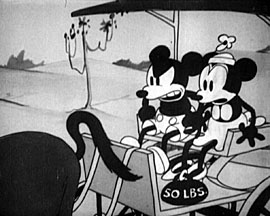
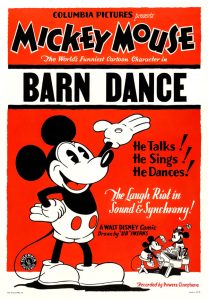 A formula had not yet been hit upon for Mickey Mouse when The Barn Dance (3/14/29, Walt Disney, dir.) was produced, so it was still possible for Mickey to lose out in the end, even against his arch-nemesis Pete. (It might be mentioned here that Mickey had also previously addressed a fad – and lost out – in his first produced cartoon, Plane Crazy, tackling the subject of private and experimental aviation. However, as he is generally accepted throughout that film as an inventive genius despite his epic failures, he is not quite enough out of his element to warrant inclusion here. For those wishing to visit it, discussion can be found in my previous “Flights of Fancy” article series on this website.) The Barn Dance finds Mickey at a similar case of disadvantage to that of Jeff before meeting his fairy benefactor – an utter inability to dance (although the rhythms Mickey prefers are substantially more rustic than Jeff’s up-to-date Charleston capers.) Even before reaching the venue of the event, Mickey finds himself faced with the challenge of new technology, as Pete attempts to steal the thunder of Mickey’s wagon pulled by Horace Horsecollar, by rolling up to Minnie’s front door with a brand-spanking new horseless carriage. Pete persistently honks the rubber bulb horn of his vehicle to attract Minnie’s attention, leaving Mickey to counter by picking up a goose rummaging for worms in the road, and squeezing its body to produce equally loud honks. Nevertheless, Minnie prefers the flash of Pete’s tin fenders, and gets in with him. But ol’ Horace turns out to be more reliable transportation, as one pull on the gearshift by Pete disconnects the car’s body from the seat, sending the works crashing into a tree, while Pete and Minnie are left seated upon a bouncing spring supporting the seat. Mickey at least wins round one, and gets to share some kisses with Minnie during a ride to the gala in his wagon (despite enduring some slaps in the face from Horace’s swishing tail).
 At the dance, though, it is another story. Mickey seems at first unaware of his lack of talent, boldly escorting Minnie onto the floor. At least one piece of voice-over narration provided in some Disney anthology show refers to his moves as the “Mickey Mouse Stomp” – a name which might well fit. All Mickey knows how to do is advance forward in time to the music, not even changing direction. Poor Minnie is left to allow him to lead, and soon finds she has no choice, as Mickey’s feet begin to trod upon her toes, one ankle, both ankles, both legs, and all the way up her torso past her waistline, trampling her like a pancake. In a clever piece of image exaggeration, Mickey’s feet seem to grow in Minnie’s eyes with each step, swelling to proportions where each shoe appears as tall and broad as the entire mouse’s combined head and torso. When the song is through, Mickey still has Minnie’s left leg pinned under his humongous shoes. Seeing Minnie glaring at him, Mickey finally realizes his breach of etiquette, and his face momentarily morphs into that of a donkey. He backs off, revealing Minnie’s limb stretched like the runner hose it is, about four to six feet long. Unable to retract it back into her body, Minnie resorts to emergency surgery, knotting her leg at midpoint to allow the excess length of hose to extend out from the knot, then producing a pair of scissors to cut off the excess length, allowing the knot to serve as a new knee joint. (Have they heard about this radical technique in the great medical institutes of middle Europe?) The next number begins, and Mickey’s ready for more – but all Minnie can see is those re-inflating shoes, and so, she gives Mickey the air, allowing Pete (who must have reached the event on foot) to cut in. Mickey stands puzzled, the proverbial wallflower, sulking at being jilted by his girl. Then, he spots a batch of balloons tied up to the wall as decorations. Tugging at the string of one, he ensures they are filled with helium, and hatches an idea. Untying one from the wall, he slips it down the back of his pants (barely able to maintain a footing upon the floor against the gas’s buoyancy). Then, he makes a graceful leap over the top of Pete, insisting on himself cutting in. Minnie heaves an exasperated sigh, expecting more of the same. Yet, she is pleasantly surprised, as Mickey is now entirely light on his feet – so much so, you might say he is walking on air. Now, it is Pete who sulks on the sidelines, until he too spots the balloons, and the not-too-well hidden one in Mickey’s trousers. Getting the idea, Pete pulls off a garter strap from around his ankle, then a small dagger from his pocket, and aims the weapon like a slingshot at Mickey’s balloon. POP! Mickey lands in a heap atop Minnie, and Pete approaches, pulling the popped balloon out of Mickey’s pants and displaying it to Minnie. Minnie turns up her nose almost to the ceiling at Mickey, and sashays away again in Pete’s arms. Mickey is left to perform a Stan Laurel whimper while seated upon the dance floor, for a quick and final iris out.
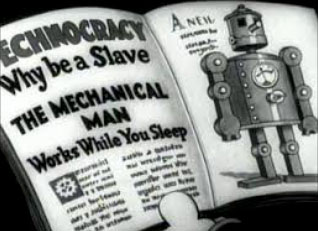 Many cartoons addressed the rising craze of belief in a mechanized world of technocracy – an economic dream of machines performing all laborious work, and mankind able to indulge in leisure pastimes rather than drowning in the workaday world. Virtually all of these films involved robots, and were discussed at length in my previous article series, “We Robots!” One such cartoon, however, seems to exemplify the frustration of dealing with this looming mechanical menace just to earn some rest and relaxation – Flip the Frog’s Techno-Cracked (Ub Iwerks/MGM, 4/12/33). Flip lounges in the backyard in a swaying hammock. The swaying is the result of his latest invention – a pulley belt, powered by a treadmill below on which Flip has placed a dog to run, pursuing a sausage suspended from a tree branch. Iwerks’s recurrent “old crone” spinster emerges from the house. While her relationship to Flip in this episode is never made clear, it is apparent she is somehow in command, and that Flip is supposed to be doing chores (possibly as a means of earning his room and board). She discovers Flip loafing in the hammock, and chases the dog away, then steps on the treadmill herself in attempt to reach Flip above. But she loses her balance on the thing, and starts running faster and faster. Flip’s hammock likewise gets rocked more and more violently, until Flip himself is “flipping” over and over, and finally thrown out of the hammock into the crone’s lap. The crone drags him over to a lawn mower, and insists Flip get busy. Flip obliges, but sticks his tongue out at her when she isn’t looking. He mows a short distance, but the blades get stuck on something and won’t budge. Flip reaches into the blocked blades, and pulls out a magazine, titled “Unpopular Mechanics”. He opens it to an illustrated article – “TECHNOCRACY – Why be a slave? THE MECHANICAL MAN works while you sleep.” Flip tears out the robot illustration, and creeps silently to a cellar door and into a basement.
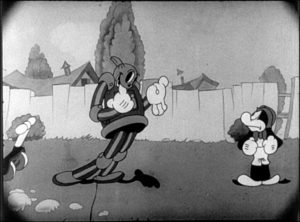 Inside, he finds raw material for his creation – a pot-bellied stove for a torso, two flat irons for feet, and stove pipes for arms and legs. For a head, Flip mounts an old Halloween Jack-o-lantern, then he tosses into the stove a large battery and an alarm clock. He applies to the robot’s shoulders a pair of battery jumper cables, plugs the wires into an electric socket, and throws the switch. Volts shoot through the robot’s frame, and the pumpkin head glows brightly, as the robot spins, spirals and does somersaults from the impact of the “juice’. He crashes against a wall, and his hollow eye-holes suddenly blink with life. He yawns, rubs his nose-hole as if wiping away the sniffles, and takes his first creaking steps. Flip cautiously approaches him, and is surprised with a spoken inquiry from the robot – “When do we eat?” Flip ponders, then provides a tray of sustenance in the form of nuts, bolts, springs, old bottles, pipes, cans, and another alarm clock. The robot begins to eat, his first mouthful clanking when it lands inside the empty stove chamber. He turns up his nose at an old smelly sock he finds among Flip’s tray – but downs the rest of the tray’s contents in one gulp, with more assorted clanks. He burps, and blushes in embarrassment – then washes it all down with a pail of water – which instantly leaks out the gratings in the side of the pot-bellied stove.
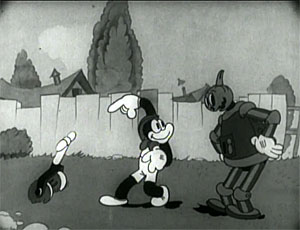 After dinner, Flip sets out to teach the robot his intended task. He shows him the lawn mower, gives it a few short pushes, then turns it over to the robot. The robot mimics the identical couple of pushes, then thinks it is finished. Flip shakes his head no, then pantomimes more pushing. The robot copies him again, pushing only in pantomime. Flip places the robot’s hands on the mower, then gives him a kick in the rear to start him – but the robot turns and simply gives Flip a kick in the rear. Flip finally puts both his own and the robot’s hands on the mower handle, and they both begin pushing – but clever Flip, concealed from the robot’s view under a shower of grass clippings, lets go of the handle and gradually falls back, leaving the robot to work alone, while Flip returns to his hammock. Once started, the robot is tough to stop. Not content with grass, he mows through a flower bed, cuts garden worms in two, rips out the front porch steps, and mows up a welcome mat (whose fibers fall back into place in re-arrayed fashion, changing “Welcome” to read “Nerts”). Inside the house, the robot hits the tail of a lion-skin rug – causing the lion-skin to yelp and run in panic. The skin gets underfoot of the old crone, causing her to fall backwards into the mower blades, which rip off her skirt and reveal her old-fashioned bloomers. She rides the lion skin outside, where she awakens the sleeping Flip. While she hides in the drop-seat of a suit of long flannel underwear on the clothesline, Flip chases the robot to get him to stop.
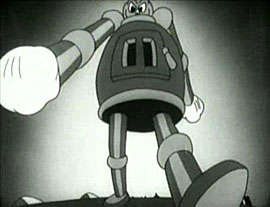 The robot runs through a chicken coop and de-feathers a rooster with the mower. But this rooster must be an ancestor of Foghorn Leghorn, as his feathers turn out to be sewn into the form of a suit which he merely puts on and rebuttons. Flip finally catches the robot and drags him to a stop, then takes the mower away from him and flings it out of frame. The robot still thinks Flip’s teaching new tricks, and picks up Flip, then throws him out of frame in the same fashion. Flip returns from the barn with an axe – but a chop at the robot does nothing, as the robot is made of metal too. What it does do is anger the robot, who no longer sees things as a game. In Frankenstein fashion, the robot crushes Flip’s axe, then turns menacingly upon his maker. Flip beats a hasty retreat into the barn, and there discovers a crate of dynamite sticks. As the robot lumbers toward the barn, Flip lights a dynamite stick and tosses it at the robot. The robot catches it, sniffs it, and apparently thinks it’s candy. He swallows it like a peppermint stick. Suddenly, he develops tummy trouble, as, in a creative trick camera shot, six duplicate images of the robot spiral around him on the screen. Not knowing what to do, the robot sees as his only out a quick trip to the backyard outhouse (typical barnyard humor that wouldn’t have passed the censors a year later). But he doesn’t quite make it, trips before reaching the outhouse door, and explodes. The scene dissolves to nighttime. The crone rocks patiently in a chair in her living room, while outside, as a clock tower strikes 2:00 a.m., Flip is still making up for his unfinished lawn mowing. The moon above morphs into the pumpkin head face of the robot, laughing at him. Flip is infuriated, and tosses the lawn mower clear to the moon, smashing the moon into a shower of stars and blackening the screen for the fade out. An original, ingenious, and well plotted episode, marking one of the finest in the series.
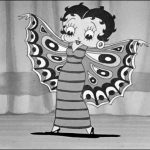
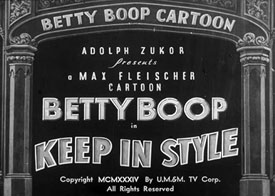 Betty Boop was seldom majorly behind the times. Instead, she receives inclusion here for one of the few instances in animated cartoons of fashion-setting instead of fashion-meeting. Keep in Style (Fleischer/Paramount, 11/16/34 – Dave Fleischer, dir., Myron Waldman/Edward Nolan, anim.), displays her as host of the Betty Boop Exhibition, an event billed as for one week only, despite the show’s inclusive dates spanning two months. Betty sings an original ditty about always keeping in style, then presents some new inventions of the day, first in the world of automotive technology, with various styles including the small car for the large family (every inch compartmentized to hold mother, father, and about a dozen children), a super-streamlined model (with the driver flat on his back), a car with four rumble seats based on relativity of order (first seat for 1sr cousin, the 2nd cousin, 3rd cousin, and finally mother in law), etc. Useful household gadgets are also displayed, including a useful grand piano that folds to double as sofa, radio, stove, hi-chair, and even walking cane. Betty then displays her own vision of the world of modern fashion, with a convertible dress ensemble that goes from long sleeve to short sleeve, high skirt to floor-length hemline, and can look like a walking flower one moment, or the wings of a bird the next. She finally reveals her ultimate creation – a pair of garter-supported sheer anklets which flap miniature skirt-style lace around each of her ankles. The embellishments make an overnight sensation, stealing the headlines, and soon a parade of various characters is marching down the street, including gentlemen, hoodlums, street sweepers, ducks, cats, and even cows, all wearing Betty’s anklets. Betty rides on a swan float, also decked out in her creation, to complete the song and the cartoon.
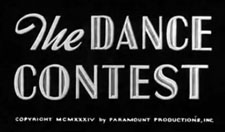 Popeye, a character who seemed to have more awkward moments dealing with the foibles of modern life than any other, had his chance to wrestle with the demands of the dance floor in The Dance Contest (Fleischer/Paramount, 11/23/34 – Dave Fleischer, dir., Willard Bowshy/David Tendlar, anim.). It seems to be Olive’s idea to pry Popeye away from his nautical life to attend a dance contest. The sailor, priding himself on being afraid of nothing, seems willing to meet the challenge, though seemingly knowing nothing of what he is getting into as he enters the hall. Inside, Wimpy acts as judge of the proceedings, armed with a magic floor lever marked “Eliminator”, which, without so much as a change of gears, automatically opens a trap door anywhere in the floor under any couple he wishes to remove from the competition. One couple is removed simply because neither has any mustard available to offer Wimpy for his hamburger! When Popeye and Olive commence their performance, it becomes clear that Popeye has little more to offer in moves than Mickey Mouse. He again marches straight ahead in forward direction, regularly stomping on Olive’s toes, and only momentarily backs up a step to perform a couple of side-to-side hops borrowed from an old sailor’s hornpipe. Ultimately, both he and Olive end up tripped-up and in a heap on the floor. From a table on the sidelines, Bluto, dressed with a waistband sash and fancy shirt, laughs with gusto at how terrible the pair are. But he sees possibilities in the woman, and vows to show them something, straying onto the dance floor and pushing Popeye aside, then offering his extended hand to Olive. Olive finds herself in the hands of a near-master, and begins to enjoy herself as Bluto leads her through a graceful series of steps and backwards dips. Popeye begins to get peeved, and tries to cut back in, but Bluto again holds him back, and Olive offers no interference nor encouragement to become rejoined with Popeye as her partner. In a dialog line that was one of Popeye’s few which might have had trouble passing the code for any reissue, Popeye observes in a moment of self-introspection, “I guess I have no sex appeal.”
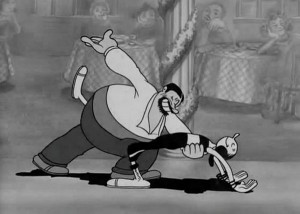 Popeye seats himself at a ringside table and orders a large bowl of spinach to console himself. “My only friend”, he states, as he downs the first mouthful. We see the bulge of the spinach he has swallowed disappear down his neck, through his waist, and into one foot, which begins tapping out a rhythm uncontrollably. Getting the idea, Popeye tries again with another mouthful, and gets his other foot tapping. Finally, he devours the remainder of the bowl – and his whole torso is full of rhythm and dance moves. Fleischer likely used either rotoscope or live-action reference to choreograph the sequences which follow, which are considerably advanced in quality for animation of Popeye from this vintage. Popeye steps out onto the floor, embarking upon some stylish Latin-flavored moves, and approaching Olive in a nice perspective shot, with Popeye entering from the foreground and Olive approaching from the background toward the camera, the two characters meeting up somewhere in the middle. “Clear the decks, on account of, I’m going to do me stuff”, shouts Popeye. Wimpy takes this cue to use his eliminator to remove all other contestants from the floor. Popeye and Olive then perform about a full-minute-long routine, including forehead-to-forehead steps borrowed from Fred Astaire and Ginger Rogers’ “Carioca” hit, but embellished so that Popeye and Olive increase distances apart with their feet while keeping their heads conjoined, rendering the dance into a dual limbo game of how low can you go. Popeye even manages to retain a few more hornpipe moves between his fancy Latin steps. The appreciative cheers of the crowd anger a flustered Bluto, who seizes Olive away as a partner for himself, determined to outdo the sailor. In animation undoubtedly supplied by Willard Bowsky, the studio’s expert on violent mayhem, Bluto tosses and bounces Olive around in a brutal Apache dance, even using Olive’s ball of hair on the back of her “do” as if the string of a yo-yo, to drag the poor girl up and down off the floor into Bluto’s grip. “That’s all I can stand. I can’t stands no more”, shouts Popeye, entering the floor. But instead of taking Olive as his partner, Popeye sets Olive aside, and begins to dance with Bluto, using similar violent moves to make Bluto the fall guy of the routine (including backwards and upwards kicks that smack Bluto in the face). After a taste of Popeye’s blows, Bluto begins to step backwards in a retreat, and all Popeye has to do is perform any sudden move, such as a shift of his waist, to get Bluto to flinch in terror. Popeye finally seizes Bluto by one leg and one arm, and begins swinging him around in a spiral (but comically, bouncing him several times upon the floor with each spin rather than making a clean swing). He lets go, hurling Bluto through four or five marble columns, and smacking him into a decorative fountain, where a cherub statue comes to rest on his pot belly, as if taking a nap. Wimpy approaches Popeye, and announces, “The winner”, then insistently prompts Popeye to take hold of the prize loving cup. Popeye sings his closing notes to Olive and the camera, while Wimpy reveals why he was so insistent on Popeye holding the cup. The prize is full of a hearty helping of the mustard Wimpy desired, complete with a stick to slather it onto Wimpy’s burger with his now-free hand, and Wimpy chows down as the film closes in an iris out.
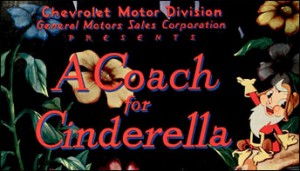 A Coach for Cinderella (Jam Handy/Chevrolet, 9/24/36). This soft-sell advertising cartoon was produced to spotlight the Chevrolet sedan – in an odd and unusual way. Directing credit for the film (unbilled on the actual footage itself, as was the custom with all Jam Handy films of the 1930’s) has recently been assigned by Wikipedia to Max Fleischer. But somehow, I doubt it. There may be confusion due to Max’s credited helming of one of the studio’s last ventures, “Rudolph the Red-Nosed Reindeer”. If Max is indeed present (which could be potentially possible, due to many Hollywood directors and animators having moonlighted from time to time on such product, including Jim Tyer on “The Princess and the Pauper”, and animation that looks like the work of some of the MGM gang from the days of the Captain and the Kids run in “Peg Leg Pedro”), then his art style had fallen off considerably since the days of Ko-Ko the clown and with the handing-off of Paramount directing chores to his brother Dave, as the characters of this film seem to bear no notable resemblance whatsoever to any of Max’s other creations. Animation of the humans is rudimentary at best. Animation of the gnomes is fairly smooth and detailed, and one scene with a pair of spiders seems meticulous in its movement – all pergaps a bit above average contemporary Fleischer standards. Were I to venture a guess upon the involvement of any known major or minor studio personnel, I’d say the artwork is perhaps closest to the artists of Van Beuren during re-training under Burt Gillett – perhaps even with Ted Eshbaugh and/or some of his crew in tow. With the sketchiness of Jam Handy records, we may never know.
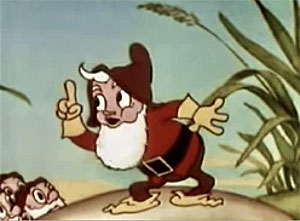 The usual Cinderella tale begins to unfold, with Cindy experiencing what appears to be offscreen violence at the hands of her two stepsisters – an act that makes a strange onlooker, one Nicky Nome (as he would be officially called in later installments) and his horse-hopper steed wince upon watching from the shadows of Cindy’s room. As Cindy falls asleep crying upon a sofa, Nick slips unto the room with a tape measure, taking measurements like a tailor, in preparation for arranging a big surprise for Cindy. Then, he is off on his steed to a gnome village in the woods (sort of the type you’d almost expect to find a stray Smurf in). Taking a podium stance atop a mushroom, Nicky reminds the other gnomes of past good deeds that Cindy had done for their kind, and announces that she needs their help now, having no formal gown, and worst of all, no coach at all to attend the royal ball. The gnomes set to work to right this wrong. First, Nicky gets busy on the wardrobe, having a flock of blue jays peck from a tree trunk a modeling dummy upon which to build Cindy’s dress from the measurements Nicky took. Two female spiders take care of the careful weaving of silken thread for the gown, while casually and realistically exchanging notes upon the latest spider-community gossip. Butterflies and birds provide the rest of the trimmings. That underway, the gnomes begin to concentrate on the coach. A carved-out pumpkin serves as the basic body, and a shell blasted by firecrackers off the back of a turtle supplies a hardtop roof. A chassis framework is constructed of large sticks, fastened together by nails hammered in using birds’ beaks. Shaven caterpillars form themselves into loops to serve as tires, and cut daisies are inserted amidst them to serve as wheel spokes and axles. Curled tendrils off plants are placed upon other flower stems to serve as automotive springs. Mosquitoes suck up fluids from dark-colored flowers (with the help of insects who operate the flower tanks like gasoline pumps), then a crew of Scottish-styled gnomes squeeze the mosquitoes like bagpipes to spray a coat of basic black over the vehicle. A crew of mice supply the power to raise and lower cylinders upon an engine, while fireflies insert themselves into conical reflectors on the front, to serve as headlights. We are quickly realizing this is not just a pumpkin coach, but more of a car. To add the finishing touch, the vehicle is pushed into a large cylindrical chamber replete with steam valves, levers, rockers, whistles, and the like, upon which is written “Modernizer”. Nicky pills a lever as the vehicle is secured inside, and the whistle of the machinery begins to play the strains of “The Peanut Vendor”. One small gnome remains trapped inside the device, and hollers to be let out. When he emerges, his old-fashioned medieval clothing has been made modern, now a fancy outfit of striped duds, as the gnome struts his stuff. This predicts for us what must be happening to the vehicle also, and the other end of the cylinder opens, to allow the finished creation to roll behind a display curtain. Without on-screen elaboration as to how the costume change was delicately accomplished, Cinderella awakens in her new gown, and is beckoned to by Nicky Nome to step forward to where the curtain is. Cindy reacts with delighted eyes, as the curtains part to reveal her ultimate “coach” – a new 1936 Chevy.
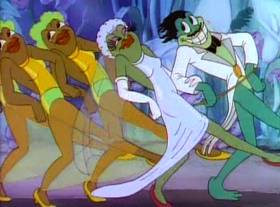 Swing Wedding (Harman-Ising/MGM, Happy Harmonies, 2/13/37 – Hugh Harman, dir.) The second of Hugh Harman’s musical all-outs involving frogs caricaturing famous black entertainers of the day, a follow-up to the Oscar-nominated “The Old Mill Pond.” While there are significant similarities between this film and its predecessor, including most of the same cast of frogs, there is here a minimal degree of plot. It is Minnie the Moocher’s Wedding Day, making reference to the Cab Calloway hit of the same name. Her intended, as in the original song, is Smokey Joe, a ne’er do well described in the Calloway songs as “cokey”, indicating he is a cocaine fiend (though the cartoon makes no direct reference to this in terms of that specific character). Smokey Joe is played by the frog impersonating Stepin Fetchit – lazy, shiftless, and seemingly incapable of quick-thinking or action unless placed in a panic. Smokey is late for his own wedding – substantially so, as he plods along through the swamp at his own chosen pace, in no hurry to face the fulfillment of his promise to Minnie, which must have been elicited in an utter moment of weakness, given his entire lack of excitement about the event. Awaiting his arrival besides Minnie is a friend of the groom, a Louis Armstrong-style cornet playing jumbo frog, known as Fog Horn. He is the first to spot Joe’s approach, and when he hears Smokey indicate that he “guesses” he is going to “dat ol’ wedding”, Fog Horn remarks, “You guess you’re goin”? Boy, you is the groom!” After a delayed reaction, this finally sinks in to Joe, who reacts with a girlish shriek, and takes off in a blur which lasts only a few seconds, before Joe returns to his snail-pace strut, mumbling to himself, “Doggone ol’ weddin’ anyhow.”
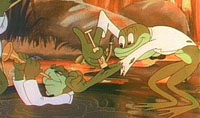 Meanwhile, Minnie is fit to be tied, wondering where her delinquent lover can be. Up from the pond water of the swamp rises a lean, thin frog with a heidi-ho chant, along with his orchestra on lily pads – the frog equivalent of Cab Calloway. He leaps up to the platform where Minnie and her bridesmaids stand, and asks Minnie to take a fling with the man who can swing. Minnie makes only the briefest remarks of unwillingness and faithfulness to her Smokey Joe – but shakes her hips provocatively at Calloway frog at the same time. Within a few more musical bars, she is ready to ditch Joe, and march up the aisle with Calloway. Joe arrives finally on the scene, just as vows are being exchanged, and the preacher asks if any man objects to the union. His jaw dropping to the floor, Joe finally speaks up, in his trademark, slow-paced drawl, stating he objects “most strenuously”. Fog Horn is with him, and pleads Joe’s case. “You say you got rhythm. HE’s got rhythm!”, says Fog Horn, pointing to the drooping Smokey Joe. “Tell me”, says a Fats Waller frog, obviously unconvinced. Fog Horn realizes that all Joe really needs is a means of encouragement – so, he pulls out his cornet, and begins sounding some hot licks straight into Joe’s back. Joe is thrust forward by the blowing, and begins flailing his arms and legs about in a wild dance of abandon, as Fog Horn continues to play hotter and hotter. Minnie begins to get swept up in the rhythmic sways, and Calloway looks around him, to realize that the situation has gotten out of hand. Calloway hops back to the safety of his bandleader lily pad, as Joe’s moves onstage continue to exhilarate the crowd. Calloway breaks into musical reaction by singing, “He’s runnin’ wild!”, with the band following with a red-hot rendition of “Runnin’ Wild”. Everyone in attendance breaks into mad dance, with Joe the inspiration of the evening (including an oft-recalled scene that got past the censors, of a trumpet player “shooting up” his arm with rhythm by use of a valve broken off the controls of his trumpet). Fog Horn closes the final moments of the film, by blowing a sky-high final note that takes so much wind, he is thrust backwards twenty yards into the pond water, submerging into it while incoherently repeating the word, “Swing…swing….”
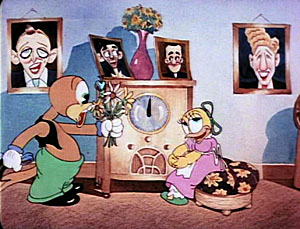
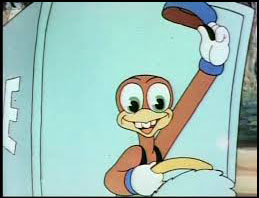 I Only Have Eyes For You (Warner, Merrie Melodies, 3/6/37 – Fred “Tex” Avery, dir.) – Our story is performed by a nearly-entirely avian cast (with the exceptions of four “photographs” appearing in the living room of Katie Canary, which are decidedly of recognizable humans – Bing Crosby, Eddie Cantor, Russ Colombo, and Rudy Vallee. Obviously from these names, the fad addressed is crooning. The lovely miss Canary, who speaks like Katherine Hepburn, is entirely balmy about radio crooners, listening to them every day over her floor-model radio, and vowing to save her love to someday meet and marry one. But true love could come to her much sooner, if she’d only let it – in the form of a local country-bumpkin iceman, who jumbles his speech in spoonerisms (voiced by Joe Twerp), and would love to break Katie away from the radio, but seems to be unable to register even a blip on her affection meter. The iceman has further problems of his own, in the form of an old maid upon his ice route, who orders 50 pounds of ice a day, but really has the hots for him. She corners him every time he enters her home to make the deliveries, tries to tempt him with an array of home-cooked pastries and entrees, and chases him around the place, this day the iceman only escaping by shutting the old maid up in the wall atop her folding Murphy bed.
 After another afternoon of being rebuffed and ignored by Katie, the iceman, though he is fully aware of his own limited singing talents, attempts to rehearse in his ice wagon, trying to perform a few bars of the song “Let It Be Me” he has heard on Katie’s radio (a performance which was borrowed from the earlier Merrie Melodie of the same name). However, the iceman’s speech impediment massacres the lyric, while his off-key sense of pitch doesn’t help the situation. “When someone seals, uh, heals your start, steals your wart, wheels your start ahey, let it me be, let it be he…aww, let it go, let it go…” Seeing no future for his own vocal abilities, the iceman spots a sign upon an office located in a nearby tree, which gives him a ray of hope – Professor Mockingbird, Ventriloquist and Imitator”. Entering the Professor’s office, the iceman attempts to inquire if he’s the guy that does imitations – but it comes out so garbled in his double-talk, that he simply asks, “Look, do something.” The Professor seems to be capable of doing everything, and offers animal impressions, a human calliope performance, and realistic airplane sounds. “That’s swell…that’s krell, but can ya swoon…can ya swim…can ya croon?” The Professor lets out with his best crooner impression – good enough, that the iceman drags him outside, and places him in the back of his ice wagon, closing the sardine-can like rear door to hide him inside, as he quickly drives to Katie’s place.
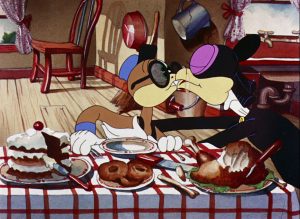 Katie hears from the window the melodious strains of the title song – except with a lyric change of “I only have ice for you.” Looking out, it appears that the notes are coming from the iceman’s golden throat. A street view, however, reveals that the iceman is merely lip-synching, with the Professor providing the real singing from inside the wagon. The ruse is good enough to fool Katie, who joins the iceman in the wagon’s front seat, falling into an embrace. The iceman rolls along in the vehicle, but presses a button on the side of the wagon, unseen by Katie. Inside the wagon, the button activates a light display, with a sign reading, “Swing it!” The Professor launches into a full verse of the song – but by now, icicles are forming on his tail feathers, frost clouds emit from his beak on every exhale, and his face is turning blue. The cold within the ice chamber has really gotten to him. He sings like he has a bad case of clogged sinuses, and punctuates his lines with sneezes. Katie is taken aback at the sneezes, which the iceman only is able to lip-sync badly, and begins to eye him with suspicion. Finally, one powerful sneeze from the Professor blows away the walls of the ice wagon, and the jig is up, much to Katie’s consternation and the iceman’s chagrin. The final scenes show us the aftermath. Katie is seen nursing the Professor back to health in her living room, and falling into his arms in an embrace, as two moving men remove her floor model radio from the house, replacing it with an electric refrigerator, ensuring she will have no further need for icemen or other crooners. What of our hero? He’s finally given in to the attentions of the old maid, and devours a table full of edible goodies at her place, while the maid puckers up to get a kiss. This is the only part that is hard for the iceman, but he accomplishes the unthinkable deed, by covering his eyes with a pair of dark sunglasses so that he does not have to look at what he is kissing. He closes with the remark to the audience, “Well never the ness, or ever the mess, well, anyhow, she can cook.”
• HELP: If anyone can direct us tp where a complete copy of this cartoon is online – we’d greatly appreciate it.
NEXT WEEK: More late ‘30‘s social dilemmas from Fleischer and Warner!