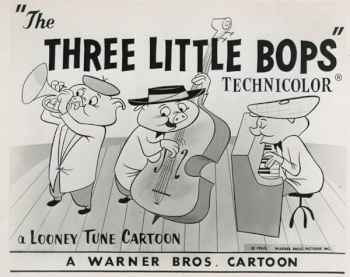

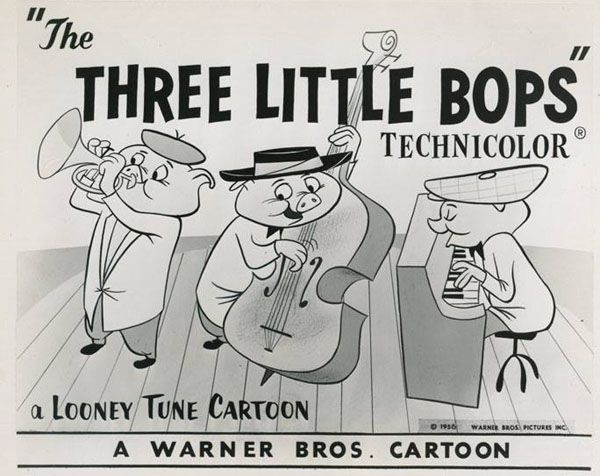
1957 was the year of Sputnik, beatniks, and cars with tail fins bigger than airplane wings. It was also the year that Friz Freleng directed one of the most beloved cartoons in Warner Bros. history. A masterful collaboration between director, voice actor, and musical artists, Three Little Bops is a confluence of cartoons and pop culture rarely seen in the 1950s.
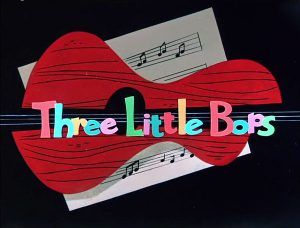 This cartoon has been studied and analyzed numerous times. There is no doubt that many animation fans know the interesting facts (no voice work by Mel Blanc, a song written by Stan Freberg, who did all the vocals, nifty jazz music by Shorty Rogers and his combo, and modern art styling in the incidental characters and backgrounds).
I’m going to take a different tack on this marvelous short and attempt to make a case for it using some research. I believe that Three Little Bops was, in reality, a sequel to a Warner cartoon featuring the same characters fourteen years earlier.
Three Little Bops (henceforth “Bops”) shares so many features with the 1943 short Pigs in a Polka (henceforth “Polka”) that it is possible to consider it a sequel rather than another variation of the Three Little Pigs fable. In short, what if the characters in Bops are the same ones in Polka, only fourteen years into the future?
 Let’s make some connections. The director for both cartoons was Friz Freleng, who was responsible for some of the most precise musical timing seen in the Warner shorts. Witness also Freleng’s hand in directing Rhapsody in Rivets (1941), another cartoon syncopated closely to music. Freleng was also known for creating continuing characters, so why not these pigs, only in a more mature form?
Also on hand in both 1943 and 1957 were several creative minds who were long-time mainstays on the Freleng unit; Warren Foster had a hand in writing both stories (although uncredited in Polka), and Gerry Chiniquy also animated in both cartoons.
Another possible clue comes in the opening lyrics of Stan Freberg’s singing, which is accompanied by a still of the pigs looking very much like they did in 1943:
Remember the story of the three little pigs
One played a pipe, and one danced jigs
The three little pigs are still around
But they’re playing music with a modern sound
Could this be a reference to the young pigs in the 1943 cartoon? In 1957, they were still around and remained musicians, only grown-ups now with modern jazz tastes.
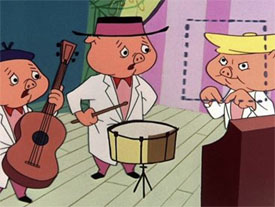 The Polka pigs are much closer in design to Porky than Chiniquy’s more mature-looking porkers, but might that be the result of the pigs aging into professional musicians? After all, character design does undergo updating; Bugs Bunny in 1954 does not look like he did in 1940.
Polka’s pigs wear three different hats and have three different color shirts. But so do the Bops, who all dress differently from one another in their 1957 cartoon. Was it a character trait held over from their youth?
It’s a bit harder to account for the wolf of Bops, who is clearly a different design from the wolf in the 1943 cartoon. However, in Bops, he apparently knew of the “Bops” beforehand, since he knowingly crashed their gig. (“Well, sho’ he was friendly, he shook their hand/ Announced he was joining up with the band/Instead of starting an argument/a one and a two and away they went”) The Bops regard him skeptically, but maybe they give the wolf another chance? This wolf is clearly musical in both his 1943 disguises as a gypsy dancer and a violin-playing older woman. Did he later decide to turn his “talents” to jazz?
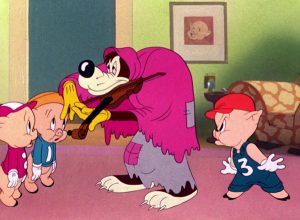 Oh, the disguises! The wolf uses several in Bops, and also in Polka. They all fail. In the original fable, the wolf uses no disguises; in 1943 and 1957, he uses them extensively. The wolf is more like a continuing character who never learns from having his plans foiled (Wile E. Coyote says, “Hold my beer”).
The fable is a parable about the dangers of sloth and carelessness, and the wolf clearly wants to eat the pigs. In 1943, this plotline follows closely. But in 1957, the wolf is motivated by the desire to be a great musician (Well, the big bad wolf was really mad/ He wanted to play music and he wanted to play bad) and be appreciated for it. These are the main thematic differences between the 1943 and 1957 cartoons. (The fable’s ending is echoed in Bops, with the wolf in Hell, boiling in a pot before rising to join the band).
These differences are very significant, but do not really weaken the possibilities that the characters in Polka and Bops may actually be the same ones, in more evolved versions, and in different settings. Is it possible that when Freleng and Foster sat down to develop Bops, they were perhaps subconsciously channeling their earlier cartoon? There are undoubtedly arguments against this, but a bit of conjecture is always fun. (Don’t worry, I know how to duck!)
WB blocks the full “Three Little Bops” cartoon on You Tube, so I’m unable to embed it here. You can watch it on Vimeo.
Drummer Shawn C. Martin has posted this video (below) – as a tribute the jazz performers on the cartoon soundtrack:
Stan Freberg – main vocal
Shorty Rogers – trumpet/flugelhorn
baritone (unknown)
Barney Kessel – guitar
Pete Jolly – piano
Red Callender – bass
Stan Levey – drums