
Created by Charles Schulz, Peanuts began as a daily newspaper comic strip which ran from 1950 to 2000. These iconic comics follow the everyday adventures of a group of children, often focusing on Charlie Brown, his sister Sally, their classmates and their dog Snoopy. Most recently, the characters were adapted to animation on Apple TV in Camp Snoopy, Snoopy in Space and The Snoopy Show, as well as a series of Snoopy Presents specials.
Behind this fresh interpretation of Schulz’s classic characters is WildBrain Studios, an award-winning Canadian animation house located in Vancouver. Toon Boom Animation visited the studio to interview the crew behind the Snoopy Presents specials and learn more about their production pipeline, which makes use of both Storyboard Pro and Harmony Premium.
In this interview, you will hear from Diego Stoliar (head of 2D), Ricky Laity (lighting director), Kaitlin Sutherland (assistant director) and Arisa López Tanaka (assistant animation director). They speak about their craft, the workplace culture at WildBrain Studios and the artistic choices that went into adapting Peanuts for animation.
How would you describe WildBrain Studios to someone not familiar with the studio?
Kaitlin: WildBrain Studios is an animation studio located in Vancouver, BC. It's a really cool place to work. The community is incredible, and I love working here.
Diego: I've been working with WildBrain for 10 years. And when I came to the studio, the first production was the My Little Pony production, and then we went to a lot of other shows until you get to the Peanuts Specials that you guys are seeing.
Arisa: You don't have to feel shy to bring your opinion when it comes to really great ideas. And when you have this freedom to bring your opinions, then that just only improves the production, that improves the studios, and that also improves the creativity.
The Snoopy Presents specials are incredibly ambitious. Can you tell us about a scene that was interesting or challenging to storyboard?
Kaitlin: The scene we just watched [from A Summer Musical] is Charlie Brown introducing Sally to summer camp for the first time. So this is them on their journey, getting on the school bus. It was a really exciting sequence to be a part of because we had to watch Sally get more and more nervous and uncertain as the kids and Charlie Brown got more and more excited about going to camp.
We just had to hit the beats of every song in this one, and so it was a lot more shots. It was a higher character count in every scene. I think just the scope of a musical is a lot more than just your regular kind of special.
There's this part where we punch in on Sally in the bus. All the kids are screaming out the windows; they're having a great time. Then we just see Sally in the corner there and we get even closer to her, kind of just like boxing her in with the frame of the camera.
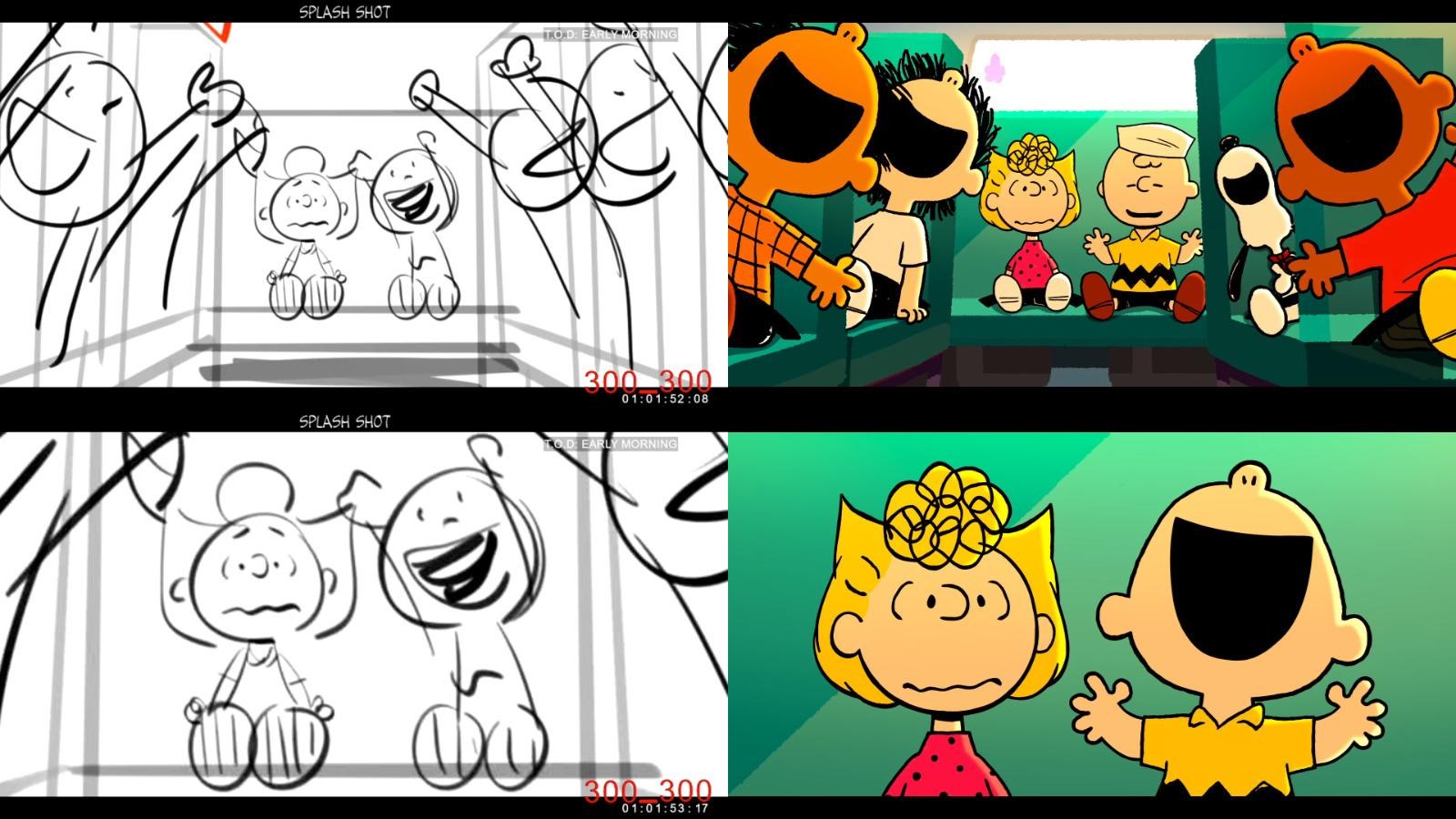
Storyboard panels alongside final renders of Sally on the bus in Snoopy Presents: A Summer Musical. Provided by WildBrain Studios.
What features in Storyboard Pro did you find most useful for storyboarding this sequence?
Kaitlin: I feel like the timeline, just in general. I know maybe it seems like a very simple answer, but especially working on something like the musical where we have the songs early on, it gives us all an opportunity to imagine what the film is going to look like. We can time our boards out to the songs from the very first images.
And I think that can't be beat versus trying to tap through, if every time you're pitching it, it's kind of a different cadence. Using the timeline and just the audio import features are my favorite part.
There are expressions that are very particular to Charles Schulz’s comics. How would you describe the faces we see when the characters are singing and shouting?
Kaitlin: It's a classic Charles Schulz face. A lot of everything that you see on screen is referenced from shorthands that he invented. If your head got tilted back, all you really would see is nostrils on the underside of your chin. So that's all we get in that Charlie Brown yelling: Nostrils, big mouth, and the ears on the side.
Arisa: You got this big space of mouth that maybe you have to animate. We shouldn't also forget about the nostrils. Those [poses], I think, are a very Schulz-like style. We try to keep that posing only for a special moment. So we don't overuse it.
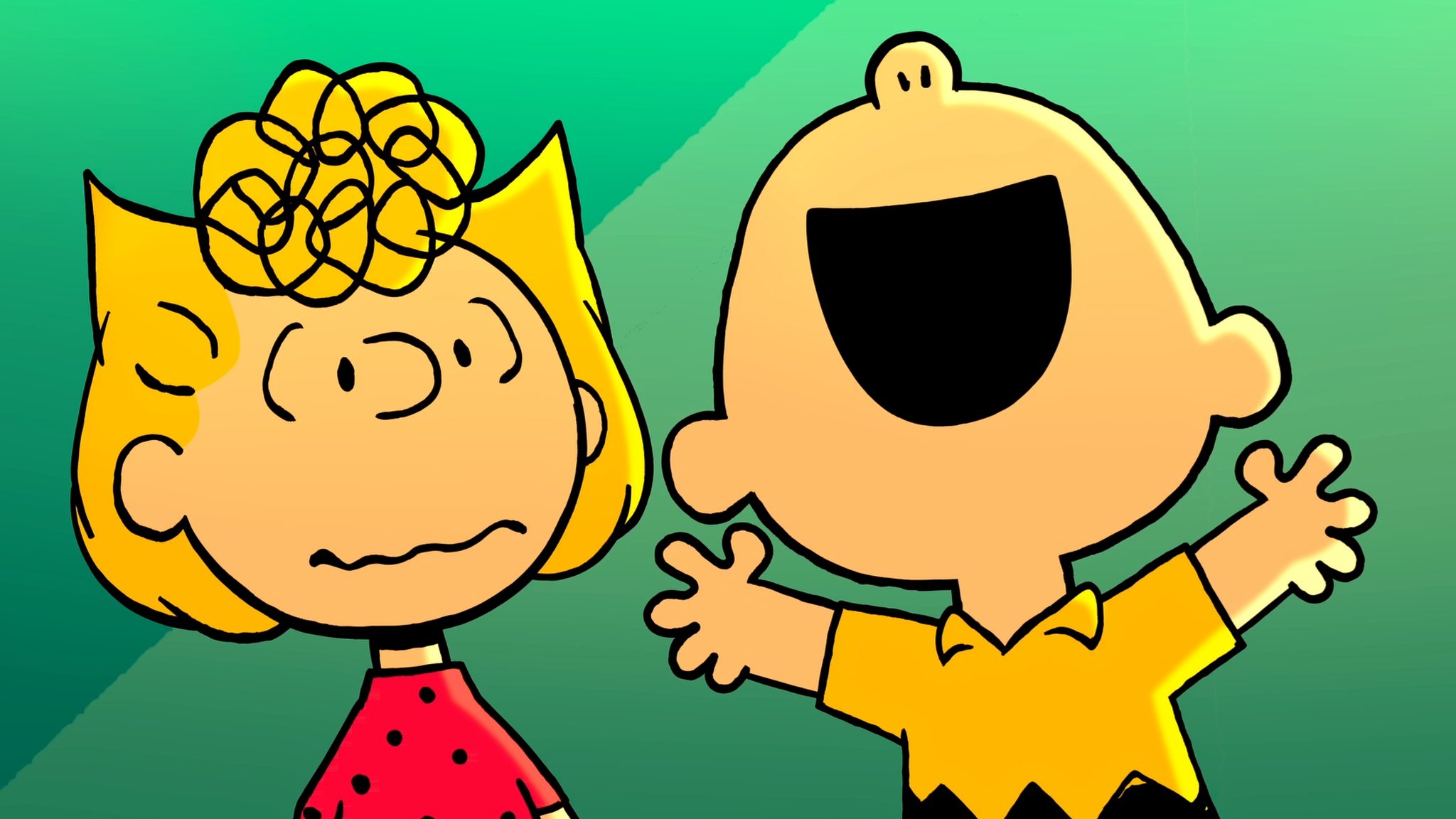
Character posing in the Snoopy Presents specials draws from the comics. Provided by WildBrain Studios.
From your point of view, what was the most interesting or challenging part of animating that scene on the bus?
Arisa: It's really challenging because of the number of the characters, but it’s also very fun to hit the notes. We also can't just rely on the song to tell the story. We try to figure out which expression actually works perfectly for the shots.
We use the deformers in Harmony Premium mostly to adjust their expressions. And also the line thickness where it comes to the mouth lines. We have a lot of control in the line thickness and also the pupils. Eyes tells a lot of emotions in stories.
In Harmony, we have a lot of control using deformer points, which make us able to animate in a similar style to hand drawing but you can click click right, click click left [to make minor adjustments]. And that subtlety really gives us important nuance in subtle acting.
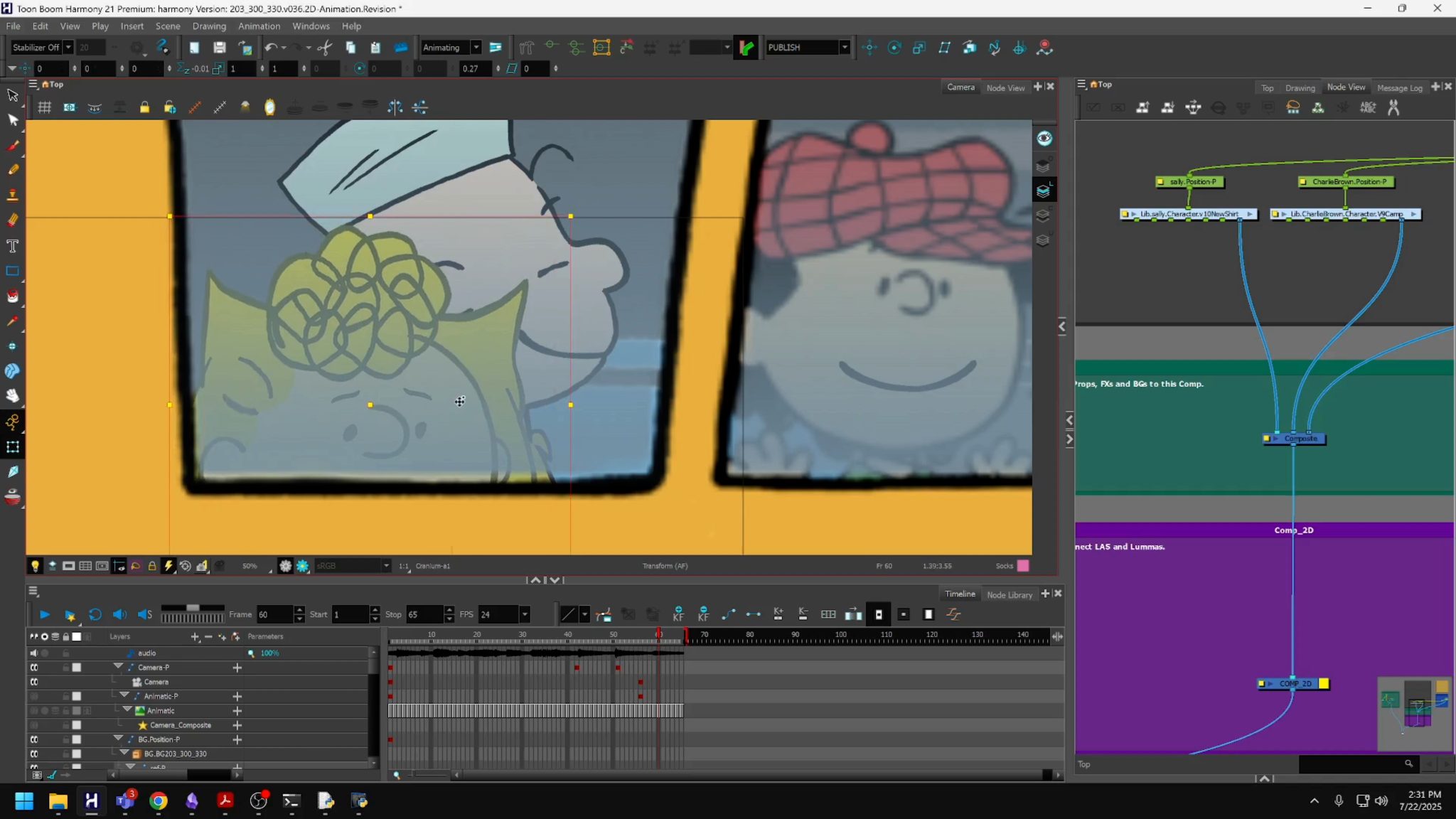
Sally’s character rig selected in Harmony Premium. Provided by WildBrain Studios.
Compared to other projects you’ve worked on, what was different about the Snoopy Presents specials?
Diego: Previs and the lighting department. That was super important and super interesting. Something we never did at that scale before.
Arisa: Previs is a step which solves camera moves, layout, character mapping and hookups. In 2D it is not common, but we needed it for a feature-like pipeline. We also have something called dailies, which is twice a week per-team for checking with animation director, if the shot is working in a sequence.
Can you describe a scene that was really interesting to light?
Ricky: On the clip from Welcome Home, Franklin when they're in the forest, it was really based around the lamp and where the characters are in relation to that lamp. So as the characters move around in this space, where does that light land on the characters? They don't get too bogged down in details, with too much form on the characters where they start to feel 3D.
It's about finding those shapes that really work with those kind of iconic characters already. Once you have that, you can start adding the terminator on the falloff or even subsurface scattering. As long as you have that basic shape and not too much detail, it will work out.
We also try to use the lighting for story structure. So we start with Charlie Brown in the cool moonlight and Franklin in the warm light to separate the two. And then as they start to make up, we see Charlie Brown walk into that warm light.
Harmony is really useful for compositing because we get to work in the exact same file that all the other departments are working in. Everything's available to us at our fingertips in seconds.
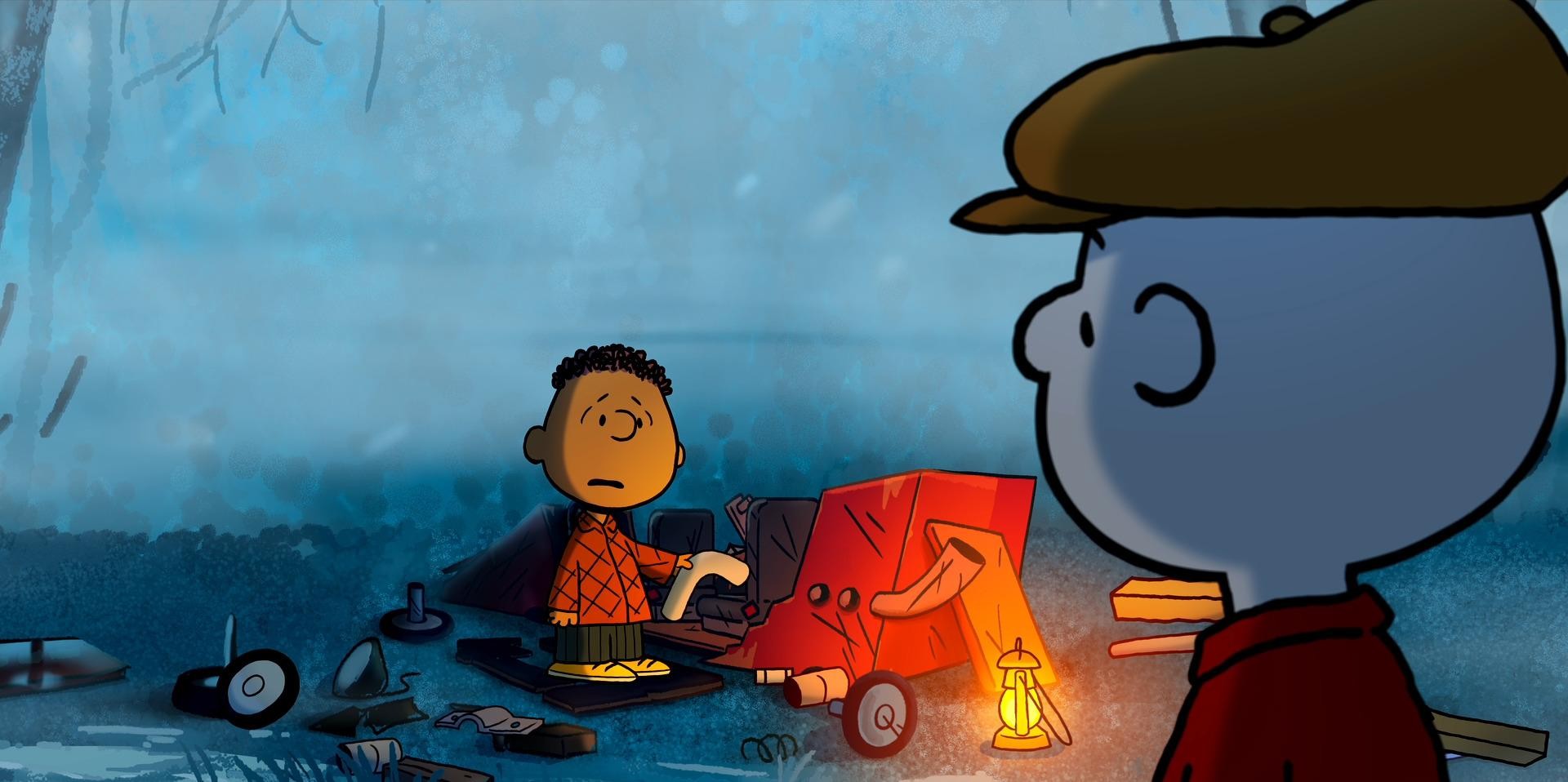
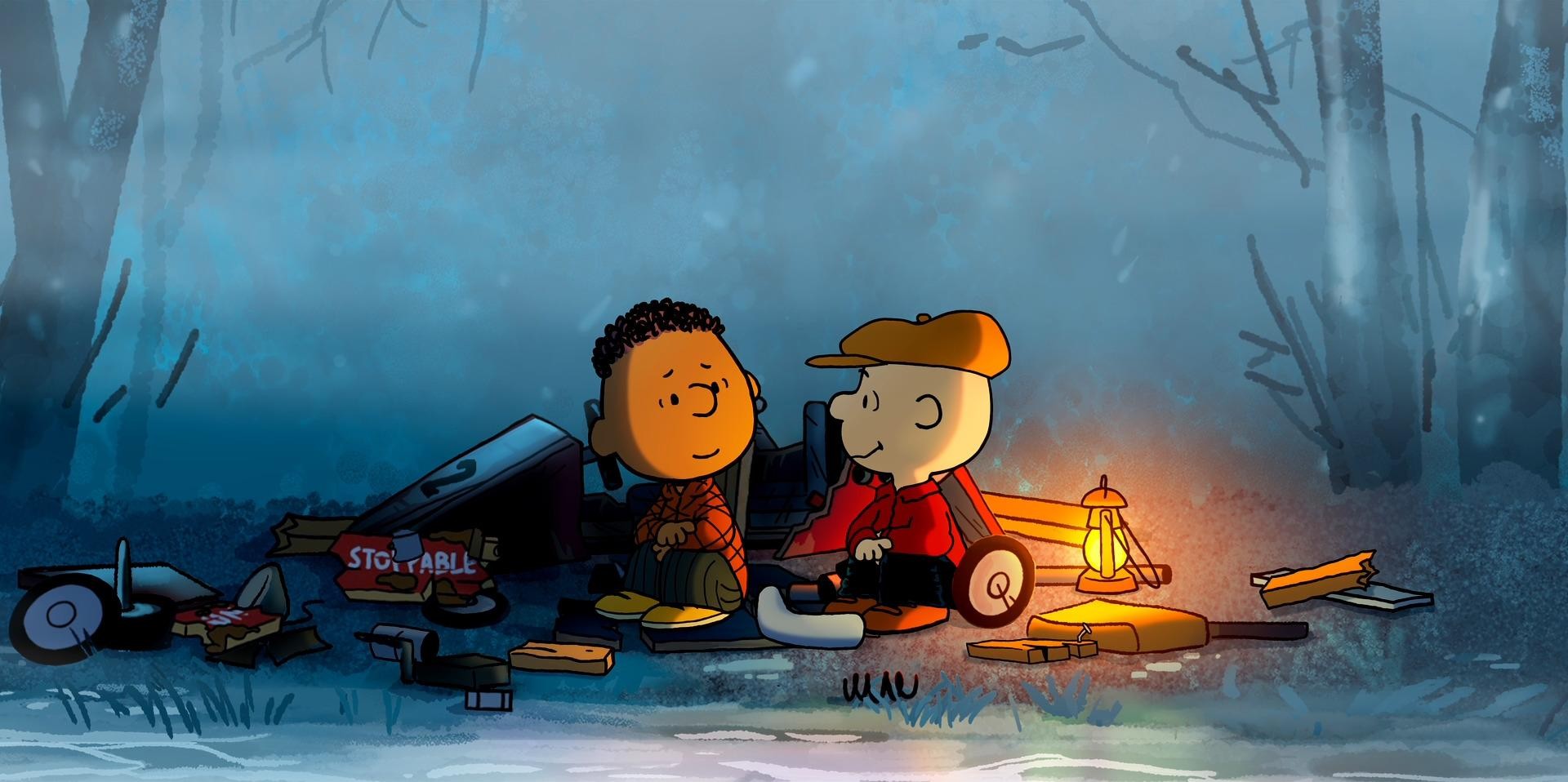
Snoopy Presents: Welcome Home, Franklin uses lighting effects to reveal both emotional distance and understanding. Provided by WildBrain Studios.
What can you tell us about the line boil effects used on A Summer Musical?
Kaitlin: Line boil is a natural occurrence in the origins of paper animation. It's where you draw a line, and if you were going to repeat that line again [on another frame], there's going to be natural human error. Using the deformer points in Toon Boom Harmony in the line, we jittered the line ever so slightly every time the character moved so it looked like each instance was redrawn by hand.
Diego: Combining the way Harmony boils lines with a texture boil and an extra step, which was our [in-house] deformation boil, creating the sensation that the character has been redrawn.
Would you like to tell us about a scene from the Snoopy Presents specials that showcases what WildBrain Studios’ compositing department can do?
Diego: So on the scene for One-of-a-Kind Marcie, when she's looking at the fish and then she goes into the dream sequence, the scenario starts in her room and there is a lot of light coming from the window. There is the lighting bouncing on the floor. So the compositing team had to balance out lighting layers that the lighting department created to do those effects.
Then when she goes into the dream, everything changes. We had to reduce the line weight until it was like zero to be able to create a difference between the imaginary traffic cop Marcie controlling the fishes and the real Marcie who is dreaming.
So the way we apply the lighting and compositing to those iconic characters was, we had to do a lot of lighting keys basically. Meaning draw like an illustration book of how the characters would look with lighting until we got to that point where we're like, “we like this. It doesn't look 3D, it looks 2D, but it has emotion. It has moods, lighting and everything.”
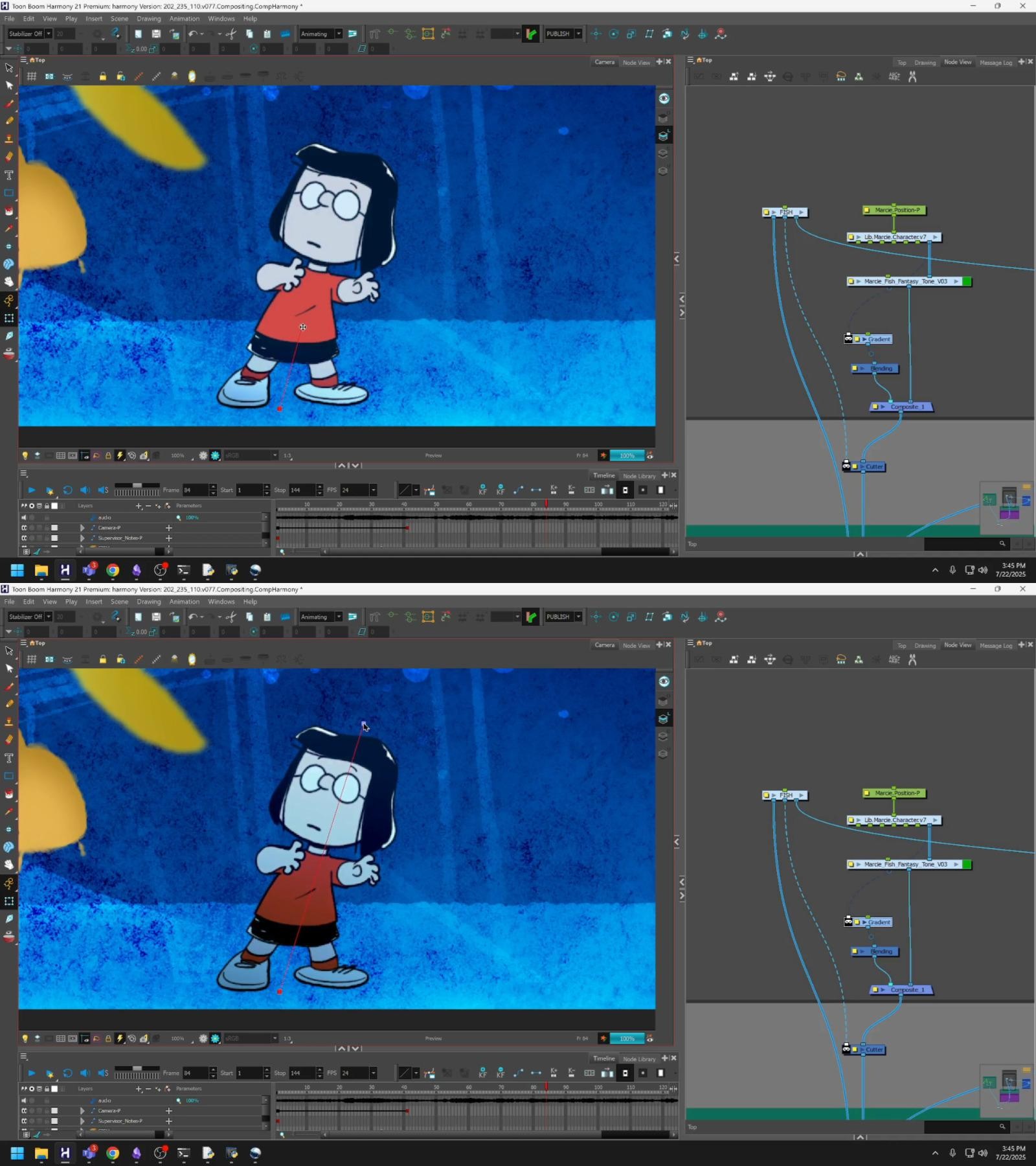
A gradient paired with a blending node can be a powerful tool for compositing. Provided by WildBrain Studios.
Which tools in Harmony do you feel are most important for compositing?
Diego: Gradients are very important because you can change a lot of the colors of the characters using a gradient, just on top of with a blending mode. I would say Channel Swap was very important because we could kind of separate characters and props and apply lighting to characters. And then flatten everything and still have the character holding a prop.
Animated Matte Generators were very important for lighting because all of the lighting shapes, the feathering and the terminators were done using Animated Matte Generators.
What was WildBrain Studios’ process for adapting the characters from Charles Schulz’ comics? Where did you look for references?
Kaitlin: As Charles Schulz worked throughout the years, even his shorthand kind of changed and developed. And so each special looks at a different era of Snoopy and Charlie Brown's and Peanuts comic strips to base their designs off of.
Diego: So the character rigs for the Peanuts specials were done in a way to emulate the Schulz line and the Schulz style in animation.
Arisa: We collected a lot of references. We also have the Peanuts library and they collect them.
Ricky: We're always finding ways to have those strip designs in the show to keep it feeling organic and hand-drawn like Woodstock flying. You have the lines behind them or the shout lines from characters.
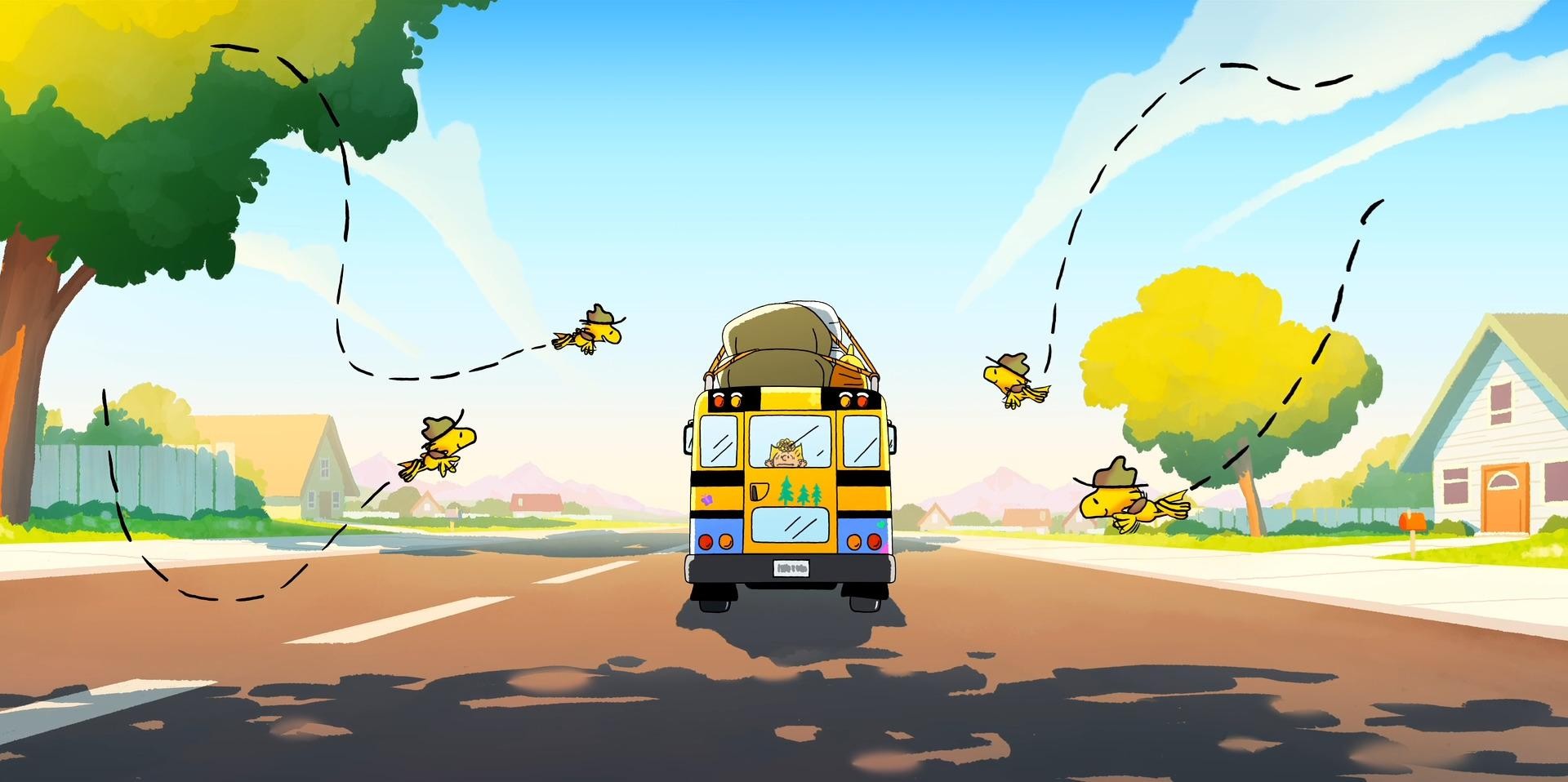
Production still of Snoopy’s Beagle Scouts in Snoopy Presents: A Summer Musical, with motion lines trailing behind the birds.
How would you describe the workplace culture at WildBrain Studios?
Ricky: WildBrain Studios is a really fun studio to work at because we're allowed to push the pipeline whenever we need to and open up treatments and try whatever we want.
Arisa: WildBrain Studios has been my favorite place to work.
Diego: It was great to join the team from the beginning. WildBrain Studios is always pushing for creative different styles and everything and pushing also the technology of the way we produce shows.
Kaitlin: I watched cartoons as a kid. I never grew out of it. I found out you could do it as a job and I couldn't imagine doing anything else. I really like trying to create content for the next generation of kids to be inspired, to feel things that the shows that I watched growing up made me feel.
The post Behind-the-scenes with WildBrain Studios on the Snoopy Presents specials for Apple TV appeared first on Toon Boom.