
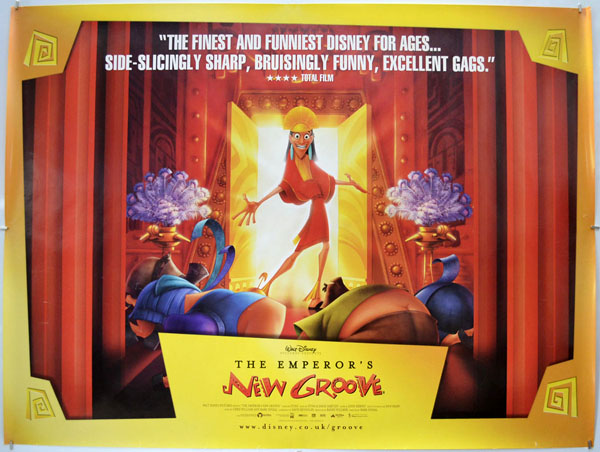
The film that “Kingdom of the Sun” became.
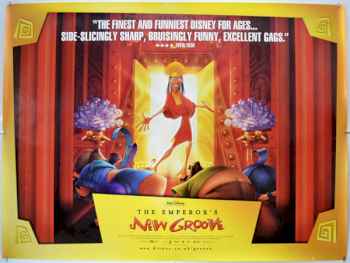
When Disney’s The Emperor’s New Groove was released on December 15th, 2000, it debuted at number four, behind What Women Want, Dude, Where’s My Car? and How the Grinch Stole Christmas. By the time it ended its theatrical run, it had the lowest box-office for a Disney animated feature since the 1980s.
A lot has changed in the twenty-five years since the film debuted. Today, The Emperor’s New Groove has a following unlike any other Disney animated feature, with fans firing off quotes from the film, cosplaying as the characters, and purchasing the myriad pieces of merchandise now available (that weren’t when the film debuted).
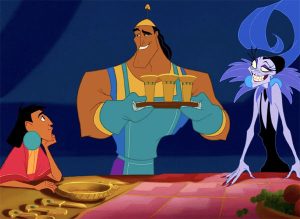
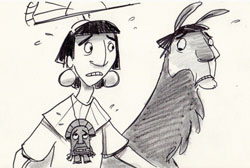 The film tells the tale of Emperor Kuzco (voiced by David Spade), who rules over a fictional South American kingdom. He is mistakenly transformed into a llama by his scheming advisor, Yzma (Eartha Kitt, who we lost in 2008), whom Kuzko had fired, and her dim-witted sidekick, Kronk (Patrick Warburton).
Pacha (John Goodman), the kind-hearted peasant, agrees to help llama Kuzco return to his human form, even though Pacha’s home will be displaced by the new resort, “Kuzcotopia.” Along the way, Kuzco’s selfishness ebbs as he learns the value of friendship.
In honor of the 25th anniversary of The Emperor’s New Groove, what follows is insight from several of the artists who worked on the film.
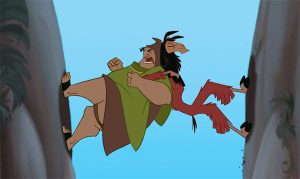 The film had been saddled with stories of its troubled production, as the fast-paced, irreverent comedy began life much differently in 1994, as Kingdom of the Sun, an epic, and more traditional animated film inspired by the novels The Prisoner of Zenda by Anthony Hope and The Prince and the Pauper by Mark Twain, all set against Incan culture.
However, The Emperor’s New Groove went through six years of story challenges and “overhauls” that have been discussed over the years, particularly in the 2002 documentary, The Sweatbox, directed by John Paul-Davidson and Trudie Styler (the wife of Sting, who wrote the songs for the film). In an interview just before the film’s release, Randy Fullmer, producer of The Emperor’s New Groove, (who sadly passed away in 2023) talked about how the major shift in the film happened:
“One day, literally, we had an argument about whether it was right to put a wheel in the movie. The Spanish were the ones who brought over the wheel [to South America], and since the Spanish hadn’t arrived yet, could we really have a cart with a wheel on it? At the end of the day, we realized that we were heading in the wrong direction.”
 Mark Dindal, who had directed 1997’s Cat’s Don’t Dance for Turner Feature Animation and would go on to direct Chicken Little (2005) for Disney, was the sole director on The Emperor’s New Groove, after Roger Allers left the project, also discussed the film’s evolution in a 2000 interview:
“It never quite clicked. Each time we tried to work out a problem, [Chairman of The Walt Disney Studios] Peter Schneider and [Disney Studios President] Thomas Schumacher would ask us to think outside the box-think, broader strokes, not just little changes. Finally, we came to a point where we decided to think beyond where we were.”
The main character in The Emperor’s New Groove, the Emperor Kuzco, is portrayed as selfish and spoiled at the start of the film and evolves into a more sympathetic character throughout. This unique personality presented a challenge when bringing the character to the screen, according to Kuzco’s supervising animator, Nik Ranieri.
“We did struggle over likeability,” said Ranieri in 2000. “A few scenes were cut early on because many felt that Kuzco was too nasty. The idea being that the more nasty he is at the beginning, the more of a personality change that he goes through.”
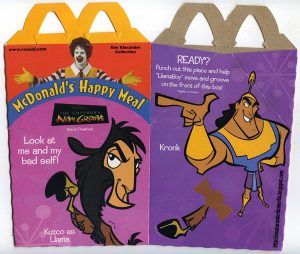 The scene-stealing character in The Emperor’s New Groove is Kronk. With Warburton’s hysterical vocal performance, coupled with stellar character animation from Tony Bancroft, Kronk, with his obsession with cooking the perfect dinner (particularly his spinach puffs) and creating and humming his own Mission Impossible-like theme song, has rightly become a favorite among fans. In an interview just before the release of the film, Bancroft reflected on Kronk’s back story that made him so memorable:
“He wasn’t given very good advice when someone told him to pursue a career as a villain’s sidekick,” laughed Bancroft. “He’s a really good-hearted guy, definitely more brawn than brain, but still a good guy.”
Then, there’s Kronk’s boss, Yzma. In 2000, the late, great animator Dale Baer (who passed away in 2021) discussed how Eartha Kitt inspired him to craft this villainous performance:
“She’s incredible. Not just watching her recording sessions but listening to them; you get a very distinctive picture in your mind. It just made coming up with ideas for her scenes that much more fun. She put so much into the performance that you wanted to do it justice.”
What has allowed The Emperor’s New Groove to find its groove among fans is how different it is from other Disney animated films released during the Studio’s Renaissance era. Bruce Smith, supervising animator for Pacha, discussed this in 2000: “The humor is way beyond anything that Disney has done. This film is like something from the Zucker brothers, like Airplane, with its non-sequiturs,” Smith said, adding, “We loved the cartoon aspect of it all.”
It’s this humor, uniquely added to the characters that audiences would come to care about, that has allowed The Emperor’s New Groove, with its message of compassion and the power of friendship, to stand out for twenty-five years.
“I like the challenge of getting emotion out of the characters that are done without realism in mind,” noted Dindal. “There’s a dimension to the characters, and all the animators apply the traditional rules to them. But, when you take something that’s far out in the imagination and still get a heartfelt moment, it’s an interesting combination.”