
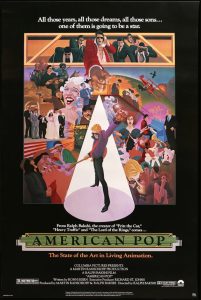
 When American Pop debuted on February 13, 1981, critic Vincent Canby wrote in his review in The New York Times that director Ralph Bakshi “…continues to push animation techniques to the outer limits more frequently explored by filmmakers who call themselves Avant Garde, but who seldom are.”
Celebrating its 45th anniversary this month, American Pop is indeed a daring animated film that opens in the late 1890’s and follows several generations, chronicling the inception and emergence of popular music.
The film seemed very personal to Bakshi. He was born in Palestine, and his family came to Brooklyn. The film seems to reflect that – the story of a similar American experience, using music as the backdrop.
American Pop begins with newsreel footage and title cards to depict a woman and her son, named Zalmie, escaping Russia, after their village is attacked and burned by Cossacks, and the father, a rabbi, is killed.
Zalmie and his mother immigrate to New York City, where young Zalmie gets a job handing out flyers for a burlesque show. This is Zalmie’s first introduction to music. Through the rest of the film, we follow future generations of Zalmie’s family, including Benny, his son, a jazz pianist during World War II, and Benny’s son, Tony, who becomes addicted to drugs as rock and roll emerges. The story ends in current day, with Pete, Tony’s son, successfully launching his music career at a concert.
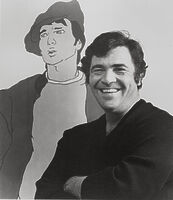
RALPH BAKSHI in 1981.
In 1981, Bakshi appeared on The Today Show with critic Gene Shalit and explained how the Rotoscoping process was used in American Pop (watch HERE).
Bakshi and his team of artists brought a number of powerful scenes to the screen in American Pop. These include one scene where Benny, while fighting in World War II, comes across a piano and is discovered by a Nazi soldier in a burned-out village, and another where a rock group performs Jefferson Airplane’s “Somebody to Love,” against the backdrop of news footage of the Vietnam War and rioting, along with psychedelic images.
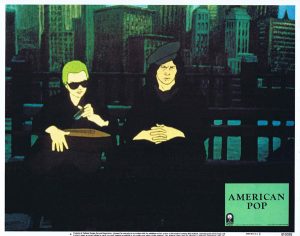 American Pop is also a wall-to-wall music book, with songs ranging from “Maple Leaf Rag,” by Scott Joplin, to “Night Moves,” by Bob Seger, tracing almost 100 years of history.
From his debut features like the X-rated Fritz the Cat (1972) and Heavy Traffic (1973) to gritty sci-fi fantasies like Wizards (1977) and Fire & Ice (1983), Bakshi has always taken chances with the medium in each of his projects. Looking back 45 years later, American Pop is, as Mr. Canby stated, a film that truly pushed “animation techniques to the outer limits.”