
 Hello to all the longtime Cartoon Research-aholics.
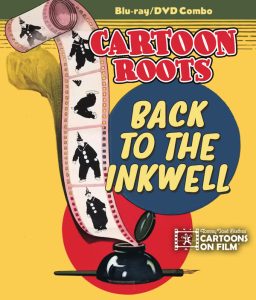
What a year 2025 ended up being…not only did I move house, but I also even managed a quick trip in December to Seattle, for an old-time radio get together, and also Hollywood, where I was able to catch up with my voice colleague pal Jeff Bergman. And as for the animation bug which infects us all, we cartoon aficionados had a marvellous collecting year. There was the first Looney Tunes Collectors’ Vault set, followed by two giant Blu-ray collections from Animation Heaven, the huge HUCKLEBERRY HOUND SHOW box, and the amazing complete and uncut TOM & JERRY set. And there was also the added bonus of Thad’s wondrously restored Paul Terry silent AESOPS FABLES… what a set of additions to all our cartoon history libraries. And it’s looking like 2026 will be huge, too – just announced is a new Tommy Stathes Cartoon Roots set: Back To The Inkwell (pictured at right) due out this week, as well as the Looney Tunes Collectors’ Vault, Vol. 2 in March, and a bunch of Lantz cartoons, new to HD, with Woody Woodpecker & Friends: Golden Age Collection. And Thad is promising some spectacular looking Famous Studios cartoons!!
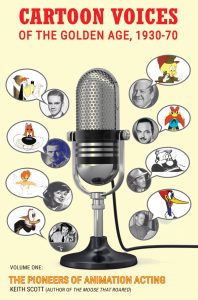 First the personal update. I’ve been completely out of the loop as far as any new pieces for Cartoon Research. For me, 2025 was also the year of finally reaching that age where my wife and I decided to move to a new apartment…the old house we had been in for over 35 years was simply getting too big for us to maintain as we enter our senior years (for want of a better euphemism), and way too expensive to contemplate giving the old abode a makeover. So we bit the bullet and put it on the market. That whole process took a good eight hectic months, including endless downsizing and decluttering. Meantime, however, I was still keeping an eagle eye out for maintaining new revisions needed for my CARTOON VOICES book update (a little over a year ago, I wrote a piece here about upgrading that mammoth book and correcting a bunch of pesky mistakes. As you know I’m a stickler for being as accurate as I can, and I can assure you that no one feels the little errors that creep in like I do!).
Working on those revisions leads me to this current piece. Thanks to the research conducted by eagle eyed cartoon experts like Devon Baxter and E. O. Costello, three new names can now be confirmed and added to the many uncredited voice artists who made the Golden Age theatrical cartoons such fun to listen to. The three voice talents I will mention this time around are Jerry Stewart, Gil Turner and Darrell Payne.
The first name Jerry Stewart is now confirmed as the excellent Bing Crosby imitator in two 1936 Friz Freleng-directed releases, LET IT BE ME and the quick follow-up BINGO CROSBYANA. Both cartoons satirized the immortal crooner Bing Crosby, who was at the time a huge star in Paramount musical comedy films, as well as being radio’s top vocalist, and a huge seller of Decca 78 rpm records.
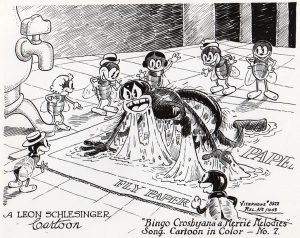 1936 was the year Bing became nationally famous in his high budgeted radio variety show, THE KRAFT MUSIC HALL. Many Warner cartoon buffs will recall a note in Jerry Beck’s and Will Friedwald’s indispensable 1989 book Looney Tunes and Merrie Melodies: in their entry on BINGO CROSBYANA they note how Bing’s attorneys didn’t find these parodies amusing (“’A potential threat to cartoon producers who caricature stars,’ was how The Hollywood Reporter [August 5, 1936] described the legal action. ‘The Crosby corporation has demanded that Warners cease distribution and exhibition of the reel. The demand states that the Crosby voice is imitated and the character of BINGO CROSBYANA is shown as a vainglorious coward.’”)
The voice imitation is accurate… at the time the younger Crosby had a slightly huskier sound, before his voice deepened a tone and became mellower in the 1940s. At the time I published the CARTOON VOICES book in 2022, I wanted the filmographies of each studio’s credits to either reflect confirmed voice artists or, if the information was only half-complete, I would append a “?” to names that were educated guesses. An unsigned 1930s news item had the name Billy Paye, a singer who had owned up to doing a Crosby imitation for cartoons, but that was all I had. I was waiting for the day when I could remove Mr. Paye’s question mark via more evidence.

This is Jerry Stewart in “Mystery Liner” (1934) with a blurry Zeffie Tilbury.
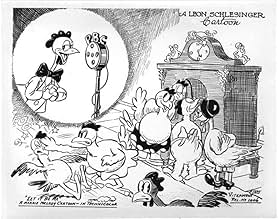
A publicity drawing for “Let It Be Me”
All these news items were sourced by ace researcher E. O. Costello [who a few years back did some impressive research here on Gus Wicke, the great Bluto voice in Fleischer Studios cartoons of the 1934-38 period.] And all these newspaper pieces stress Jerry Stewart’s Crosby voice as if it was a highlight of his shows. Just last month I found a 1933 radio show in my collection from a syndicated series called The Laff Parade, in which Stewart does a routine in a most authentic take off of comedian Ed Wynn. From this brief appearance I can vouch for his strong stage presence and accuracy of voice.
So finally we know who the Crosby delineator of these 1936 Warners cartoons was. Of course Bing, being such a huge star name, was mimicked in animation by various other singers as well, including Cliff Nazarro, Bill Roberts and Art Scott. This brings us to my second new name.
It was in the 1940s when, as previously noted, Crosby’s voice deepened. He was an even bigger name throughout the war-torn 40s, but he now faced new competition from the younger radio sensation of the bobby-soxers set, Frank Sinatra. Radio shows soon began featuring light-hearted “feuds” between Bing and Frankie, as to who was the top swoon-inducing voice of the era, and the Warners cartoon gag men sniffed a new opportunity for celebrity satire.
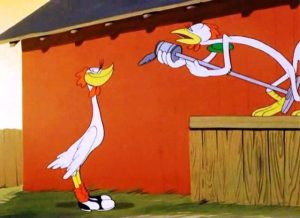
“Swooner Crooner”
Except …. Well, it now appears that Mr. Clampett recalled slightly incorrectly: Bickenbach indeed DID do the dreamily soft crooning of Sinatra singing numbers like “As Time Goes By,” “It Can’t Be You” and “Always in My Heart.” But he did NOT do the hilarious pipe-puffing Crosby voice from that cartoon, as I mistakenly assumed and first reported in my book.
Cartoon expert Devon Baxter’s digging into Warner cartoon history recently turned up a small but most interesting item from the well-known trade paper The Hollywood Reporter in its March 19, 1944 issue. In a brief item entitled “Schles Finds Voices,” it is noted that, “After testing scores of Hollywood imitators seeking vocal counterparts of Bing Crosby and Frank Sinatra for his forthcoming ‘Merrie Melodie’ cartoon ‘Swooner Crooner,’ Leon Schlesinger found just the right talent in his own backyard. Gil Turner will do the Crosby voice, and Dick Bickenbach the voice of Sinatra. Both are [Schlesinger’s] staff animators.”

Gil Turner
And in 1947, Art Davis’s new unit carried on with still another topical Crosby-Sinatra feud cartoon, CATCH AS CATS CAN, with Bing animated as a parrot and Frankie as a canary. This time those famous voices were mimicked by impressionist-comedian Dave Barry, less authentically perhaps, but just as amusingly.
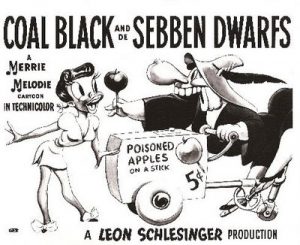 So that takes care of a few factual corrections I have appended to my revised “CARTOON VOICES” book. But regarding the aforementioned Bob Clampett, another research error further marred my book’s quest for accuracy. And it involves Clampett’s legendary, and controversial, cartoon classic COAL BLACK AND DE SEBBEN DWARFS.
The first edition of my book claimed – incorrectly, as it regrettably turns out – that Danny Webb, a highly prolific cartoon voice man based in Hollywood from 1937-41, had done the dialogue for the Amazonian wicked Queen in COAL BLACK (1942). It had previously been noted by my late research associate Hames Ware in the magazine Animato! (issue #40, Winter 1999). Clampett, who was normally possessed of a razor sharp memory for these production and personnel details, had apparently mis-remembered who did this famous froggy-voiced character in a letter he sent to British cartoon buff Graham Webb back in 1977.
As it turns out, comedian MC Darrell Payne (known professionally as “Don” Payne) was the one who recorded the funny Popeye-esque voice for the Queen (“Magic Mirror on the wall, send me a Prince about six feet tall !!!….”).
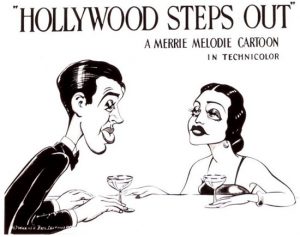 Following below is how I corrected and updated the section originally praising Danny Webb for a voice he did not in fact do – the next six paragraphs (appearing here in italics) are the way it will read in the updated version of the book.
With the outbreak of World War II in Europe, the versatile thirties voice-man Danny Webb, formerly Dave Weber, was drafted in the spring of 1941. He spent time in the European theatre in a USO troupe attached to a Red Cross unit (“he was dubbed the Atomic Comic by General Eisenhower”). Following the conflict, he relocated to New York in 1944 and a career in radio and early TV.*
(* Webb even resumed his cartoon career in 1945, with voice work for several “Gandy Goose” and “Heckle & Jeckle” entries for Terry-Toons.)
While he never returned to Hollywood, Danny Webb’s place in animation history is assured, both for his dead-on Joe “Egghead” Penner voice, as well as his endless variety of dialect characters and impressions for cartoons released by Warner Bros., Columbia and Walter Lantz between 1937-1940. Had the war not intervened, Webb may well have ended up with some latter-day recognition like his studio colleague Mel Blanc. And Webb wasn’t the only one. Kent Rogers, the young impersonator-actor from Avery’s HOLLYWOOD STEPS OUT (1941) would soon be grabbed by Uncle Sam, with other actors to follow. Although Blanc now dominated the scene, Webb and Rogers had both enjoyed a lot of cartoon employment over a short period. The animation industry loved latching on to uniquely gifted talents who were quick studies and therefore cost-efficiently reliable at recording sessions, where studio time was expensive. Of course, once those talents were no longer available, fresh voices were immediately sought, checked out and auditioned by cartoon directors.
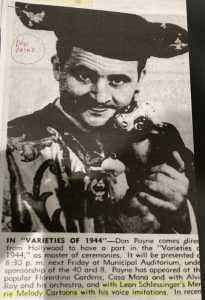 One young stage artist, Darrell Payne, was a veteran club comedian (“the man with the jumping eyes”), and a voice impersonator of screen and radio notables. He was known in the trade as “Don” Payne. Like many of his ilk, although he made a good living working in the endless theatres and nightclubs dotted across America, he remained mostly unknown as a name performer by the public. In one sense anonymity helped these “no-namers”: once they gained a reputation for being a “total pro” in, say, the role of a comic master of ceremonies with a solid reputation for getting big laughs, they were assured of constant employment, which enabled them to hone and fine-tune a tight, bulletproof act. Payne, who hailed from Wichita Falls in Texas, could dance, act in skits and had a solid standup act with “screwball antics and a winsome manner.” He also had that useful skill of being a multi-voiced imitator.
According to one report, he was doing a seasonal stint at Hollywood’s popular Florentine Gardens nightclub in a variety revue with Alvino Rey’s Orchestra, “doing his voice impressions of various famous persons. A producer from Warner Bros.’ cartoon department heard him change his voice and contacted Payne.” One of his featured voices was an excellent Popeye, a voice that really stood out in his act.
As someone who always made sure he mentioned doing “voice imitations for Leon Schlesinger’s Merrie Melodies,” Payne dined out for years with one particular story which had a Bugs Bunny connection: “The [Warner cartoons] man was looking for a burp for Bugs Bunny. All he needed was a man who could give a burp polite enough to get by the then-strict Hays office, and vigorous enough to get over the point. ‘I burped continuously for almost eight hours before they got just the one they liked,’ Payne remembers with a smile. ‘It was not too high and not too low – just a medium burp.’” PR puffery, or a smattering of truth? If any reader can identify this Bugs cartoon, recorded circa 1941-42, you’ll be entitled to a bottle of carrot-flavored Pepto Bismol.
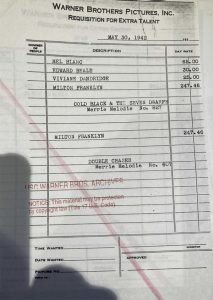 That aside, in the spring of 1942 Bob Clampett employed Payne to play the frog-voiced Wicked Queen in the previously noted cult-classic COAL BLACK AND DE SEBBEN DWARFS (1942).159 This was a hilarious performance, a tour de force characterization that perfectly matched that cartoon’s frantically palpable energy. (Eventually, like his vocal mimic colleagues before him, Payne, too, was inducted into the armed forces, his turn coming in the spring of 1944.)
And here is Note #159, cited above, from the updated Warner Bros. Notes section of my book:
159. “Atomic Comic” quote by Jack Bundy, Jack Bundy’s Album radio show (guest, Danny Webb), 7 May 1945 (audiotape in author’s collection). Updated: Also Don Payne clippings: Wichita Falls Times (Texas), 25 April 1944, San Angelo Standard Times (Texas), 23 July 1944, undated clipping from Hollywood Citizen News: “In Varieties of 1944,” other unsigned squibs from 1949 and 1956. Also, USC Warner Bros. Collection: Music payroll records from three Coal Black talent requisitions, May & June 1942.
And check out these two screen shots – first the photo of an original talent document from USC (this shot actually appears on page 221 of my CARTOON VOICES book). It is for a session supervised by Carl Stalling’s arranger-associate Milt Franklyn for a singing sequence with Mel Blanc (who voiced the dwarfs), Vivian Dandridge (the voice of So White) and Clampett’s Central Avenue pianist friend Edward Beale, who had contracted the black voice talents, and filled in as one dwarf. This was the section of COAL BLACK where the dwarfs and So White sing “You’re in the Army Now” and “Wacky over Khaki,” plus the “Five O’ Clock Whistle / What’s Cookin’?” sequence. This photocopy was taken on my return to USC in 2005, when I was actually allowed to request just ten (count ‘em, ten) photocopies of original documents.
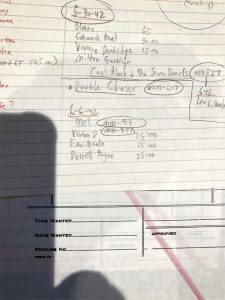 But next, check the handwritten notes from my initial research visit three years before, in 2002, when I was only permitted to copy notes from the original documents in pencil on to index cards. You can see in my handwritten scribble that another recording session, dated a week later on 6-6-42, was actually for COAL BLACK too, but on the original “REQUISITION FOR EXTRA TALENT” document from which I was making this pencil copy, somehow, they had assigned an incorrect production number – the number 977 was in fact the Chuck Jones cartoon FLOP GOES THE WEASEL. Note too I also hand-copied a third date for COAL BLACK (6-13-42), when drummer Leo Watson, the voice of Prince Chawmin,’ was scheduled. And that one shows the correct production number! Aaaarggh, trying to make sense of occasionally sloppy original documents was challenging too….in fact you can see on the actual May 30 photocopy the secretarial person who typed up the data wrote COLD BLACK! So for that date the production number was right, but the title of the cartoon was wrong. Mercy….
Actually in the 1942 documents a couple more cartoon titles were also given erroneous production numbers. That’s what confused me, otherwise I might have considered Darrell Payne as the Queen voice some twenty years ago. I can’t believe I did all that on site research at USC back in 2002, and there, hiding in plain sight in my reams of handwritten file cards, was the session information for the COAL BLACK song & dialogue recording with Darrell Payne and Vivian (this was the “Five O’ Clock Whistle”-poison apple-“she’s stiff as a board” sequence). I’ve had this info for 23 years and somehow, I missed the Payne connection and just remembered Clampett saying it was Danny Webb as the Queen years before, like a fait accompli. It just goes to show that for every tiny fact we learn in this always arcane subject, a new wrinkle keeps cropping up to confound we researchers even more. But we valiantly soldier on, always willing to correct one tiny fact with another that only a few folks on the planet care about!!
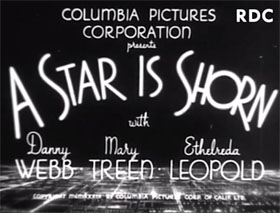
Click on this title card above to see the one and only live action comedy short starring Danny Webb.
After my book was published I came across a VARIETY clipping from May 1941, noting that Danny Webb had been drafted (“he is now making noises for Uncle Sam”). He had in fact disappeared from West Coast cartoons by the time COAL BLACK was underway. For upcoming stories for which Clampett needed voice mimicry, he had already begun using Kent Rogers and Jack Lescoulie. He and Tex Avery were always open to considering new talents who came to the cartoon studio to audition. And finally we should note that Clampett used the obscure Darrell Payne at least once more, voicing Mr. Meek in the zany Daffy Duck entry THE WISE QUACKING DUCK (1943).
That’ll do for now, I get exhausted thinking about corrections. The uncredited cartoon voices of the theatrical era is a topic that is always teetering on the edge of some nugget of new and hitherto unknown intelligence. Until next time, do keep listening to those old soundtracks. You never know who you might hear.
END NOTE: I’d especially like to thank Devon Baxter and E. O. Costello, along with Tom Samuels, all of whom are diligent researchers, and who are maintaining a vigil for any obscure information that might add to our knowledge of early cartoon voices of the pre-TV era. I recently completed a Famous Studios filmography to add to the reference section of the book, and there are still gaps in my knowledge there – so if anyone finds odd clippings mentioning New York radio and Broadway talent doing cartoon voices (1940s and 50s), please let me know and you will be noted in the revised book’s acknowledgments.
Copyright ©2025 by Keith Scott