

 Pretty much a maintaining of status quo as Lantz’s production continues through 1935. More color experiments, higher budgets overall, and some lively James Dietrich music, allowed Lantz and Universal to respectably hold up their heads among their competitors. Lantz had not risen to the status of a big boy or superstar in the industry, but at least, he wasn’t a Woolworth’s like Paul Terry or Van Beuren, and continued to show an interest in the gradual but progressing improvement of his product.
Do a Good Deed (3/25/35) – Oswald is operating a camp for boys out In the woodland, and the membership of this camp appears to be quite international. Some Russian kids, and even Dutch boys. Many of them sing song score of this film in their own nationality style. A bear gets loose, and starts chasing all the woodland creatures – object, mealtime. Oswald warns the camp about the bear’s approach, while we get one of those “woodland creatures gang up on menace and chase him away” scenarios. Even mosquitoes get into the act, and the bear gets the worst of it. No romantic subplot here. Song: “Do a Good Deed Every Day”, inspired by the usual Boy Scout trope.
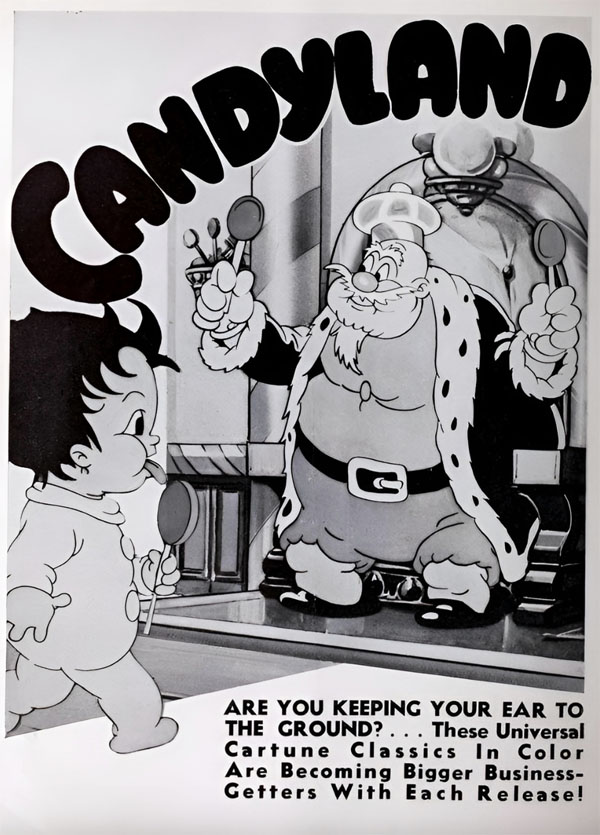
Candyland (4/22/35) – A color Cartune Classic. A little boy is taken by the sandman into a dream world of Candyland, where the Candy King bids him welcome. But the Candy King has a dark side, as he abuses some of his courtiers, and later in the cartoon offers the child a great surprise – a bottle of castor oil. I think even by this time, parents were using castor oil more as a punishment than as a remedy. As for gags, most of them are built around a candy factory, where a toy steam roller turns globular blobs of candy into wafers, and everything moves down a conveyor belt. This is an operetta styled cartoon, so nearly all the dialog and most of the exposition is sung, in original material. Arias might include “The Sandman Song” and a march for the candy makers as they work in the factory.
Elmer the Great Dane (4/29/35) – Elmer (who looks more dalmatian than great dane in this early design) is seen skulking, then running down a staircase at Oswald’s house. Somehow, he swallows a cuckoo clock, and gets a case of hiccups. Oswald digs up a book from his shelf of home remedies, and tries out various ones upon Elmer, including frightening him, and heating up his stomach. None of the treatments seem effective. Eventually, the clock comes out of Elmer’s mouth, but Elmer still has the hiccups from things ingested during the remedies, and flips Oswald in his Murphy bed into the wall. Song: “Blue Sky Avenue”, from Universal’s Gift of Gab. Gene Austin recorded a vocal version for Victor. Both Ted Weems on royal blue Columbia, and Angelo Ferdinando and his Hotel Great Northern Orchestra on Bluebird, used the song as the flip side to their recordings of “Talkin’ To Myself” from the same picture, discussed in our last installment. Jan Garber got the Victor scroll release.
Springtime Serenade (5/27/35) – A color Oswald, originally billed as one of the Cartune Classics, but altered in its opening titles upon reissue. It’s February 2, and rhe woodland creatures are just preparing for their springtime activity – except for Professor Groundhog, who sees his shadow, and knows it means six more weeks of cold weather. This doesn’t stop everyone from ignoring his foreboding warnings, including Oswald and his Missus, who busily engage in spring cleaning to open their tourist lodge for the season. Eventually such vernal activity is brought to a screeching halt by a late-season snowfall, leaving Professor Groundhog with an “I told you so” smile on his lips. For all his troubles, he receives a snowball tossed in his face. Song: “Hi Ho, Ho Hum”, an original sung by Oswald and the Missus, and also as exposition by the Rhythmettes.
At Your Service (7/8/35) – This could easily be called “Oswald’s Service Station”, and is not to be confused with “At Your Service, Madame” (Warner, 1936), or any of several cartoons set around the modern filling station (such as “Mickey’s Service Station” “Porky’s Super Service”, etc.) which offered the kind of service you can’t get nowadays. Oswald’s nephew comes by and wants to help out. Oswald lets him, but lives to regret it. A rich man leaves his streamlined car to e serviced. Oswald winds up on the top of the lift, then in the bottom of a hole when the car is brought back to earth suddenly. The rich man comes back and asks, “Is my car finished?” “I’ll say it is”, says Ozzie’s nephew. Finding the car a wreck, the rich man nevertheless leaves happy, confiscating the nephew’s soap-box scooter, and snapping his fingers in defiance at the rabbits as if to say, “I’m having more fun this way.” Song: “(Oswald) At Your Service”, an original song that fits into a spunky Dietrich score.
Towne Hall Follies (6/3/35) – This cartoon can be compared to Betty Boop/’s She Wronged Him Right, in that the Town Hall is the venue for the staging of a melodrama, preceded by a trapeze act climaxing with a “slide for life” down an inclined wire – and right through a brick wall. Oswald is the hero, and his leading lady, Bunny Lou, seems to have curves in all the right directions (as does another dancer in the troupe, until her corset snaps, revealing her to be a 300 pound behemoth, who has to be removed with a derrick). Bunny Lou delivers a Mae West-type song in Betty Boop style. The plot goes along as most such spoofs go, without resorting to the train tracks or the buzz saw. Oswald uses the slide for life to send the villain on his way, via unicycle. Oswald and the soubrette wind up coupled for the final kiss in silhouette, behind a stage backdrop. Song: “Won’t You Be My Sweetie?”, sung by Bunny Lou, and a number for quartette mimicking the lyric and meter of “The Man on the Flying Trapeze”.
Three Lazy Mice (7/15/35) – Our cartoon is set in the community of Mouseville, where each mouse is kept industriously busy at work by order of their king, to earn their daily cheese. But there are three young mice that don’t want to work, and conspire among themselves to try to get out of it – by masquerading as three blind mice. They ignore a warning sign placed at the city limits by the authorities, and blindly (thanks to their dark glasses) venture into the wide, wild world, where they are chased by a predatory cat, who sets up a very obvious large mousetrap to capture them. However, the unseeing mice bumble their way past the trap. Eventually, the disguises are found out by the cat, and the mice elude the cat in a chase, propelling themselves aerially back to their home upon the snapping mechanism of the trap. Once back in Mouseville, they are found out by the king, who sentences them to dishwashing duties. The mouse who thought up the whole scheme gets dunked in the soap suds for his bum idea. Song: “We Don’t Have To Work”, an original by Dietrich, extolling the virtues of laziness.
Bronco Buster (8/5/35) – This cartoon begins with a good deal of sung exposition regarding a wild horse – wild in the sense of uncontrollable. The song in this case is inspired by “The Strawberry Roan”, a song which goes back on record as early as 1930. This horse is currently corralled at the O.K. Ranch, where Oswald makes his first appearance, as part of a medicine show troupe. Our boy Oswald tries to ride this particular horse, and at first finds it as impossible as the other cowboys have found it. Much of the cartoon is accompanied by lively fiddle and guitar music and harmonized yodeling, provided by no less than the Sons of the Pioneers (Leonard Sly (aka Roy Rogers) (vocal and rhythm guitar), Hugh Farr (fiddle), Carl Farr (lead guitar), Vern Tim Spencer (vocal), and Bob Nolan (vocal)), who receive screen credit. Eventually the horse seems to be tamed from ingesting some of Oswald’s cure-all. Song: “Way Out There”, a genuine song released as the flip side of “Tumbling Tumbleweeds” by the Sons of the Pioneers for Decca in 1934 and for Vocalion and the dime store labels in 1937. Riley Puckett would cover for Bluebird. Bill Boyd and His Cowboy Ramblers also got a Bluebird edition for dancing. Yet a third Bluebird version was issued by the Hall Brothers, probably recorded in Atlanta. A late version appeared by Bob and Dottie Brown on the Horace Heidt label, presumably sourced from some winner of his Youth Opportunity Program.
Here are the Sons of the Pioneers singing the song at the beginning of this great Paramount short, The Star Reporter In Hollywood (1937). I recommend watching the whole short as it has much else for cartoon fans to enjoy.
NEXT TIME: Further 1935 and 1936 next time, as Oswald “passes” himself as white.