

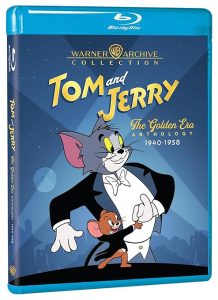
 With every one of these posts, I seem to say we’re living in a surreal world in many ways. Well, it’s true! Even as early as this year, did we think we’d have all kinds of restoration projects on the horizon (my own *cough* included)? That Terrytoons would see the light of day on MeTV Toons? The most science fiction-like fact of all is the subject of this post: Tom and Jerry: The Golden Era Anthology physically exists on Blu-ray, with all 114 of the shorts from the Hanna-Barbera MGM cartoon unit, restored and uncensored.
It’s remarkable the series has endured, given it never blazed trails in terms of content. “All you needed was a cat and mouse, and everybody knew what was going to happen,” Joe Barbera says in the accompanying booklet (but no contents list, which is being remedied as a free online print-out, the equivalent of getting a QR code at a bar). That may have been Barbera gloating in his typical fashion, because it’s no secret that despite the never-failing popularity, the lack of ideas is painfully obvious the later you get into the Tom & Jerry oeuvre. But, he and Bill Hanna really had something in the first decade of the series’ production.
For better or worst, it was the Hollywood cartoon at its purest. The prey/predator dynamic is mostly tossed (Tom almost rarely tries to actually eat Jerry) in favor of sibling rivalry, and it becomes more about how much annoyance the characters can cause each other. And the more violent that annoyance, the better and funnier. Combine that with Hanna’s timing, Barbera’s gags and unique poses, the best draftsmen-animators in the business, and the overbearing but beautiful Scott Bradley music, and you get cartoons that have endured for eighty-five years now. We had Tom & Jerry: The Complete Cinemascope Collection earlier this year, and we have all those cartoons here, too. But it was the earlier films we wanted most, restored and uncensored. And boy, did we get them!
 Their simplicity (along with the general lack of dialogue) has given Tom & Jerry more worldwide overexposure and popularity than any other theatrical cartoon series (it’s the only one whose characters still make actual money). So we’ve had the opportunity to buy these cartoons over and over and over on VHS, laserdisc, DVD, and Blu-ray. (Some of us, myself included, have them on 16mm and 35mm, too.) As a result, I’ve had no end of questions asking me about the new set. The main one is: is this really it for Tom & Jerry? Is this really the last time we have to buy them?
It’s a fair question, because past T&J collections have had serious issues, be it censorship or subpar mastering. This particular set was a collaboration between Warner Archive Collection and Warner Home Video, and neither have had the best track records with (when they exist) complete cartoon collections, where simply too much was unnecessarily messed up to be given a pass. Warner Archive Collection has been going in the right direction, proven by this year’s The Huckleberry Hound Show – The Complete Series, which is almost intimidatingly close to perfect in many ways.
Tom and Jerry: The Golden Era Anthology goes in that direction even more impressively since it was more or less put together in a few months, thanks to good sales on the Cinemascope disc and a change in direction at the company. “All 114 of the shorts […], restored and uncensored” at an astonishingly low price tag.. it’s of course a must-have!
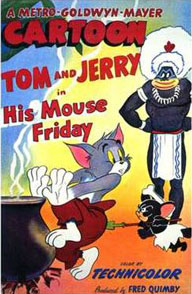 Indeed, the “cancellable” aspects of the series are fully embraced here. A long-in-development documentary titled The Lady of the House does an excellent job of contextualizing and celebrating Tom’s black owner voiced by actress Lillian Randolph (and all of those cartoons retain their original soundtracks on this set). The marketing team also made a point to answer that yes, Mouse Cleaning and Casanova Cat, the two shorts that have been prohibited from inclusion for some twenty years due to lengthy blackface gags, are included. They’ve also touted the inclusion of His Mouse Friday, a cartoon which is just a blackface gag but for some reason never reached the verboten status of the other two, given it’s all over official streaming and video-on-demand channels with no contextual warning. Never ask to make sense of this. It’s moot now anyway.
As far as the mastering/restoration, I can’t do a microscopic dissection of the history in this review, but to head off the fans’ questions: in almost all cases, these are the same exact high-definition copies you’ve seen on past collections, streaming, or MeTV. (And no, no original titles were reinstated.) Only a few transfers are brand-new. That’s mostly fine, as the picture and audio ranges from excellent to serviceable on most titles (the newly unleashed Mouse Cleaning in particular looks fantastic), so there is nothing unexpected besides some of the improvements recently made. There does appear to be some unnecessary noise reduction (read: smoothing out grain, not erasing the animation) applied to a number of the older transfers, like The Night Before Christmas, which was probably inadvisable, but it doesn’t render them unwatchable.
Readers should know that the original negatives for most of the pre-‘50s MGM cartoon library were lost in a fire decades ago, so they will never look as good as the Warner, Fleischer, and Famous cartoon restorations put out by Warner Archive. The best that can be done is sourcing them from grainier and dupier interpositive elements, and in many cases it’s daunting to figure out where the best source exactly is. Speaking from similar personal experience, I don’t envy the position WAC producer George Feltenstein and friends find themselves in with these beloved films.
 The most egregious issue with past copies, though, was that several were improperly mastered for the Tom & Jerry Golden Collection Vol. 1 in 2010 from subpar faded material (lovingly and erroneously dubbed “Metrocolor”, since these retained the black MGM lion logos from ‘60s Eastman color reissues). They were never flagged at any point in production (obviously George F. was not involved), so more than a few genuine classics (including two Oscar winners) have looked embarrassingly awful everywhere for the last fifteen years. Better source material being unavailable can’t be an excuse because all of these titles looked much better in previous collections and incarnations. Some of that has been fortunately fixed by utilizing superior sources: The Bowling Alley-Cat, Sufferin’ Cats, The Zoot Cat, The Million Dollar Cat, and Puttin’ on the Dog now look on par with the best transfers on the Tex Avery Screwball Classics discs. The rest of those “Metrocolor” cartoons, sadly, look as rotten as ever here, though technicians tried to “hide it” by getting rid of the ‘60s MGM lion, as if no one could tell the difference by what the actual cartoon looks like. (In Lonesome Mouse’s case, they forgot and left the ‘60s lion on!)
Dwelling on the few disappointments, though, misses that there has never been any kind of comprehensive home video collection where errors didn’t get through. Producers and fans need to resign themselves to the fact that even the most diligent job will have a few slip-ups when you’re talking about over a hundred short films, though the sting is worse when it’s on some of the best entries in the series. It’s not just about the severity of the errors, it’s really if, overall, the best job possible was clearly done.
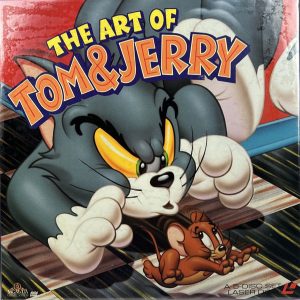
The first laser disc boxed set in 1993
It’s also nice to see bonus features again on a Warner-produced cartoon collection. Porting over all the pre-existing audio commentaries is appreciated (though the embarrassing tracks pairing the late historian Earl Kress with actress Nicole Parker, part of some cynical cross-marketing scheme Warners was trying to do with its classic properties and MadTV at the time, would have been better off forgotten), and the talking head docs are harmless fun, mostly for seeing friends give their two cents and knowledge on an official product. It’s a great throwback to the days twenty years ago when we took the extras for granted.
Fearless leader Jerry Beck and George Feltenstein have intimated Tom & Jerry: The Golden Era Anthology represents a serious change in direction, and since they started off with, well, one of the main things we fans all wanted but thought we’d never see, it really does seem like anything can happen now.
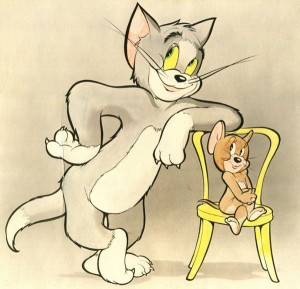 I’m breaking down the entire set in my usual review fashion, only this time each semi-weekly post will cover one disc (I’m foregoing the cartoons included on the Cinemascope Collection, as I did those already). All cartoons were, of course, directed by Bill Hanna and Joe Barbera. For history’s sake, I’m also including the cartoons’ in-house production numbers, so you can see the order they were actually started in.
Disc one is the first five years of the series, showcasing the evolution from what historian Mike Barrier called “Terrytoons in a Harman-Ising shell” origins to Hanna and Barbera never quite shaking them but still incorporating the inescapable influence of their frenemy Tex Avery. There’s a charm to the earliest in which Jerry has a “baby walk” (usually animated by Barbera’s Terry cohort George Gordon) and Tom is mostly still on all fours, but it starts to quickly run its course, and the Avery/Warner influence in the likes of Zoot Cat and Million Dollar Cat is a welcome change of pace.
PUSS GETS THE BOOT (Prod. #42)
The one that started it all, the Hanna-Barbera cartoon empire included. (Although a lot of people felt something was owed to Rudy Ising for making it happen, Ising himself included.) The cat’s called Jasper, and if he breaks one more thing, he’s going “o-w-t, out!” The mouse, unnamed, sees to it that that happens. The specificity of the acting and timing (and slapstick violence) made it stand out enough for an Oscar nomination, cementing the success of the Hanna-Barbera unit, which, after making a number of insufferable cat-and-mouse-less cartoons, would make almost nothing but cat-and-mouse cartoons for 17 years.
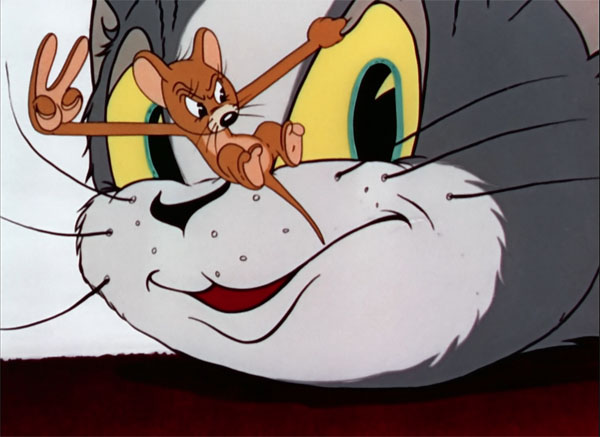
THE MIDNIGHT SNACK (Prod. #60)
The characters are officially christened Tom and Jerry (names suggested by animator Jack Carr). Jerry’s icebox raid is usurped by Tom, who attempts to pin it all on the mouse but ultimately takes all the blame. Jack Zander becomes the shorts’ “personality animator” with Tom’s lengthy buffet, and some unpleasant business happens with a fork and cheese grater. But my favorite bit is when Tom is called in to chase Jerry, and he gloats to the camera. It’s behavior that only someone who’s known cats could capture, and this sort of acting helped make the series so unique.
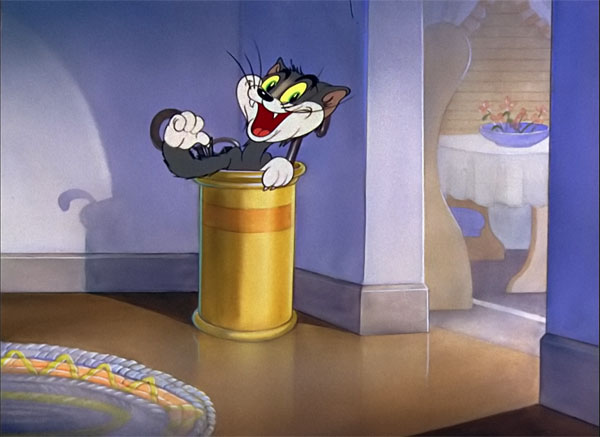
THE NIGHT BEFORE CHRISTMAS (Prod. #78)
Nostalgic-favorite with a chase around the Christmas tree that cements the series as “not your typical cat and mouse cartoon”, with some genuinely compelling staging and acting that convinces you that Tom might actually not want to kill Jerry. Later attempts at “heart” didn’t get it nearly as right. The sixth Tom & Jerry to go into production, but the third released, perhaps to make it in time for holiday season screenings. Oscar nominee.

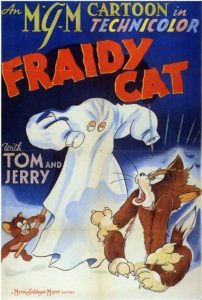
FRAIDY CAT (Prod. #69)
Jerry preys upon Tom’s fear of the supernatural, which ends with an assault on “Mammy’s” backside.
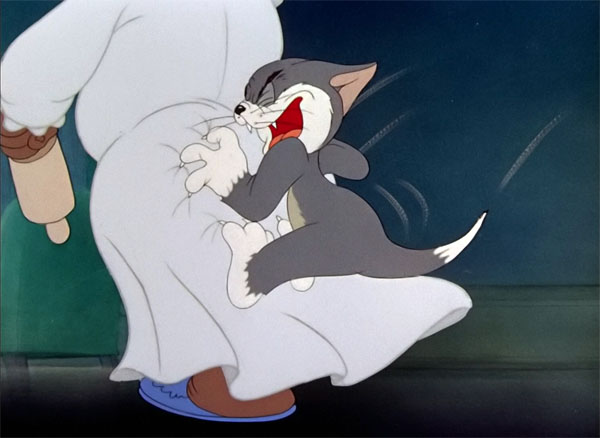
DOG TROUBLE (Prod. #64)
The first time Tom and Jerry team up against a foe, this time Spike the bulldog in his first appearance. Early showcase for Bill Hanna’s turn-on-a-dime timing, and the beauty of a belabored set-up (Jerry rigging the house with yarn) paying off with instant destruction.
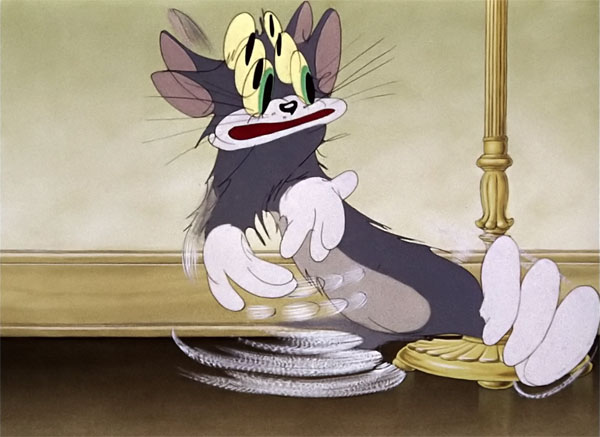
PUSS N’ TOOTS (Prod. #74)
Tom’s first failed romance, with his “gifting” of Jerry to his gal backfiring in a fabulous record-player display.
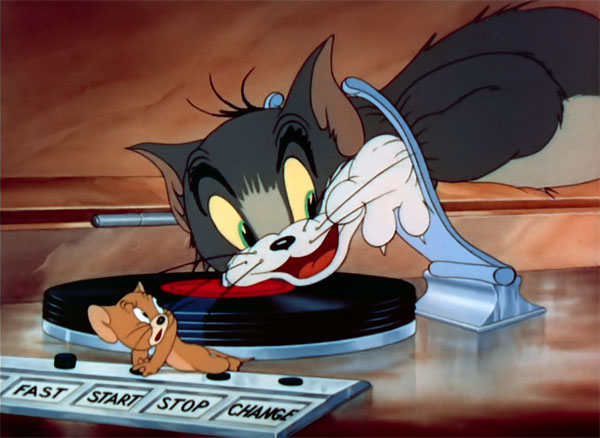
THE BOWLING ALLEY CAT (Prod. #79)
After hour antics at a bowling alley with the cat and mouse. This routine entry gets a reprieve with a stunningly nice new restoration that highlights some interesting lightning techniques.
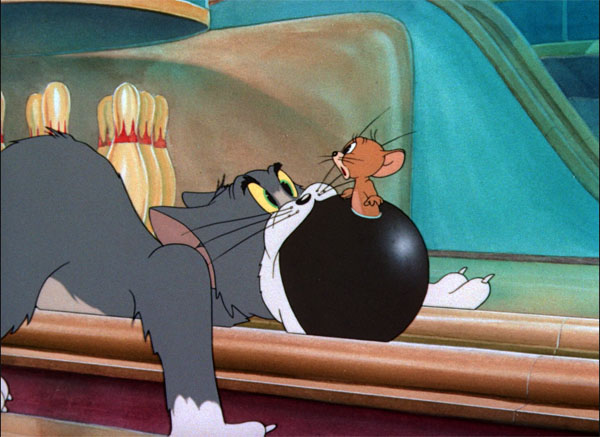
FINE FEATHERED FRIEND (Prod. #81)
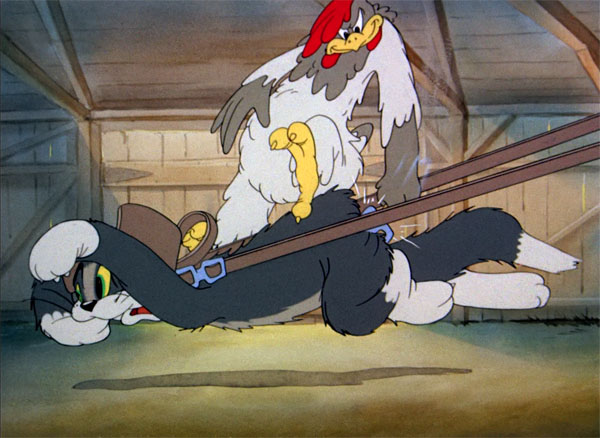
Tom pursues Jerry through the remnants of a Happy Harmony-style barnyard, where Tom and a mother hen receive quite a bit of abuse to their respective backsides.
SUFFERIN’ CATS (Prod. #85)
The introduction of Tom’s alley cat chum Meathead, who quarrels with Tom over eating Jerry in a particularly brutal fashion. As noted before, this one boasts a wholly new, colorful transfer.

THE LONESOME MOUSE (Prod. #89)
Jerry regrets getting Tom kicked out of the house, so the two stage the cat’s redemption. Unique for being the only cartoon with Tom and Jerry both talking (voiced by Bill Hanna and Harry Lang) throughout, and the only one where they treat “Mammy” with active contempt and violence. This awkward misfire’s reissue in 1950 generated a formal complaint from the NAACP (there’s also a gag where dice and a razor fall from her skirt), which probably went a long way in retiring the character (the last ones with her would have been in production at the time).
YANKEE DOODLE MOUSE (Prod. #91)
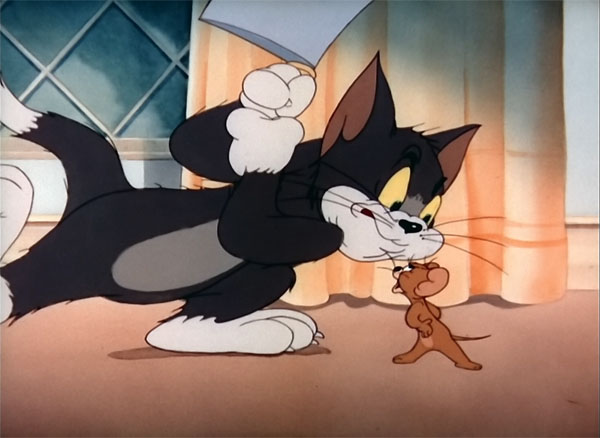
Tom and Jerry wage war in the basement in the series’ first Oscar-winner, a win owing more to wartime patriotism than anything else. This one has been missing a scene involving a wrench, Tom’s tongue, and ration stamps ever since it was cut for reissue in 1950.
BABY PUSS (Prod. #99)
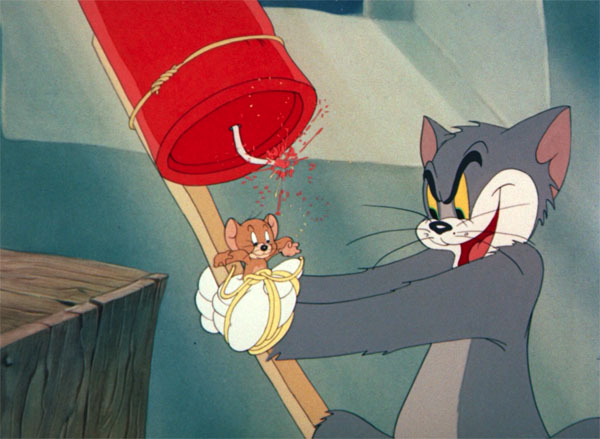
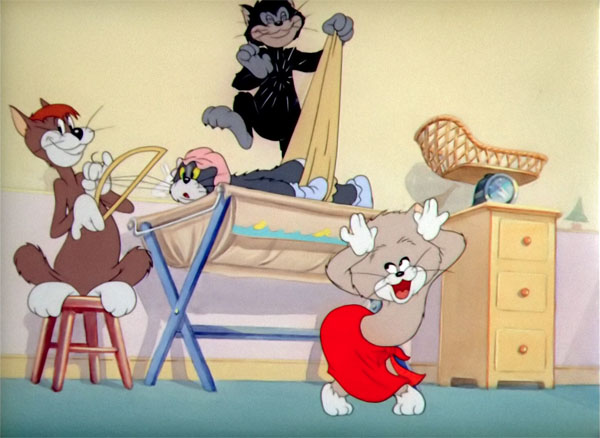
Tom suffers humiliation dressed as a baby doll at the hands of a bratty girl, Jerry, and his alley cat chums (two of them, Butch and Topsy, in their first appearance). Maybe the most “queer” coded entry in the series, they certainly didn’t make one like this ever again.
THE ZOOT CAT (Prod. #104)
Tom gets hep with a makeshift zoot suit to woo his southern belle gal in this 1944-specific cartoon that’s endured as an immortal classic. The last time for any dialogue for the mouse (aside from Anchors Aweigh), but they would often have the cat talk if the gag called for it. Looking particularly ratty for years in the HD era, this one boasts a great new transfer here.
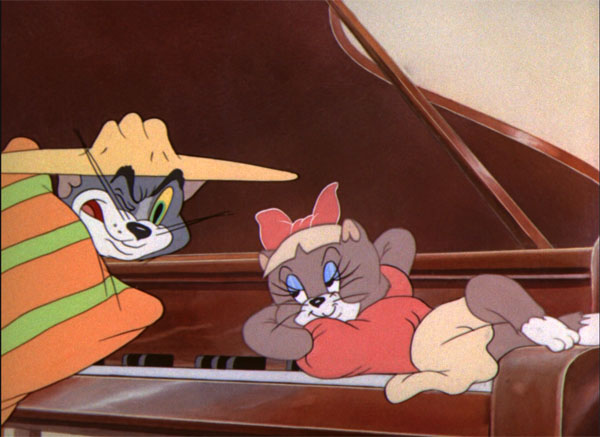
THE MILLION DOLLAR CAT (Prod. #109)
Tom will forfeit his inheritance if he harms Jerry in a story that was done a little funnier with Bugs and Elmer by Friz Freleng and Mike Maltese two years earlier, but this one has a particularly strong Scott Bradley score. Like Zoot Cat, this one, too, gets a reprieve with a great new transfer.
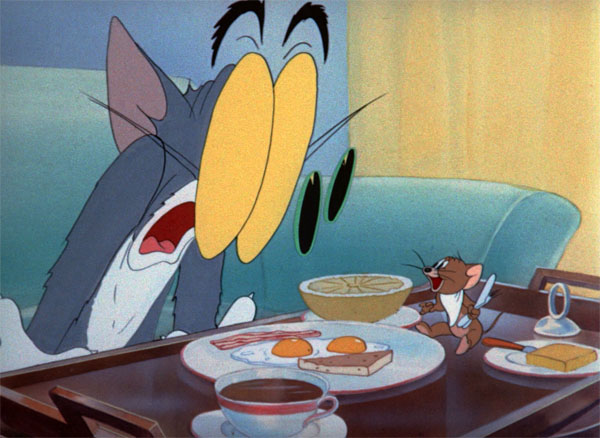
THE BODYGUARD (Prod. #114)
Jerry earns around-the-clock protection when he frees Spike from the dog catcher. Another where the music really carries the cartoon, and Irv Spence’s handling of Tom’s pasty gumball scheme is the highlight.
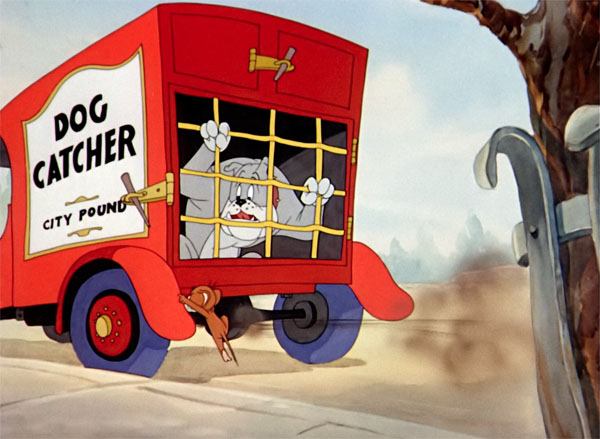
PUTTIN’ ON THE DOG (Prod. #117)
Underrated entry with Jerry seeking refuge in a dog pound, and Tom utilizing the cartoon logic that the dogs won’t recognize him so long as he wears a fake dog head at all times. The circumstances get crazier and stupider. Another 1944 cartoon sporting a new transfer.
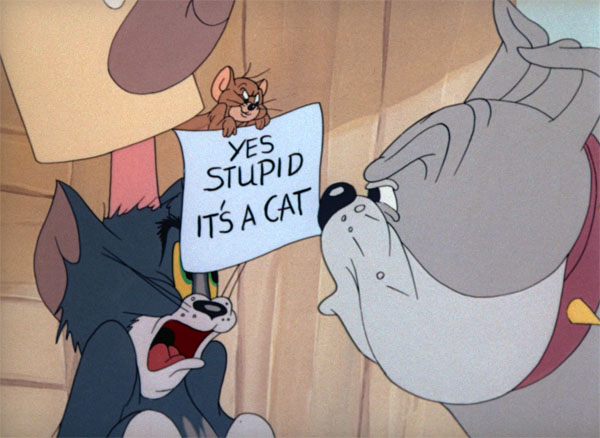
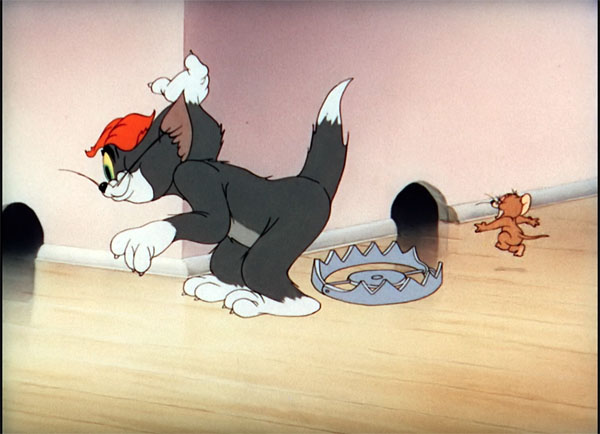
MOUSE TROUBLE (Prod. #118)
Writer Cal Howard insisted he wrote this Oscar-winner uncredited when he worked for MGM, which I have no trouble believing. The use of the blackout gag format, centered on Tom’s using the book “How to Catch a Mouse” to destroy Jerry, and Tom’s bodily injuries carrying over to the next scenes (and the cat ultimately dying, which didn’t happen any other time besides Heavenly Puss), make this a wholly unique entry in the series—and one of its best, darkest, and funniest.
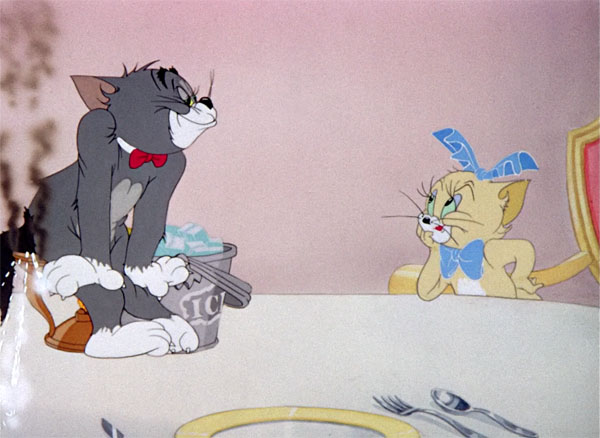
THE MOUSE COMES TO DINNER (Prod. #123)
Tom crashes his owners’ dinner party, inviting Toodles over and coercing Jerry to be their waiter, with the expected results. The funniest, unspoken aspect is that Toodles is still sitting there watching all of this carnage happen.
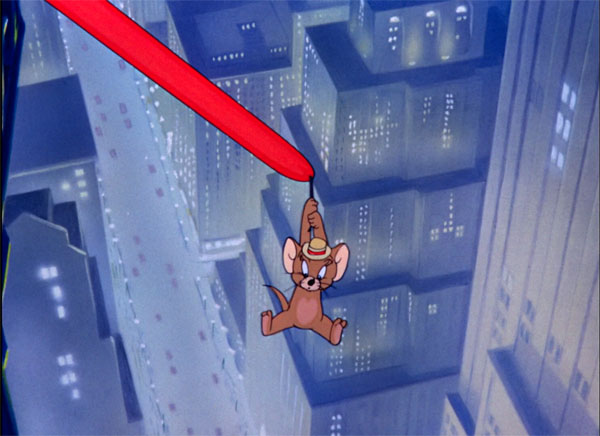
MOUSE IN MANHATTAN (Prod. #132)
The most lyrical cartoon in the series. Jerry seeks a better life in New York City, with Bradley utilizing “Manhattan Serenade” for nearly the entirety of the soundtrack. This always felt like a cartoon specifically made to win the Academy Award, but it wasn’t even nominated and the prize went to a more routine T&J.
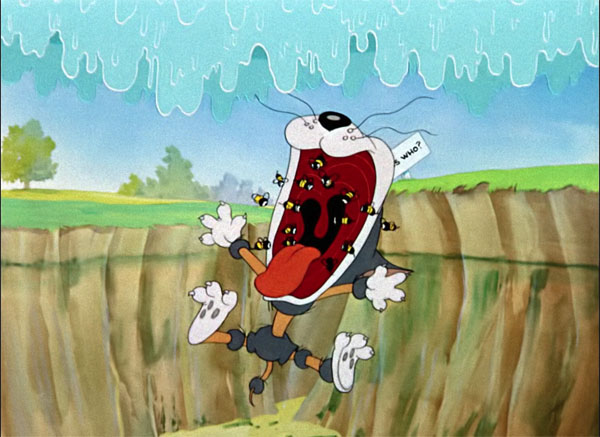
TEE FOR TWO (Prod. #126)
The first cartoon that casts Tom as not a housecat but a regular “human” funny animal character, out playing the worst game of golf with Jerry as his shanghaied caddy. Noteworthy for the savage gag (animated by Ken Muse) of Tom getting a swarm of bees stinging his throat in a manner that’s both horrifying and hilarious.
FLIRTY BIRDY (Prod. #129)
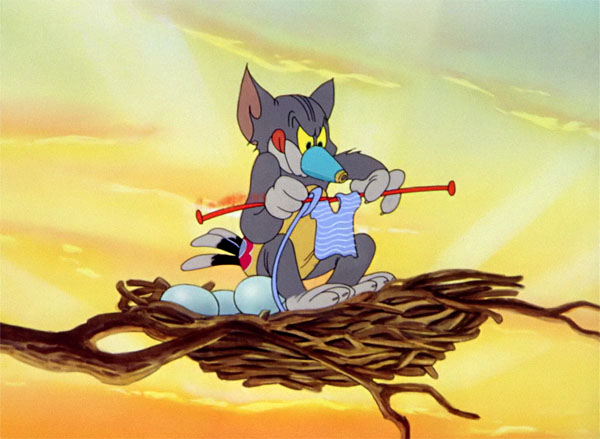
This oddball entry has Tom donning the worst drag possible to reclaim Jerry from a horny eagle. It works too well, as the cat ends up married and hatching eggs. Another uncredited Cal Howard story?
QUIET, PLEASE! (Prod. #131)
Spike threatens to skin Tom alive if he makes any more noise trying to slaughter Jerry. What could possibly go wrong? Funny stuff, and an Oscar-winner, for some reason.

COMING SOON: I’ll be back to discuss Disc Two, when the series is at its peak.